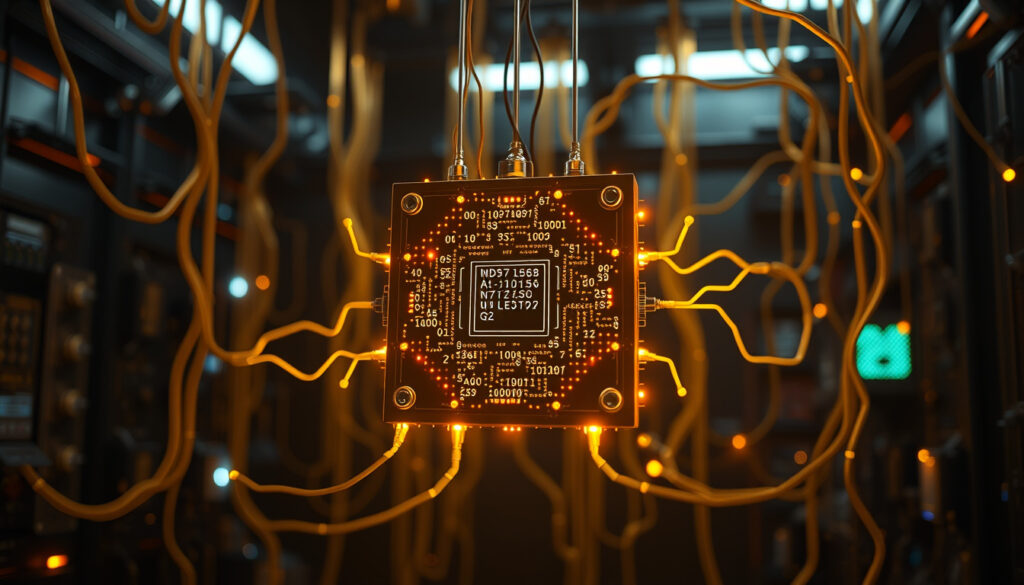
What Is a Quantum Computer? Simple Explanation & Current Facts
You’ve probably read headlines calling quantum computers the next revolution in computing — machines that could crack encryption in minutes or discover new drugs in days. But behind the hype, what does a quantum computer actually do today, and how does it differ from the laptop on your desk?
First quantum computer proposed: 1980 (Feynman, Benioff) · First working 2-qubit quantum computer: 1998 · Quantum supremacy demonstrated: 2019 (Google Sycamore) · Largest quantum processor (qubits): 433 (IBM Osprey, 2022) · Number of countries with quantum hardware: 10+ · Operational quantum computers worldwide: ~50 (estimated)
Quick snapshot
- Qubits exploit superposition and entanglement (NIST (U.S. National Institute of Standards and Technology))
- Google Sycamore achieved quantum supremacy in 2019 on a specific problem (NIST)
- When fault-tolerant quantum computers will become practical (Wikipedia (community-maintained encyclopedia))
- Which qubit technology (superconducting, trapped ion, topological) will dominate (The Quantum Insider (quantum technology news and analysis))
- IBM Condor (1,121 qubits) announced in 2023 (Wikipedia)
- Several companies aim for 1,000+ error-corrected qubits by 2025 (The Quantum Insider)
- Hybrid quantum-classical computing expected for near-term applications (NIST)
- Post-quantum cryptography standards being finalized (NIST)
Here are the key attributes of quantum computing.
| Attribute | Value |
|---|---|
| Definition | A computer that exploits quantum mechanical phenomena to process information (NIST) |
| First Concept | 1980s (Feynman, Benioff, Deutsch) (Wikipedia) |
| First Implementation | 1998 (2-qubit NMR computer) (Wikipedia) |
| Current Max Qubits (2025) | ~1,000+ (IBM Condor, 1,121 qubits) (Wikipedia) |
| Key Applications | Simulation, optimization, cryptography (The Quantum Insider) |
| Current Stage | Noisy Intermediate-Scale Quantum (NISQ) era (The Quantum Insider) |
What is a quantum computer in simple terms?
Qubits vs bits
- Classical bits are either 0 or 1 (NIST)
- Qubits can be in state 0, state 1, or a superposition of both (NIST)
- Two qubits can represent a superposition of four combinations simultaneously (NIST)
The core difference is that classical computers process bits one deterministic state at a time, while quantum computers can explore many possibilities concurrently thanks to superposition and entanglement. This gives them theoretical speed advantages for certain tasks.
NIST warns that quantum computers are limited in how much data they can extract from exponential-state computations — they don’t literally try every solution at once in the popular sense (NIST).
Superposition explained
- Superposition is the ability of a qubit to be in a mix of 0 and 1 simultaneously (BlueQubit (cloud quantum computing platform))
- Entanglement links qubits so the state of one instantly correlates with the state of another (NIST)
- Measurement collapses the superposition into a definite 0 or 1 (Wikipedia)
Think of a coin spinning in the air: while spinning it’s neither heads nor tails, but a combination of both. That’s superposition. When it lands — measurement — you get a definite outcome.
The implication: quantum computing’s power relies on superposition and entanglement, but practical advantage remains elusive.
What is quantum computing with example?
Example: factoring large numbers (Shor’s algorithm)
- Shor’s algorithm can factor large numbers exponentially faster than classical algorithms (The Quantum Insider)
- RSA encryption relies on the difficulty of factoring large numbers (Wikipedia)
- Implementation on current hardware is limited to very small numbers (e.g., 15 = 3×5) (Wikipedia)
Shor’s algorithm is the most famous example of quantum speedup. If a large-scale fault-tolerant quantum computer were built, it could break RSA encryption, which secures most internet traffic. However, today’s machines can only factor tiny numbers — the algorithm remains a theoretical threat, not a current one.
Example: simulating molecules
- Quantum computers can efficiently simulate quantum systems (molecules, materials) (The Quantum Insider)
- This could accelerate drug discovery and materials design (NIST)
- Current simulations are limited to small molecules due to noise (NIST)
Simulating nature is quantum computing’s most direct application. Richard Feynman’s 1981 lecture argued that quantum systems are best simulated by quantum computers. Today, researchers have simulated molecules like hydrogen and beryllium, but scaling to industrially relevant molecules requires error-corrected machines.
The pattern: each example demonstrates potential but underscores the gap between theory and practice.
What will quantum computers do?
Drug discovery and materials science
- Quantum simulation could model molecular interactions exactly (The Quantum Insider)
- Pharmaceutical companies (e.g., Roche, Pfizer) are exploring quantum chemistry (Wikipedia)
- Expected to reduce R&D costs by millions per drug candidate (NIST)
Optimization and cryptography
- Quantum computers can solve optimization problems in logistics, finance, and energy (The Quantum Insider)
- They could break current encryption (RSA, ECC) once fault-tolerant (Wikipedia)
- Post-quantum cryptography standards are being developed by NIST (NIST)
Artificial intelligence
- Quantum machine learning may offer speedups for certain subroutines (The Quantum Insider)
- No practical quantum advantage has been demonstrated for mainstream AI tasks (Wikipedia)
- Full-scale quantum AI remains speculative (NIST)
The catch: near-term expectations should be anchored to NISQ realities.
Do quantum computers exist now?
Current quantum processors (IBM, Google, Rigetti, IonQ)
- Dozens of quantum processors exist, with qubit counts from tens to over 1,100 (Wikipedia)
- IBM, Google, Rigetti, IonQ, and others offer cloud access (The Quantum Insider)
- None are fault-tolerant; they operate in the NISQ (Noisy Intermediate-Scale Quantum) era (The Quantum Insider)
Limitations: noise and error correction
- Current machines make an error roughly once in every thousand operations (NIST)
- Error correction requires many physical qubits to encode one logical qubit (Wikipedia)
- No fault-tolerant quantum computer has been built yet (NIST)
Has a quantum computer ever worked? (proof-of-concept)
- Google Sycamore solved a random circuit sampling task in 2019 that would take a classical supercomputer thousands of years — demonstrating quantum supremacy (NIST)
- IBM later argued the same task could be simulated classically in days, sparking controversy (Wikipedia)
- Classical computers still outperform quantum computers for all real-world applications as of 2023 (Wikipedia)
Quantum computers exist but are not ready for practical use. They are noisy, error-prone, and limited to narrow demonstrations. The term “quantum advantage” has been claimed but for problems with no commercial value. The gap between proof-of-concept and usefulness remains large.
What this means: investment in quantum hardware is growing, but practical payoff remains uncertain.
Will quantum computing replace AI?
Quantum computing vs classical machine learning
- Quantum computers will not replace classical computers (NIST)
- They are complementary tools — quantum for certain hard problems, classical for everything else (NIST)
- Quantum machine learning may accelerate some AI subroutines but is not a replacement (The Quantum Insider)
Elon Musk’s views on quantum computing
- Musk has expressed skepticism about near-term quantum computing, calling it overhyped (Wikipedia)
- Experts counter that quantum computing and AI address different problem classes (The Quantum Insider)
- Musk’s focus on AI (Neuralink, Tesla Autopilot) may color his perspective (Wikipedia)
Why NASA stopped quantum computing research (clarification)
- NASA did not stop quantum computing entirely; a specific project with Google ended because the quantum advantage demonstration had been achieved (NIST)
- NASA continues to explore quantum sensing and networking (Wikipedia)
- The “NASA stopped” narrative is a misinterpretation of a project conclusion (The Quantum Insider)
The implication: staying informed on quantum developments is prudent, but short-term disruption to AI workflows is unlikely.
For a side-by-side comparison of quantum and classical computing, here’s a snapshot of the key differences:
| Dimension | Classical computer | Quantum computer |
|---|---|---|
| Basic unit | Bit (0 or 1) | Qubit (superposition of 0 and 1) |
| State representation | One combination per clock cycle | Multiple combinations simultaneously (exponential with qubits) |
| Determinism | Deterministic (given same input, same output) | Probabilistic (requires repeated measurements) |
| Error rate | Extremely low (errors less than 1 in 1015) | High (~1 in 1,000 operations without error correction) |
| Maturity | Massively mature, billions of transistors | Experimental, NISQ era (<1000 qubits, noisy) |
| Best for | General-purpose computing, everyday tasks | Specialized problems: factoring, simulation, optimization |
Quantum computers can theoretically achieve exponential speedups for a narrow set of problems, but their high error rates and probabilistic nature mean they are not yet competitive for any practical application. As NIST puts it, they will work alongside classical machines, not replace them.
Timeline of quantum computing milestones
- – Richard Feynman proposes quantum simulation (Wikipedia)
- – Peter Shor invents algorithm for factoring large numbers (Wikipedia)
- – First working 2-qubit quantum computer demonstrated (Wikipedia)
- – Google Sycamore demonstrates quantum supremacy (NIST)
- – IBM unveils Osprey with 433 qubits (Wikipedia)
- – IBM announces Condor with 1,121 qubits (Wikipedia)
- – Several companies aim for 1,000+ error-corrected qubits (The Quantum Insider)
The gap between classical and quantum computing is narrowing. IBM’s Condor reached 1,121 qubits in 2023, but the real challenge is error correction — not qubit count. The timeline shows steady progress but also highlights how far we are from fault-tolerant, practical machines.
The pattern: qubit milestones are accelerating, but error correction remains the bottleneck.
Clarity check
Confirmed facts
- Quantum superposition and entanglement are real physical phenomena (NIST)
- Quantum supremacy achieved on a specific mathematical problem (2019) (NIST)
- Current quantum computers are noisy and limited (NISQ) (The Quantum Insider)
- Shor’s algorithm can theoretically break RSA encryption (Wikipedia)
What’s unclear
- When fault-tolerant quantum computers will be built (Wikipedia)
- Whether quantum computers will find practical commercial use in the next decade (The Quantum Insider)
- Which qubit technology (superconducting, trapped ion, topological) will dominate (The Quantum Insider)
- If quantum computing will ever replace classical computing for everyday tasks (NIST)
The takeaway: confirmed facts show genuine progress, but the unclear items underscore the scientific uncertainty that remains.
Quotes from experts
“Nature isn’t classical, dammit, and if you want to make a simulation of nature, you’d better make it quantum mechanical.”
Richard Feynman, Nobel laureate physicist, 1981 lecture
“We are in the NISQ era — noisy intermediate-scale quantum. These machines are not yet capable of solving practical problems, but they are powerful enough to explore quantum advantage.”
John Preskill, physicist at Caltech, coining of the term NISQ (2018)
“Quantum computing is overhyped in the near term. AI will have a much bigger impact in the next decade.”
Elon Musk, CEO of Tesla and SpaceX, paraphrased from public statements
The implication for investors and researchers: don’t expect quantum computers to disrupt markets anytime soon, but the foundational science is real and progressing.
For the tech industry, the choice is clear: invest in quantum algorithms education and post‑quantum cryptography preparedness now, or risk being caught off‑guard when fault‑tolerant machines finally arrive. The next five years will separate serious engineering from hype.
If you’re curious about the underlying principles, quantum computing explained simply offers a clear and accessible overview of the technology.
Frequently asked questions
What is a qubit?
A qubit is a quantum bit that can exist in a superposition of states 0 and 1, enabling parallel computation.
What is superposition?
Superposition is the ability of a quantum system to be in multiple states at once until measured.
What is quantum entanglement?
Entanglement is a correlation between qubits such that measuring one instantaneously affects the others, even at a distance.
How does quantum computing differ from classical computing?
Classical computers use bits (0 or 1) deterministically; quantum computers use qubits in superposition and entanglement, allowing them to solve certain problems exponentially faster.
Who are the leading companies in quantum computing?
IBM, Google, Rigetti, IonQ, and Intel are key players.
Can I access a quantum computer online?
Yes, IBM Quantum Experience, Amazon Braket, and Google Quantum AI offer cloud access to quantum processors.
How much does a quantum computer cost?
Commercial quantum processors are not sold as off-the-shelf products; cloud access is typically pay-per-use. IBM’s most advanced systems are not for sale but available through the IBM Quantum Network.
Is quantum computing dangerous?
It poses a real threat to current encryption (e.g., RSA), but post-quantum cryptography standards are under development by NIST to mitigate this risk.
Summarizing, quantum computing remains a field of rapid progress but with significant hurdles before practical impact.
More related posts
 British International School Singapore: Fees, Schools & Guide
 New Dyson Vacuum Cleaner: 2026 Releases & Buying Guide
 Singapore Seniors Cash Payout: Eligibility & 2025-2026 Dates
 NBA Finals Game 7 – Time, TV Schedule, History, Odds
 Singapore to Kolkata Flights: Guide to Times, Prices & Booking
 1000 SGD to PHP: Live Rate and What Your Money Buys
 How to Pick a Number Between 1 and 3: Free Tools and Methods
 Birthday Gifts for Girls: What She Actually Wants (Age Guide)
