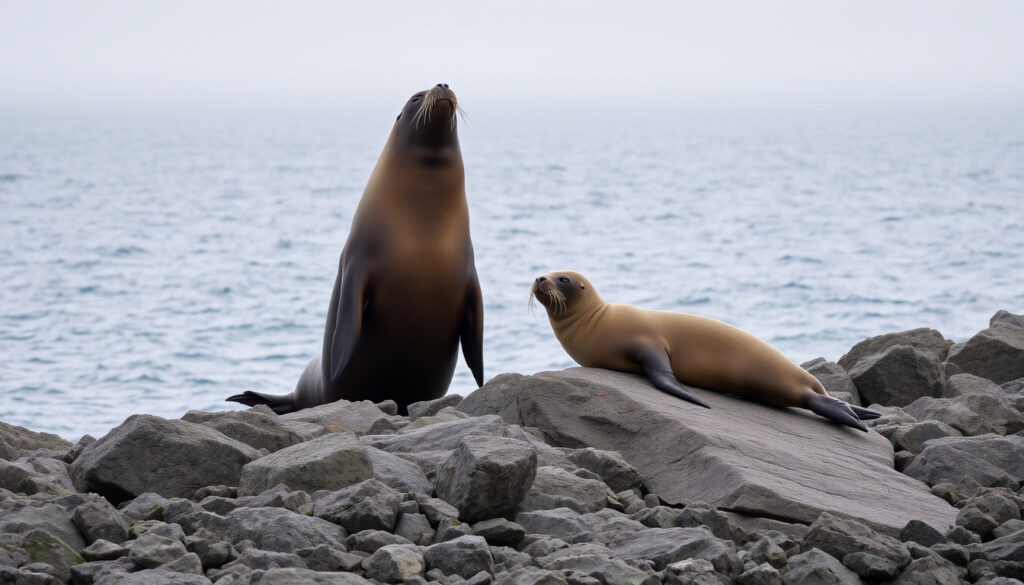
Sea Lion vs Seal: Key Differences in Behavior, Size, and Habitat
Anyone who has watched a viral clip of a barking, wave-surfing pinniped and wondered whether that was a seal or a sea lion is asking a question that trips up far more than casual beachgoers. The two marine mammals, while close cousins, split into distinct families with eye-opening differences in anatomy, behavior, and temperament. This guide separates the facts from the footage, pairing the physical tell-tale signs with the data on aggression and the surprising truth about which species actually call Irish waters home.
Ear flaps: Sea lions have visible external ears; seals do not. ·
Size: Sea lions are larger, up to 2.5 m long; seals up to 1.8 m. ·
Aggression: Sea lions accounted for the majority of recorded pinniped attacks on humans. ·
Vocalization: Sea lions bark like dogs; seals grunt softly. ·
Movement on land: Sea lions can walk using large flippers; seals scoot on their bellies.
Quick snapshot
- Sea lions have visible external ear flaps, while true seals lack them (NOAA Ocean Service).
- Sea lions use their front flippers for propulsion; seals use their rear flippers (NOAA Fisheries).
- Ireland has harbour and grey seals, but no native sea lions (National Parks and Wildlife Service, Ireland).
- Whether sea lions are inherently more aggressive or simply more frequently encountered by humans.
- The exact number of inter-species conflicts in the wild due to limited observation.
- The exact number of sea lion attacks on humans per year is not systematically recorded.
- Public scrutiny of sea lion aggression has intensified with viral encounters, though attack data remains sparse.
- Expect more attention on managing human-pinniped encounters as coastal populations overlap.
The following table provides a side-by-side comparison of key metrics for seals and sea lions.
| Metric | Seals (Phocidae) | Sea Lions (Otariidae) |
|---|---|---|
| Number of species | 33 | 6 |
| Largest species | Elephant seal | Steller sea lion |
| Average weight range | 50–1,500 kg | 50–1,000 kg |
| Maximum recorded age | ~40 years | ~30 years |
| Conservation status | Several species endangered | Most species of least concern |
Are seal and sea lion the same?
No. Despite looking similar to a casual observer, seals and sea lions belong to different families within the suborder Pinnipedia. The easiest way to tell them apart is to look at the head: sea lions have visible external ear flaps, while true seals have only small ear openings without any flap (NOAA Ocean Service). The National Park Service explains that true seals are called “earless” for this reason, while eared seals, or sea lions, have an external ear flap (National Park Service).
What are the key physical differences?
- Ear flaps: Sea lions have external ear flaps; seals have ear holes but no flap (NOAA Fisheries).
- Flippers: Sea lions have longer flippers and can rotate their hind flippers forward to walk on land; seals cannot rotate theirs and scoot on their bellies (IFAW UK).
- Size: Seals are generally smaller than sea lions (Smithsonian Ocean).
The physical differences are not just cosmetic; they reflect completely different evolutionary strategies for moving through water and on land. Sea lions are built for agility and terrestrial mobility, while seals are streamlined for efficient underwater propulsion.
How do their ear flaps differ?
This is the single most reliable field marker. Sea lions have a small, visible external ear flap (pinna) on each side of their head. True seals have only a tiny opening with no external flap, which is why they are sometimes called “earless” despite having excellent hearing (National Park Service).
What about flippers and movement?
The flippers tell you everything about how each animal moves. Sea lions use their large front flippers for propulsion in the water and their rear flippers for steering, and they can bring all four flippers under their bodies to walk on land. True seals use their rear flippers to propel themselves and cannot rotate their hind flippers forward, forcing them to scoot on their bellies when on shore (NOAA Fisheries).
The takeaway: if it walks like a dog, it’s a sea lion; if it wriggles like a caterpillar, it’s a seal.
Which is more aggressive, a sea lion or a seal?
Sea lions are more often involved in aggressive encounters with humans than seals. This is partly because sea lions are more social and more frequently encountered in human-populated areas, but the data on recorded attacks points to sea lions as the more dangerous of the two (Seal Conservancy).
“Sea lions are more often involved in aggressive encounters with humans than seals.”
Are sea lions dangerous to humans?
Sea lions can be dangerous, especially when they feel threatened or are protecting their young. Documented aggressive encounters include biting incidents, and their size and sharp teeth make them capable of inflicting serious injury. The pattern is consistent: sea lions, being more territorial and more comfortable around humans, are more likely to act aggressively when they feel cornered.
Have there been documented attacks?
Yes. One of the most widely reported incidents involved a 15-year-old girl attacked by a sea lion in Southern California, a case that drew international attention to the risks of close encounters. While such attacks are rare, they are almost exclusively linked to sea lions rather than seals, driven by their larger size and more assertive behavior.
Are seals in Ireland aggressive?
Seals in Ireland are generally not aggressive toward humans, though they can be protective of their pups. The National Parks and Wildlife Service (NPWS) notes that both harbour and grey seals are native to Irish waters and generally keep their distance from people (National Parks and Wildlife Service, Ireland).
What this means: the “dangerous seal” narrative is a sea lion story. Irish beachgoers are far more likely to encounter a curious but docile seal than an aggressive one.
What happens if a seal meets a sea lion?
Seals and sea lions can co-exist in the wild, but they do compete for resources. Both species feed on similar prey, including fish and squid, and they may compete for the same haul-out sites. Aggressive interactions, including biting and chasing, have been observed when the two come into contact (Seal Conservancy).
Do they interact in the wild?
Yes, they share the same coastal habitats and can be found in the same areas, though sea lions are more social and often gather in large groups, while seals are more solitary (Smithsonian Ocean).
Do they compete for food or territory?
They compete for food, primarily fish and squid, and for prime haul-out spots. Sea lions, being larger and more aggressive, often dominate these interactions, pushing seals to less desirable areas.
Can they interbreed?
No. Seals and sea lions are different species belonging to different families—Phocidae for seals and Otariidae for sea lions. They cannot interbreed, as their genetic distance is too great for successful reproduction.
The dynamic is one of displacement rather than conflict: sea lions typically win the turf battles, and seals adapt by shifting their range.
What are the differences in size, diet, and teeth between sea lions and seals?
Size, diet, and teeth are where the practical differences really matter, especially for anyone trying to identify these animals in the wild or considering their ecological impact.
What are typical sizes?
Sea lions are generally larger. A male California sea lion averages about 700 to 800 pounds and 7 to 8 feet long, while a male harbor seal averages about 300 pounds and 6 feet long (Seal Conservancy). The largest sea lion, the Steller sea lion, can reach about 2,200 pounds (Smithsonian Ocean).
What do they eat?
Sea lions are carnivores that eat fish, squid, crabs, and clams (PBS Nature). The largest sea lion species, the northern sea lion, even eats seals. Seals primarily eat fish and squid, with a diet that is less varied than that of sea lions.
How do their teeth differ?
Seal teeth are adapted for gripping slippery prey, with sharp, pointed cusps perfect for holding onto fish. Sea lion teeth are more robust, capable of crushing the shells of crabs and clams, reflecting their more varied diet.
The pattern: sea lions are bigger, eat a wider range of prey, and have the dental hardware to back it up. Seals are more specialized, streamlined predators focused on fish and squid.
Does Ireland have seals or sea lions?
Ireland has seals—specifically the harbour seal and the grey seal, both native to Irish waters—but it has no native sea lions (National Parks and Wildlife Service, Ireland). Sea lions are a Pacific and Southern Hemisphere species, while the seals found in Ireland are Atlantic species.
Which species are found in Ireland?
The two native seal species in Ireland are the harbour seal (also known as the common seal) and the grey seal. Both are protected under Irish and EU law, and they are a common sight along the Irish coast.
Are they aggressive?
Irish seals are generally not aggressive. They are wild animals and can be protective of their pups, but they typically avoid human contact. The NPWS advises the public to keep a safe distance, especially during pupping season.
What is the rare animal in Ireland?
The rarest animal in Ireland is the Irish hare (Lepus timidus hibernicus), a subspecies of the mountain hare unique to the island. It is not a seal or a sea lion, but a land mammal that has become a conservation symbol for Ireland’s unique biodiversity.
For Irish readers, the distinction is simple: if you see a pinniped on the Irish coast, it is a seal. Sea lions are a Pacific story, not an Irish one.
Related reading
- Best Picnic Spots Near Me in Ireland for Families & Friends
- Free Events Near Me: Dublin & Ireland Guide
ifaw.org, worldanimalrescuenetwork.org, discoverwildlife.com
Frequently asked questions
Can sea lions and seals live together in captivity?
Yes, they can coexist in captivity, as seen in some marine parks, but they are usually housed separately due to size differences and dietary needs.
How fast can seals and sea lions swim?
Sea lions can swim up to about 25 mph in short bursts, while seals are slightly slower, reaching speeds of about 15-20 mph. Sea lions’ front flipper propulsion gives them an edge in agility.
What is the lifespan of a seal vs. a sea lion?
Seals generally live longer, with some species reaching 40 years, while sea lions typically live to about 30 years in the wild.
Are there sea lions in the UK?
No, the UK has native grey and harbour seals, but sea lions are not found in UK waters. They are primarily found in the Pacific and Southern Hemisphere.
Do seals and sea lions migrate?
Some sea lion and seal species do migrate seasonally to follow food sources or breeding grounds, though the patterns vary by species and region.
How do sea lions communicate?
Sea lions are vocal and bark loudly, using a range of barks and growls to communicate. Seals are quieter, using softer grunts and growls (Seal Conservancy).
What predators do seals and sea lions have?
Their main predators include killer whales and sharks. Sea lions also face predation from larger sea lions, such as the Steller sea lion eating smaller seals (PBS Nature).
More related posts
 The Clementi Mall Directory: Shops, Restaurants & Map
 150 SGD to INR: Singapore Dollars to Rupees Conversion
 Mount Pleasant BTO Flats 2025: Prices, Eligibility & Masterplan
 Gold Rate in Singapore Today: 22K & 24K Per Gram
 Man Fut Tong Nursing Home: Cost, Wait Time, and Services in Singapore
 Aircon Gas Top Up Singapore: Costs, DIY Risks & When You Need It
 How Did Michael Jackson Die? Cause, Date & Final Moments
 Burnley F.C. vs Chelsea F.C. Lineups – Predicted XIs, Injuries, Team News
