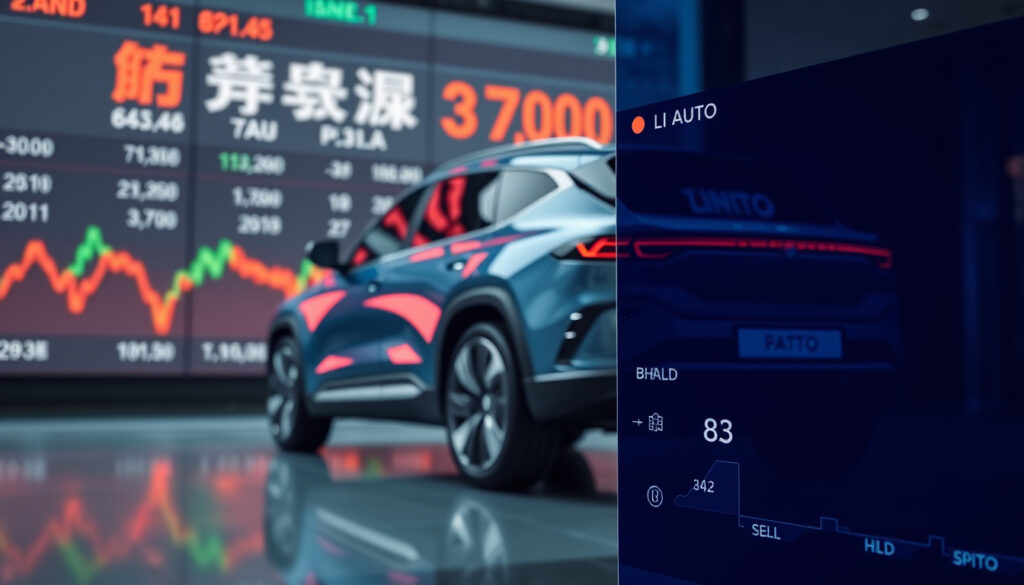
Li Auto HK Share Price: Buy, Hold, or Sell Now
Few stocks test an investor’s patience like Li Auto, whose Hong Kong-listed shares trade closer to their 52-week low of HK$44.56 than to the HK$105.30 high they touched in the past year. The EV maker, listed on both the HKEX and the Nasdaq, is a study in analyst disagreement: some panels rate the stock a Buy with double-digit upside, while another platform’s consensus model lands on Hold. The question underneath every price target is whether Li Auto can turn revenue growth into dependable profit — and how long investors will wait.
Current Price (HK$): 47.82 ·
52-Week Low: 44.56 ·
52-Week High: 105.30 ·
Market Cap (HK$): 98.54B ·
Average Volume: 12M
Quick snapshot
- Li Auto’s US-listed ADR trades on the Nasdaq as LI, while its Class A shares trade in Hong Kong as 2015.HK (Markets Insider (markets desk)).
- 28 analysts polled by StockAnalysis rate the stock a Buy, with a 12-month target of $19.85 (StockAnalysis (consensus tracker)).
- The ADR closed at $11.81 in the latest Yahoo Finance market snapshot (Yahoo Finance (market data)).
- US price targets on Markets Insider run from $13.00 to $40.00, with a median of $20.82 (Markets Insider (markets desk)). (TradingView (analyst survey))
- Hong Kong targets span HKD 40 to HKD 96 across the 19 analysts TradingView tracks (TradingView (analyst survey)).
- HSBC trimmed its US price target to $15.60 from $17.20 with a Hold rating, and lowered its Hong Kong-listed target to HKD 61 from HKD 67 (Yahoo Finance (via Investing.com)).
- Barchart’s consensus model reads Hold at 3.17, with an average target of $16.26 (Barchart (market analytics)).
- The next scheduled earnings reference on MarketWatch: 2026 results, expected around 19 February 2027 (MarketWatch (financial news desk)).
- Beyond that report, the profit target is not defined in the tracked analyst data. (MarketWatch (financial news desk))
Li Auto at a Glance: Key Facts
Ten rows set the scene: where Li Auto lists, when it was founded, and how wide the 52-week range really is.
| Metric | Value |
|---|---|
| Ticker | 2015.HK (Hong Kong) / LI (Nasdaq) |
| Exchange | Hong Kong Stock Exchange; Nasdaq secondary line |
| Sector | Automotive – Electric Vehicles |
| Founded | 2015 |
| Headquarters | Beijing, China |
| US IPO | July 2021, priced at $11.50 per share |
| Hong Kong listing | Dual-primary listing completed August 2021 |
| Market cap | ≈ HK$98.54 billion |
| 52-week range | HK$44.56 – HK$105.30 |
| Analyst split | Buy per StockAnalysis; Hold per Barchart |
The pattern: the facts are easy to line up, but the valuation is not — a market cap near HK$98.54 billion with no GAAP profit is a bet on the future, not a snapshot of the present.
Is Li Auto a Buy Right Now?
What do analysts say?
- StockAnalysis’s panel of 28 analysts: consensus Buy, 12-month target $19.85, implied upside of 32.25%.
- Barchart’s model: consensus rating 3.17, labeled Hold; average target $16.26, with a low of $10.00 and a high of $21.00, implying 32.4% upside from a current price of $12.28 (Barchart (market analytics)).
- Yahoo Finance’s panel: average target $16.42, range $9.02 to $27.16 (Yahoo Finance (market data)).
Notice the split: the stock-picking survey leans Buy, while the rating-weighted model lands on Hold. The gap is not a data glitch — it reflects two different questions. One asks whether Li Auto can grow; the other asks whether the margin story is real yet.
The optimistic upside — about 32% on the US line — assumes the margin recovery arrives as promised. If it slips, the Hold-rated targets become the anchor, not the Buy targets.
Key valuation metrics
- Market cap: ≈ HK$98.54 billion, with the share price near the bottom of the 52-week range.
- Revenue growth: positive in the tracked snapshot; operating margin: negative.
- GAAP profit: not yet reported; the 2023 record showed a net loss.
The implication: there is no P/E ratio to anchor the valuation. Investors are pricing a turnaround, which is why every margin comment from the company moves the shares.
What Happened to Li Auto Stock?
Recent price history
- The Hong Kong line traded at HK$47.82, against a 52-week range of HK$44.56 to HK$105.30. From the high, the shares are down about 55%.
- The US ADR closed at $11.81 in the latest snapshot noted above, and Barchart captured it at $12.28 at the time of its survey.
- Hong Kong analyst consensus followed the price down: TradingView’s latest survey trimmed the average target to HKD 68.11 (TradingView (analyst survey)).
The pattern: since the 52-week high, both lines have lost more than half their value, and analyst targets have followed the price down rather than catching it. That is the signature of a de-rating, not a one-quarter wobble.
The HK$105.30 high was printed when growth expectations ran ahead of profits; the HK$44.56 low was set as the margin question took over. The next earnings print decides which extreme gets remembered.
Major events affecting price
- — Nasdaq IPO at $11.50 per share.
- — Hong Kong dual-primary listing (2015.HK).
- — share price swung between roughly HK$44 and HK$105 as competition from BYD and NIO intensified.
- — L9 Ultra model announced alongside expansion plans.
- — price near HK$47.82, close to the 52-week low.
Why this matters: the 2025 product news was not enough to lift the shares. The market is waiting for financial proof, not model announcements.
What Is the Current Price Target for Li Auto?
Analyst price targets
- StockAnalysis: 12-month target $19.85, implying 32.25% upside from the latest price.
- Barchart: average target $16.26, with a low of $10.00 and a high of $21.00.
- Yahoo Finance: average $16.42, range $9.02 to $27.16.
- MarketWatch is the outlier: an average of 118.16, with a low of 67.82 and a high of 158.97 — far above every other survey in this analysis (MarketWatch (financial news desk)).
The trade-off: the visible consensus says upside of 22% to 31% on the Hong Kong line and about 32% on the US line, but the dispersion is wide enough that averages should be read with caution.
When the low target is $9.02 and the high is $40, the average tells you more about the aggregation method than about the company. The argument is not about the stock — it is about the margin.
Forward estimates for 2026 and 2030
- MarketWatch expects Li Auto to report 2026 earnings on 19 February 2027 — the next fixed profit checkpoint.
- Long-range targets out to 2030 do not appear in the tracked analyst data; the published horizon is 12 months.
What this means: anyone promising a 2030 price target is working outside the analyst record. The honest horizon for a decision is the next two earnings cycles.
Is Li Auto Profitable?
Revenue and net income trends
- Revenue growth: positive in the tracked snapshot — the top line is expanding.
- Operating margin: negative; the company has not yet reported a GAAP profit (2023 net loss on record).
- The live question, per Barchart’s analysis: can the promised margin recovery actually arrive? (Barchart (market analytics))
The catch: revenue growth is not the problem. The problem is the distance between the top line and a durable profit, and every month of delay makes the optimistic targets harder to defend.
Break-even timeline
- The next scheduled earnings reference on MarketWatch: 2026 results, expected around 19 February 2027.
- No tracked analyst survey publishes an explicit break-even date for Li Auto.
What this means: investors are being asked to fund a turnaround with no printed date for the finish line. The share price’s distance from its high only makes sense if that turnaround arrives on schedule.
Why Is LI Stock Going Down?
Macroeconomic headwinds
- Price competition in China’s EV market has intensified, with BYD and NIO operating in Li Auto’s segment.
- Margins across the Chinese EV sector are under pressure; Li Auto’s margin math sits at the center of Barchart’s analysis, cited above.
- US regulatory changes could affect Chinese ADRs like LI — an open risk that shows up as a discount in the US line.
The macro story is real, but sector pressure alone does not explain a 55% drawdown from the high.
Company-specific issues
- Institutional disagreement: Markets Insider’s tracked targets run from $13.00 to $40.00, a spread that signals uneven conviction (Markets Insider (markets desk)).
- HSBC holds a Hold rating with a target at $15.60, noted in the snapshot above, suggesting banks see limited near-term upside.
- Product news — the February 2025 L9 Ultra announcement — did not reverse the downtrend; the market is waiting for margin data, not model cycles.
The pattern: the decline is a story of expectations resetting. The stock ran up on growth hopes, and it has been re-priced as the profit proof failed to appear on schedule.
Li Auto Stock: Pros and Cons for Investors
Upsides
- Buy-heavy consensus: all 28 analysts tracked by StockAnalysis rate the stock a Buy, with implied upside near 32%.
- Dual listing in Hong Kong and the US gives investors two liquid markets.
- Revenue is still growing; the top line supports a turnaround argument.
Downsides
- No GAAP profit yet; the 2023 record showed a net loss.
- Rating-weighted models disagree: Barchart labels the consensus Hold.
- Target dispersion is extreme — $9.02 to $40 on the US line, HKD 40 to HKD 96 in Hong Kong.
- US regulatory risk for Chinese ADRs remains unresolved.
The trade-off: the stock is only a bargain if the margin recovery lands. If it slips, the low end of the target range becomes the more honest valuation.
Li Auto Share Price: Timeline of Key Events
Five moments explain the current price more clearly than any single headline.
- — Nasdaq listing for LI at $11.50 per share.
- — Hong Kong dual-primary listing begins under 2015.HK.
- — Hong Kong price swings between roughly HK$44 and HK$105 as competition from BYD and NIO intensifies.
- — L9 Ultra model and expansion plans announced.
- — price near HK$47.82, close to the 52-week low.
The next marker on the calendar is the 2026 earnings report, which MarketWatch expects around 19 February 2027 (MarketWatch (financial news desk)).
What this means: every major swing on the HK line tracks a product or margin narrative. The 2025 model news could not hold the price, so the market’s attention has moved to the financial statements.
What’s Confirmed, What’s Unclear
Confirmed facts
- Li Auto is a Chinese EV maker listed on the HKEX as 2015.HK and on the Nasdaq as LI.
- Market cap is approximately HK$98.54 billion.
- The company has not reported a GAAP profit; the 2023 record showed a net loss.
- 28 analysts tracked by StockAnalysis rate the stock a Buy (StockAnalysis (consensus tracker)).
What’s unclear
- The exact timeline to sustained profitability.
- The “right” price target: estimates run from $9.02 to $40 on the US line and HKD 40 to HKD 96 in Hong Kong.
- The impact of US regulatory changes on the LI ADR.
- Whether the margin recovery math works — the core of Barchart’s open question.
- How long the Hold-rated institutional posture lasts before banks either cut further or upgrade.
Why this matters: with the confirmed list this short and the open list this long, a rational position is sized to the uncertainty — not to the highest target on the board.
What Analysts Are Saying
Two data providers read the same stock from different angles: one sees a Buy, the other sees a math problem.
28 analysts rate Li Auto a Buy with a 12-month target of $19.85, implying 32.25% upside from the latest price. (StockAnalysis (consensus tracker))
StockAnalysis analyst survey
19 analysts set an average 12-month price target of HKD 69.2 for Li Auto’s Class A shares, with forecasts ranging from HKD 40 to HKD 96. (TradingView (analyst survey))
TradingView analyst survey
The contrast is the story: one consensus wants to buy the turnaround, the other keeps trimming the target. Both can be right only if the margin recovery lands inside the range.
The Investor Takeaway
Li Auto’s Hong Kong share price is not a consensus trade: it is a Buy on one platform, a Hold on another, with targets ranging from HKD 40 to HKD 96 on the Hong Kong line and from $9.02 to $40 on the US line. The company has a real product pipeline and growing revenue, but no GAAP profit and an unresolved margin question — which is exactly why the price sits near the bottom of its 52-week range. For investors weighing the HKEX listing, the decision is clear: buy only if you trust the margin recovery math to arrive within the next two earnings cycles, or wait for the 19 February 2027 report to prove it first.
Frequently Asked Questions
What is the future of Li Auto?
The future hinges on the margin recovery and the product cycle. Li Auto is expanding its lineup (the L9 Ultra arrived in early 2025) and revenue is still growing, but analysts are split between Buy and Hold. The Hong Kong consensus sits near HKD 68-69, which implies meaningful upside only if the profit math lands.
Who owns Li Auto?
Li Auto is a publicly traded company. Through the dual listing, shareholders own either Nasdaq-listed ADRs (LI) or HKEX-listed Class A shares (2015.HK). Specific ownership percentages were not part of the verified data used in this analysis.
Is Li Auto allowed in the USA?
Yes. Li Auto’s ADRs trade on the Nasdaq under the ticker LI. The open regulatory question is the same one that hangs over most US-listed Chinese companies: future US policy changes could affect the ADR line even if operations are unchanged.
Is Li Auto a reliable company?
Operationally, Li Auto has delivered a growing product lineup and positive revenue momentum. Financially, reliability is still being tested: the company has not reported a GAAP profit, and the margin-recovery question remains the center of analyst debate. Which picture matters more depends on your holding period.
What is Li Auto’s market share?
A single official market-share percentage is not part of the tracked data used here. What is clear is that Li Auto competes directly with BYD and NIO in China’s premium EV segment, and that competition is one of the factors behind the recent decline.
Does Li Auto pay dividends?
The company has not reported dividend payments in the tracked data, and with no GAAP profit on record, income distributions are not part of the current investment case. Investors buy Li Auto for growth and a possible turnaround, not for income.
How does Li Auto’s stock compare to NIO?
Li Auto and NIO are both China-based EV makers. Li Auto’s tracked market cap was approximately HK$98.54 billion, and its analyst targets carry a wide spread. The sharper comparison for an investor is Li Auto’s own Buy-versus-Hold spread, which is broad enough to define the risk.
More related posts
 Thai Baht to MYR: Current Exchange Rate & Travel Cost Comparison
 Things to Do in Sentosa – Free Beaches, Theme Parks & More
 KrisFlyer Global Redemption Sale 2025: 20% Off Saver Awards
 Jack in the Box: History, Menu, E. coli Scandal Explained
 Manchester United vs Liverpool 2026: Preview, Tickets, Head-to-Head
 RHB Fixed Deposit Rate: Latest 2025 Rates in Malaysia
 BitMine Immersion Technologies (BMNR): Buy or Sell
 Slot Gacor: What to Know About Rajamenang1.com
