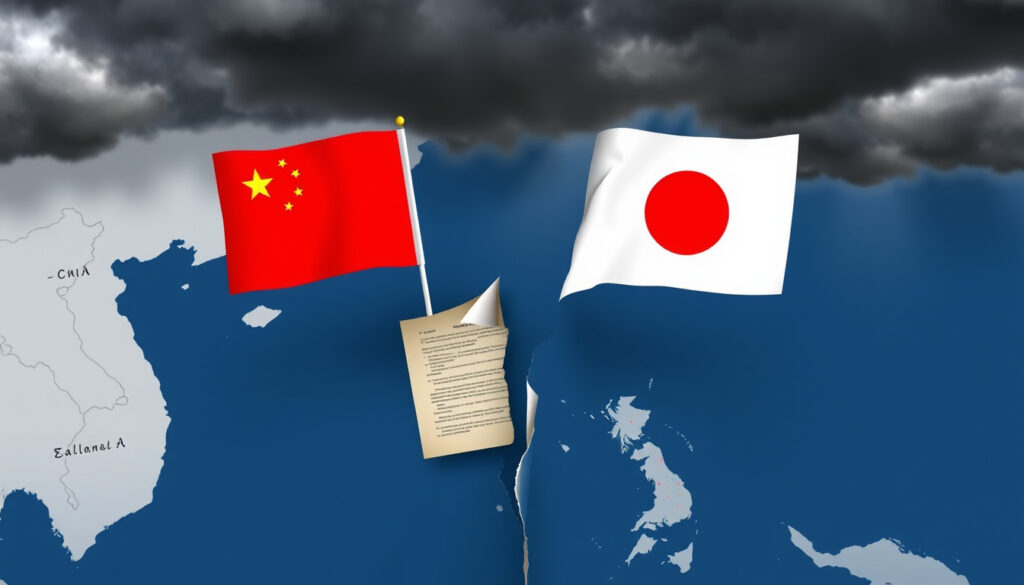
China and Japan Tensions: 2025-2026 Diplomatic Crisis Explained
When a Japanese prime minister publicly links a Taiwan contingency to Japan’s own security, the ripple effects are immediate. That’s exactly what happened in November 2025, and it set off the most serious diplomatic crisis between China and Japan since their relations were normalized in 1972. By early 2026, Beijing had moved from maritime pressure to economic coercion, restricting rare earth exports to Japan in a way that echoes — but escalates — the 2010 showdown. Here’s how we got here and what it means for the region.
Current Status: Diplomatic crisis since November 2025 ·
Key Trigger: Senkaku/Diaoyu Islands sovereignty dispute ·
Escalation (2026): China restricts rare earth exports to Japan ·
Historical Context: Post-WWII grievances unresolved ·
Military Balance: China leads in active personnel (2M vs 240K) ·
Alliance Factor: Japan’s closest ally is the United States
Quick snapshot
- Diplomatic crisis began November 2025 after PM Takaichi’s Taiwan remarks (CSIS)
- China restricted rare earth exports to Japan in early 2026 (Reuters)
- Chinese coast guard vessels sailed through Senkaku Islands on Nov 16, 2025 (Al Jazeera)
- Whether the crisis will escalate into armed conflict (Crisis Group)
- If economic sanctions will expand beyond rare earths (Crisis Group)
- Potential for third-party mediation (Crisis Group)
- Nov 2025: PM Takaichi’s Taiwan remarks trigger crisis (CSIS)
- Nov 16, 2025: Chinese coast guard enters Senkaku waters (Al Jazeera)
- Jan 6, 2026: China bans dual-use exports to Japan (CSIS)
- May 2026: Reuters confirms rare earth cutoff for 4+ months (Reuters)
- Risk of further economic decoupling between Asia’s two largest economies
- Potential for US-Japan joint military posture adjustments
- Global supply chain disruption from rare earth restrictions
Six key facts capture the state of play in the China-Japan relationship as of mid-2026:
| Label | Value |
|---|---|
| Status | Diplomatic crisis (2025–2026) |
| Start Date | November 2025 |
| Key Issue | Senkaku/Diaoyu Islands sovereignty |
| Recent Trigger | China restricts dual-use goods and rare earth exports (2026) |
| Relation Benchmark | Worst since 1972 normalization (Brookings) |
| Japan’s Main Ally | United States |
What’s going on with China and Japan right now?
Overview of the 2025–2026 diplomatic crisis
The current crisis traces directly to November 2025, when Japanese Prime Minister Sanae Takaichi linked a Taiwan contingency to Japan’s security and possible military response. Within days, Beijing responded with a sharp escalation. On November 16, 2025, Chinese Coast Guard vessels sailed through waters near the Japan-administered Senkaku Islands, a move that Al Jazeera reported as a direct show of force.
A single statement by Japan’s prime minister about Taiwan — and Beijing’s response was immediate: coast guard vessels in disputed waters within days, and a full trade restriction within weeks.
Key events in the current escalation
- November 2025: Diplomatic crisis begins after PM Takaichi’s Taiwan remarks (CSIS)
- November 16, 2025: Chinese coast guard vessels sail through Senkaku Islands waters (Al Jazeera)
- January 6, 2026: China’s Ministry of Commerce bans dual-use exports to Japan (CSIS)
- May 2026: Reuters reports China cut Japan off from heavy rare earths for at least four months (Reuters)
- June 2026: New York Times reports China added 20 more Japanese entities to an export watch list (The New York Times)
The pattern: each escalation has been met with a counter-escalation, and neither side shows signs of backing down. The implication is that the crisis has moved from diplomatic posturing into active economic warfare, with rare earths as the primary weapon.
Is China in good relationship with Japan?
Historical ups and downs in bilateral ties
China and Japan normalized diplomatic relations in 1972, but the relationship has always been fragile. The 1995 Murayama Statement, in which Japan apologized for its wartime aggression, was seen as a milestone — but many in China view it as insufficient. Since then, disputes over history textbooks, prime ministerial visits to Yasukuni Shrine, and the Senkaku/Diaoyu Islands have repeatedly strained ties. For travelers interested in Chinese history, what to do in Shenzhen offers a modern perspective on China’s development.
Assessment of current state of relations
Today, the relationship is openly hostile. Brookings describes the current state as the worst since normalization in 1972. Trade and investment have suffered directly: China’s rare earth restrictions have hit Japan’s defense and tech manufacturing sectors, while Japanese firms face uncertainty about supply chains for critical minerals.
Who is Japan’s closest ally?
The US-Japan alliance framework
Japan’s closest ally is the United States, formalized through the Treaty of Mutual Cooperation and Security. This alliance provides Japan with a nuclear umbrella and a commitment from Washington to defend Japan in the event of an armed attack. The US maintains approximately 50,000 troops in Japan, making it the largest American military presence in Asia.
Why Japan cannot join NATO
NATO membership is not a realistic option for Japan. The alliance’s Article 5 collective defense clause is geographically limited to the North Atlantic area, and Japan’s constitution — specifically Article 9 — restricts collective military action. While Japan has reinterpreted its constitution to allow expanded roles for its Self-Defense Forces, full NATO membership would require treaty changes that neither Tokyo nor NATO members are pursuing.
Japan’s security posture depends on the US-Japan Treaty of Mutual Cooperation and Security, not NATO. For Japanese policymakers, the question is whether Washington’s commitment will hold if a conflict over Taiwan or the Senkaku Islands escalates.
Why does China have conflict with Japan?
Historical grievances from WWII
Japan’s invasion and occupation of China from the 1930s through 1945 left deep scars. The 1937 Nanjing Massacre, forced labor, and biological warfare programs are still taught in Chinese schools and cited in state media. Japan issued apologies, most notably the 1995 Murayama Statement, but China and South Korea have consistently viewed them as insufficient. The New York Times reported that China’s government now frames its sanctions as a response to what it calls Japan’s “new militarism.”
Territorial disputes in the East China Sea
The Senkaku/Diaoyu Islands dispute is the most immediate territorial flashpoint. Japan administers the islands, but China claims them based on historical records. The ORCA Asia analysis notes that the dispute centers on competing sovereignty claims. In 2025, Chinese government vessels operated in the contiguous zone around the islands on 357 days — a record high for the fourth consecutive year, according to The Diplomat. Those patrols involved 1,380 Chinese government vessels.
Economic and strategic rivalry
Beyond territory, China and Japan compete for influence in Southeast Asia, technology leadership, and access to critical resources. China’s rare earth export restrictions — which Reuters reported on May 22, 2026, had cut Japan off from several heavy rare earths for at least four months — represent a direct economic weapon. The CSIS analysis describes this as a shift from symbolic coercion to economically targeted controls.
China’s rare earth restrictions are not a one-off. They signal a willingness to weaponize supply chains that Japan — and the global tech industry — depends on. For Japanese manufacturers of electric vehicles, defense electronics, and renewable energy systems, the vulnerability is now exposed.
Who has a stronger military, China or Japan?
Personnel and equipment comparison
China’s People’s Liberation Army has approximately 2 million active personnel, compared to Japan’s Self-Defense Forces at roughly 240,000. China’s defense budget is estimated at $296 billion, roughly four times Japan’s $68 billion. However, Japan maintains advanced naval and air capabilities, including Aegis destroyers and F-35 fighter jets, supported by the US alliance.
Defense budgets and technological edge
Japan’s technological edge in certain domains — submarine warfare, missile defense, and naval aviation — is significant, but China’s sheer scale is overwhelming. The Crisis Group warns that the deterioration in relations has “spiraled beyond an island sovereignty dispute and risks an armed conflict neither side wants.”
Timeline: Key events in the China-Japan crisis
- November 2025: Tensions escalate sharply; diplomatic crisis begins after PM Takaichi’s Taiwan remarks (CSIS)
- November 16, 2025: Chinese coast guard vessels sail through Senkaku Islands waters (Al Jazeera)
- January 6, 2026: China’s Ministry of Commerce bans dual-use exports to Japan (CSIS)
- May 2026: Brookings publishes analysis stating relations are at worst since 1972 (Brookings)
- May 2026: The Diplomat reports a more dangerous phase of rivalry (The Diplomat)
- 2026: China restricts export of dual-use items and rare earth materials to Japan (Wikipedia)
- Ongoing: Crisis Group warns of risk of armed conflict neither side wants (Crisis Group)
The timeline shows a consistent pattern of escalation with no signs of de-escalation.
Confirmed facts and what remains unclear
Confirmed facts
- Diplomatic crisis started in November 2025 after PM Takaichi’s Taiwan remarks (CSIS)
- China imposed rare earth export restrictions in early 2026 (Reuters)
- Territorial dispute over Senkaku/Diaoyu Islands is the core issue (ORCA Asia)
- Japan’s closest ally is the United States
- Chinese coast guard presence near the islands reached a record 357 days in 2025 (The Diplomat)
What’s unclear
- Whether conflict will escalate into armed confrontation (Crisis Group)
- If economic sanctions will expand further
- Potential for third-party mediation
- Long-term trajectory of bilateral relations
The confirmed facts provide a solid foundation, but the unknowns leave room for further escalation.
Key perspectives from analysts
“Some say the current state of Japan-China relations is at its worst since their normalization in 1972.”
— Brookings analyst
“The deterioration in relations between China and Japan has spiraled beyond an island sovereignty dispute and risks an armed conflict neither side wants.”
— Crisis Group report
The two perspectives share a common thread: the crisis is no longer just about islands. It is about Taiwan, about economic dominance, and about whether Asia’s two largest economies can coexist without a military confrontation.
Related reading: China Food Near Me
facebook.com, amandavandyke.substack.com, wsj.com, en.wikipedia.org, csis.org, yahoo.com
Amid escalating tensions, Takaichis warnings on China highlight the growing concerns over Beijing’s coercive tactics.
Frequently asked questions
What caused the 2025 China-Japan diplomatic crisis?
The crisis was triggered in November 2025 when Japanese Prime Minister Sanae Takaichi linked a Taiwan contingency to Japan’s security, prompting China to escalate maritime patrols and later impose rare earth export restrictions (CSIS).
How has Japan responded to China’s export restrictions?
Japan has sought to diversify its rare earth supply chains, including partnerships with Australia and the United States, while also strengthening its alliance with Washington. Tokyo has not imposed reciprocal trade restrictions but has signaled it will not back down on territorial claims.
What role does the United States play in the conflict?
The US is Japan’s closest ally under the Treaty of Mutual Cooperation and Security. Washington has condemned China’s export restrictions and reaffirmed its defense commitments to Japan, including the Senkaku Islands, which the US recognizes as under Japanese administration.
Are there any signs of de-escalation?
As of mid-2026, there are no public signs of de-escalation. China’s rare earth restrictions remain in place, and coast guard patrols continue at record levels. The Crisis Group warns that the risk of armed conflict is real.
How does the Senkaku/Diaoyu dispute factor in?
The islands are the most visible territorial flashpoint. Japan administers them, but China claims sovereignty. In 2025, Chinese government vessels operated in the contiguous zone on 357 days — a record (The Diplomat).
What are the economic implications for both countries?
China’s rare earth restrictions threaten Japan’s defense and high-tech manufacturing sectors. For China, the risk is that other countries accelerate efforts to diversify rare earth supply chains, reducing Beijing’s leverage over the long term. Global supply chains for electric vehicles, wind turbines, and military electronics are directly affected.
Has Japan sought mediation from international organizations?
Japan has raised the issue at the United Nations and through diplomatic channels with the US and European allies. However, no formal mediation process has been initiated, and China has rejected external involvement in what it considers a bilateral matter.
What is the stance of the international community?
The US and European Union have expressed concern over China’s export restrictions and called for de-escalation. However, no major power has imposed sanctions on China in response, reflecting the complex economic interdependencies at play.
The China-Japan crisis of 2025–2026 is not a temporary spat. It is a structural confrontation driven by territorial disputes, historical grievances, and economic rivalry — now armed with rare earths as a weapon. For Japanese industry, the choice is clear: accelerate supply chain diversification, or remain vulnerable to Beijing’s next move. For the region, the risk is that a crisis that began with words about Taiwan ends with something far more dangerous.
More related posts
 Potato Corner Singapore Menu: Prices, Flavors & Sizes
 Hard Rock Hotel Bali Review: I It Worth the Hype?
 Singapore to Vienna Flights – Cheap Deals, Duration and Airlines
 Singapore 2025 Low Income Cash Payout: Eligibility, Amounts
 Sea Lion vs Seal: Key Differences in Behavior, Size, and Habitat
 Tesla Model Y Singapore: Price, Depreciation & Buying Verdict
 Round Dining Table Singapore: Best Options & Buying Guide
 XXXXL Shirts 2025 Lahore Reviews: Size Guide and Prices
