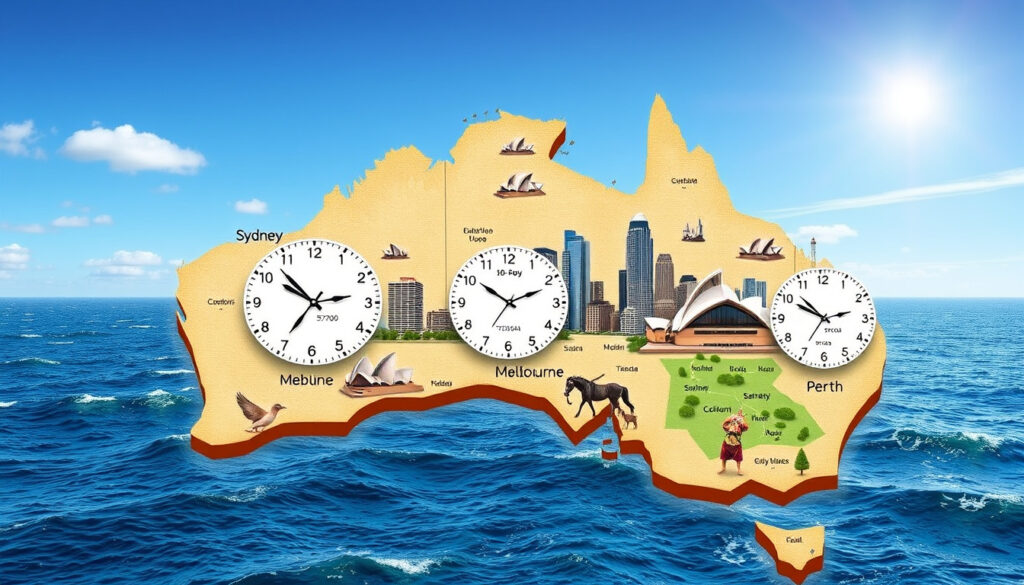
Time in Australia Now: Sydney, Melbourne, Perth & Zones
Australia stretches across nearly 3,000 miles west to east — and that geography means the country doesn’t run on a single clock. If you’re trying to sync a call between Sydney and Perth, or wondering whether it’s morning or night in Brisbane right now, you’ll need to know which time zone applies. This guide covers the current time across Australia’s major cities, breaks down why three separate zones exist, and shows you exactly how the math works for planning ahead.
Main Time Zones: 3 (AEST, ACST, AWST) · Sydney Time Zone: AEST (UTC+10) · Perth Time Zone: AWST (UTC+8) · Melbourne Time Zone: AEST (UTC+10) · Brisbane Time Zone: AEST (UTC+10)
Quick snapshot
- Australia has 3 main time zones: AEST, ACST, AWST (Australia.com)
- The exact current minute varies by live feed — check a real-time clock for your specific city
- DST resumes in eastern states on 4 October 2026 — clocks shift forward 1 hour (Savvy Time converter)
- Time gaps between cities widen to 3 hours when eastern DST kicks in
| Label | Value |
|---|---|
| Primary Time Zones | AEST, ACST, AWST |
| Sydney Time | AEST (UTC+10) |
| Perth Time | AWST (UTC+8) |
| Number of Zones | 3 main + variants |
| Melbourne Time | AEST (UTC+10) |
| Brisbane Time | AEST (UTC+10) |
| Perth-Sydney difference | 2 hours (standard) |
| DST status (east) | Not active in April 2026 |
What time is it in Sydney and Melbourne?
Both Sydney and Melbourne currently sit in Australian Eastern Standard Time (AEST, UTC+10). Since it’s April 2026, daylight saving time has ended for the season — clocks reverted to standard time on the first Sunday of April. The time on your screen right now reflects that setting.
Sydney current time
Sydney operates under the Australia/Sydney timezone with a standard offset of UTC+10:00. During summer, the city shifts to Australian Eastern Daylight Time (AEDT, UTC+11:00). The switch back to standard time happened on 5 April 2026, which means Sydney is currently aligned at the base offset. Savvy Time converter confirms that eastern states reverted to AEST for the non-DST period.
Melbourne current time
Melbourne shares Sydney’s timezone designation — both cities use AEST (UTC+10:00) right now, matching the same offset and the same day length. Melbourne moves to AEDT (UTC+11:00) when daylight saving resumes in October. Wikipedia’s time zone data lists Melbourne alongside Sydney under the same Australia/Melbourne timezone rules.
Daylight saving differences
The time difference between Sydney and Melbourne stays at zero year-round — both observe DST and both end it together. However, when DST is active (October through early April), eastern states shift to UTC+11:00, creating a 3-hour gap with Perth instead of the usual 2 hours. Savvy Time converter tracks these seasonal transitions for cross-city scheduling.
The 2-hour gap between Perth and eastern cities holds steady in April but stretches to 3 hours once eastern DST begins on 4 October 2026. If you’re scheduling recurring calls, mark that date.
Is it AM or PM in Australia right now?
That depends entirely on which city you’re checking. Australia spans multiple time zones, so “morning” in Brisbane and “morning” in Perth don’t start at the same moment.
AM/PM across time zones
When it’s 9:00 AM in Sydney, Perth is still at 7:00 AM. By 3:00 PM Sydney time, Perth sits at 1:00 PM. These gaps trip up plenty of travelers and remote workers coordinating across zones. The 30-minute difference between South Australia (ACST, UTC+9:30) and New South Wales (AEST, UTC+10) creates situations where one city is finishing lunch while another is starting. Australia.com’s official overview outlines how these offset variations play out across the country.
Current status in major cities
Right now (April 2026, standard time):
- Sydney and Melbourne: same time, AEST UTC+10
- Brisbane: matches Sydney exactly (UTC+10, no DST)
- Perth: 2 hours behind the east coast
- Adelaide: 30 minutes behind Sydney/Melbourne
Queensland’s decision not to observe DST means Brisbane stays aligned with Sydney year-round — unlike the southern capitals that shift twice yearly.
How many time zones in Australia?
Australia officially uses three main time zones, but the full picture includes some unusual outliers that don’t fit the standard offsets.
Main zones: AEST, ACST, AWST
Australian Eastern Standard Time (AEST, UTC+10) covers New South Wales, Victoria, Queensland, Tasmania, and the ACT. Australian Central Standard Time (ACST, UTC+9:30) serves South Australia, the Northern Territory, and Broken Hill in New South Wales. Australian Western Standard Time (AWST, UTC+8) covers Western Australia, including Perth. Australia.com’s official tourism guide confirms this three-zone structure.
Australia/Eucla and Lord Howe Island
Two regions break the standard pattern. Australia/Eucla operates at UTC+8:45, a 45-minute offset used in parts of Western Australia near the South Australian border. Lord Howe Island sits at UTC+10:30 standard, shifting to UTC+11:30 during DST. Wikipedia’s detailed time zone table lists these anomalies alongside the main zones.
Affected regions
Broken Hill in far-western New South Wales follows South Australian time (ACST, UTC+9:30) rather than matching the rest of NSW. This reflects how time in Australia is regulated by individual state governments, not centrally — a quirk that creates the patchwork visitors and business coordinators need to navigate.
The takeaway isn’t memorizing eight zones — it’s identifying which state your location falls into, then checking whether that state observes DST. Everything else follows from there.
What’s the time in Australia just now?
Here’s the current breakdown for Australia’s major cities, based on the standard time offsets in effect this April.
Perth time
Perth uses AWST (UTC+8:00) with no daylight saving. The city abolished DST in 2009, which means the 2-hour gap with eastern cities stays fixed year-round. Sunrise runs around 6:46 AM with sunset near 5:42 PM in late April. Time.is solar tracker confirms the no-DST status since 2009.
Brisbane time
Brisbane matches Sydney’s offset at AEST (UTC+10) but shares Queensland’s policy of no daylight saving — meaning Brisbane stays locked to UTC+10 even when southern states shift to UTC+11. Wikipedia’s Brisbane timezone entry confirms the year-round consistency.
Adelaide time
Adelaide operates on ACST (UTC+9:30), placing it 30 minutes behind Sydney and Melbourne. This puts Adelaide 2.5 hours ahead of Perth. The city observes ACDT (UTC+10:30) during daylight saving, which widens the gap with non-DST Perth to 3 hours during summer. Australian High Commission time guide lists Adelaide’s ACST offset alongside other states.
The most practical shortcut for cross-city coordination: if your call lands between 11 AM and 5 PM Sydney time, it’s a workable window for Perth (9 AM to 3 PM) — per Savvy Time’s optimal call time recommendations.
How many hours ahead is Australia right now?
Here’s how Australia’s major zones stack up against other cities you’re likely comparing against.
Vs UK
Sydney sits 9 hours ahead of the UK during non-DST periods. Perth is 7 hours ahead. The UK falls between the two — closer to Perth’s time but not aligned with either. Australian High Commission’s official government page lists these offsets for UK-based travelers and business coordinators.
Vs Dublin, Ireland
Dublin follows the same offset as the UK (IST during summer, GMT in winter). With Sydney at UTC+10, that puts Dublin roughly 10 hours behind Sydney outside of Irish DST. Perth runs 9 hours behind Dublin in standard time.
Global offsets
The international picture: eastern Australian cities (UTC+10) sit 14-15 hours ahead of US East Coast time, 17 hours ahead of US West Coast, and 8-10 hours ahead of Western Europe depending on the season and specific country.
These city-to-city comparisons help frame where Australian time sits relative to major global business hubs. The pattern holds: if you’re calling from London, budget for a morning call — Sydney’s afternoon is London’s early morning.
| City | Current Offset | Difference from Sydney |
|---|---|---|
| Melbourne | UTC+10 | Same |
| Brisbane | UTC+10 | Same |
| Adelaide | UTC+9:30 | −30 min |
| Perth | UTC+8 | −2 hours |
| London (UK) | UTC+0 | −10 hours |
| Dublin (Ireland) | UTC+0 | −10 hours |
Australia is divided into three separate time zones: 1. Australian Eastern Standard Time (AEST) 2. Australian Central Standard Time (ACST), and 3. Australian Western Standard Time (AWST).
— Australia.com (Official Tourism Site)
Perth has not had daylight saving time since 2009.
AEST (Australian Eastern Standard Time) is 2 hours ahead of AWST (Australian Western Standard Time).
— Savvy Time (World Clock Tool)
Related reading: Indonesia time to Singapore time converter · Singapore to Kolkata flight times
Australia’s sprawling layout means Sydney on AEST differs sharply from Perth on AWST, as Sydney-Melbourne time zones overview similarly highlights for coordination.
Frequently asked questions
What time zone is Australia in?
Australia uses three main time zones: AEST (UTC+10) for the east, ACST (UTC+9:30) for the centre, and AWST (UTC+8) for Western Australia. Individual states and territories decide whether to observe daylight saving time within those zones.
Does Australia observe daylight saving time?
It depends on the state. Victoria, New South Wales, the ACT, Tasmania, South Australia, and (during its DST period) Lord Howe Island observe daylight saving. Queensland, Western Australia, and the Northern Territory do not. DST in the east runs from the first Sunday in October to the first Sunday in April.
What is ACST?
ACST stands for Australian Central Standard Time, the offset of UTC+9:30 used in South Australia, the Northern Territory, and Broken Hill in New South Wales. During daylight saving, these areas shift to Australian Central Daylight Time (ACDT) at UTC+10:30.
What is the time difference between Perth and Sydney?
Perth is 2 hours behind Sydney year-round. This gap widens to 3 hours during the period when eastern states observe daylight saving (October through early April) and Perth does not.
What time is it in Adelaide right now?
Adelaide operates on ACST (UTC+9:30), which puts it 30 minutes behind Sydney and Melbourne. In late April 2026, Adelaide is 2.5 hours behind Perth.
What time zone is Melbourne in?
Melbourne uses Australian Eastern Standard Time (AEST, UTC+10) right now, matching Sydney and Brisbane. During daylight saving, Melbourne shifts to Australian Eastern Daylight Time (AEDT, UTC+11).
How many hours ahead is Australia than the UK?
Sydney is 9 hours ahead of the UK during non-DST periods. Perth is 7 hours ahead. When eastern Australia observes daylight saving, the gap from Sydney to the UK widens to 10 hours.
Does Queensland observe daylight saving?
No. Queensland has not observed daylight saving time since the 1970s. Brisbane stays on AEST (UTC+10) year-round, matching Sydney’s offset but without the seasonal shift to AEDT.
More related posts
 Singapore to Vienna Flights – Cheap Deals, Duration and Airlines
 Potato Corner Singapore Menu: Prices, Flavors & Sizes
 300 Ringgit to SGD: Current Rate and Conversion Tips
 Rajamenang1.com OSINT: Situs Slot Risks & Red Flags
 One&Only Desaru Coast: New Mandarin Oriental Owner & Timeline
 Concrete Floor Troweling: Process, Price & Rental Guide
 SSC Napoli vs Genoa CFC Lineups: Feb 7 Match
 Oppo Find X8 Ultra Singapore: Price, Specs, Release Date
