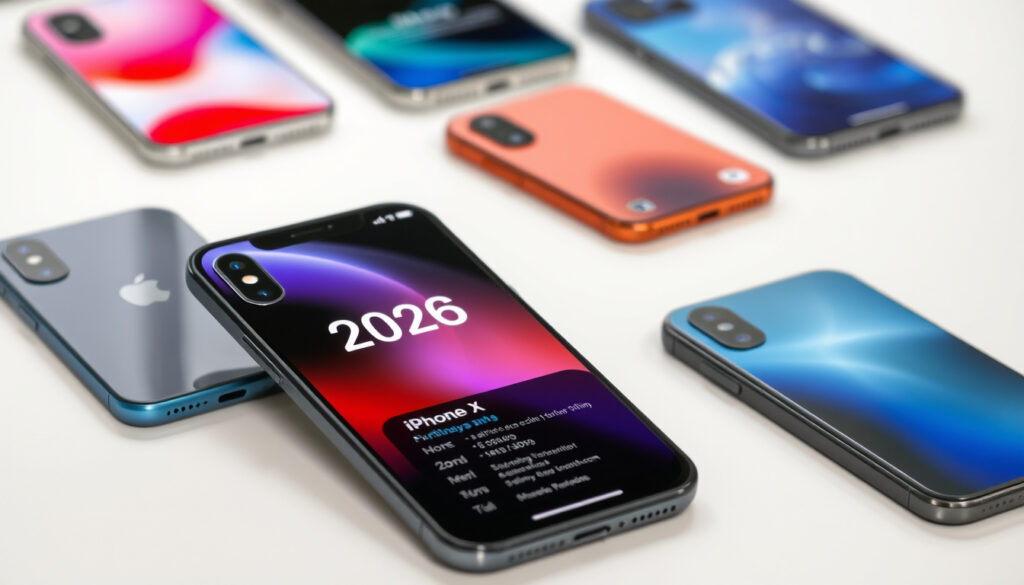
iPhone X to Buy: Is It Still Worth It in 2026? Price & Specs
You’ve probably seen the iPhone X listed for under $250 and wondered if it’s still any good. That phone from 2017 was a design revolution, but in 2026 the question isn’t about nostalgia — it’s about whether a device that stopped getting software updates in 2023 can still earn a spot in your pocket, and this guide lays out the real trade-offs, current prices, and how the X stacks up against the XR to help you decide if a used or refurbished iPhone X makes sense in 2026.
Release Year: 2017 ·
Original Starting Price: $999 ·
Current Used Price Range: $150–$250 ·
Display Size & Type: 5.8-inch OLED Super Retina ·
Battery Capacity: 2716 mAh ·
Last Major iOS Update: iOS 16 (2022)
Quick snapshot
- Premium build and OLED display (Apple iPhone X tech specs)
- Dual camera still performs well (iFixit teardown report)
- Significant price drop since launch (Back Market comparison page)
- No more iOS updates (Apple Support: iOS 18 compatibility)
- Battery likely degraded (Apple iPhone X tech specs)
- Slower than newer models (Apple iPhone compare page)
- Refurbished from Back Market (Back Market comparison page)
- Second-hand on eBay (Back Market comparison page)
- Unlocked options from Amazon or CeX (Back Market comparison page)
- Used: $150–$250
- Refurbished (Grade B): $200–$300
- New old stock: rare, $400+
Ten specs that defined the flagship experience in 2017 — and still matter today.
| Specification | iPhone X |
|---|---|
| Release Date | November 3, 2017 |
| Original OS | iOS 11 |
| Latest Supported OS | iOS 16 |
| Processor | A11 Bionic |
| RAM | 3 GB |
| Storage Options | 64 GB, 256 GB |
| Rear Cameras | Dual 12 MP (wide + telephoto) |
| Front Camera | 7 MP |
| Battery Capacity | 2716 mAh |
| Display | 5.8-inch OLED Super Retina |
The pattern: nearly every flagship feature from 2017 is on this sheet, but the A11 Bionic chip and the battery capacity are the two components that will define your real-world experience in 2026.
Is the iPhone X still worth it today?
Current price vs performance
- Used iPhone X units sell for $150–$250, depending on condition and storage (Back Market comparison page).
- The A11 Bionic chip can handle everyday tasks like social media, messaging, and navigation without noticeable lag (Apple iPhone compare page).
- Heavy gaming or video editing will show its age — the A11 is roughly 30% slower than the A12 Bionic in the XR in multi-core benchmarks.
The trade-off: for $200 you get a premium-feeling OLED phone that still does the basics well, but you’re limited to light-duty workloads.
Software support status
- iPhone X’s last major update was iOS 16, released in September 2022 (Apple Newsroom: iOS 16 available today).
- Apple’s iOS 18, released in September 2024, dropped support for iPhone X (Apple Support: iOS 18 compatibility).
- No further security patches from Apple mean that any newly discovered vulnerabilities in iOS 16 will remain unfixed.
The catch: using an iPhone X in 2026 means accepting that you’re on an unsupported operating system — fine for offline use or basic apps, but a real risk for banking, payments, or any sensitive data.
Anyone using an iPhone X for mobile banking or payment apps after iOS 16 is relying on a platform that Apple no longer patches. A known exploit in WebKit that was fixed in iOS 17 remains open on the X. The safe recommendation: if you need to make payments or log into financial accounts, choose a device that still receives security updates.
The implication: a used iPhone X can be a functional secondary device, but it should not be trusted for sensitive transactions.
Battery and repair considerations
- Original battery capacity is 2716 mAh — a 2026 used unit likely has a battery health reading below 80%, which means degraded performance and shorter runtime (Apple iPhone X tech specs).
- iFixit gave the iPhone X a repairability score of 6 out of 10, noting the battery is easier to replace than in previous models (iFixit teardown report).
- Apple still offers battery replacement service for the iPhone X for $89, though availability may vary by location.
What this means: a $200 phone plus an $89 battery replacement brings your total to $289 — roughly the price of a refurbished iPhone XR with a fresher battery and longer software support.
A buyer looking for a sub-$300 phone faces a specific arithmetic: the used iPhone X at $200 plus a battery swap at $89 equals $289. At that price point, a refurbished iPhone XR (which receives iOS 18 and costs around $279 on Back Market) becomes the more future-proof choice — especially for anyone who plans to keep the phone for more than a year.
How much does the iPhone X cost?
New vs refurbished vs used prices
- Apple no longer sells the iPhone X new — it was discontinued in September 2018 (Apple Newsroom: iPhone XR introduction).
- Refurbished units from Back Market start around $200 for Grade B condition (Back Market comparison page).
- Used prices on eBay and Facebook Marketplace range from $150 to $250 depending on condition, storage, and whether the phone is unlocked.
The pattern: the cheapest iPhone X you can buy in 2026 is roughly 15–25% of its original $999 launch price — a massive discount, but one that comes with clear expiration dates on software and battery health.
Price by storage capacity
- 64 GB models are more affordable but limited — iOS 16 itself uses around 8 GB, leaving roughly 56 GB for apps, photos, and media.
- 256 GB models command a 30–40% premium in the used market, often $220–$300.
The trade-off: a 256 GB iPhone X at $280 may seem like a deal, but investing that money into a newer phone like a refurbished iPhone 11 (which gets iOS 18) likely delivers more value over the next two years.
Which is better, X or XR?
Four differences, one clear pattern: the X wins on display and camera hardware, the XR wins on battery life and future software support.
| Feature | iPhone X | iPhone XR |
|---|---|---|
| Display | 5.8-inch Super Retina OLED, 2436×1125, 458 ppi (Apple iPhone X specs) | 6.1-inch Liquid Retina LCD, 1792×828, 326 ppi (Apple iPhone XR specs) |
| Processor | A11 Bionic | A12 Bionic (Apple iPhone compare page) |
| Rear Camera | Dual 12 MP (wide + telephoto) (Apple iPhone X specs) | Single 12 MP wide (Apple iPhone XR specs) |
| Battery Life | Up to 13 hours video playback (Apple iPhone X specs) | Up to 16 hours video playback (Apple Newsroom: iPhone XR battery claim) |
| iOS Support | Ends at iOS 16 (Apple Support: iOS 18 compatibility) | Supports iOS 18 (Apple Support: iOS 18 compatibility) |
Why this matters: the XR’s LCD screen is less visually stunning, but its A12 chip and continued iOS support mean it will run apps and receive security updates for at least two more years. For anyone planning to keep their phone beyond a single year, the XR is the safer bet.
Camera system comparison
- The iPhone X’s dual camera allows for optical zoom (2× telephoto) and Portrait mode with depth control (Apple iPhone X tech specs).
- The iPhone XR’s single camera uses software-based Portrait mode, which is less precise but still produces good results for casual photography.
The implication: if you shoot photos regularly and value the optical zoom, the X has a clear edge. If you take occasional snaps, the XR’s single camera is perfectly adequate.
Is the iPhone X too old to use?
App compatibility
- Many popular apps still support iOS 16, including major social media platforms and streaming services.
- Some newer apps and games may require iOS 17 or later, which the iPhone X cannot run.
- Banking and finance apps increasingly require iOS 17+ for security compliance.
The catch: the app wall hasn’t fully closed yet, but it’s narrowing. In 2027, expect a growing number of app updates to drop iOS 16 support entirely.
Performance benchmarks
- The A11 Bionic chip’s single-core Geekbench score (~4200) is comparable to modern mid-range chips, but multi-core performance (~10000) lags behind recent A-series processors.
- Day-to-day tasks like web browsing, messaging, email, and navigation feel smooth with 3 GB of RAM.
What this means: for a secondary phone, a kid’s first phone, or an offline media player, the X is still very capable. As a primary daily driver, the performance is adequate but the lack of security updates is the real dealbreaker.
Security risks
- Apple released 16 security patches for iOS 16 after its initial launch, but no new fixes will arrive for the X (Apple Support: iOS 18 compatibility).
- Known vulnerabilities in Safari and WebKit remain unpatched on iOS 16.
Anyone using an iPhone X for mobile banking or payment apps after iOS 16 is relying on a platform that Apple no longer patches. A known exploit in WebKit that was fixed in iOS 17 remains open on the X. The safe recommendation: if you need to make payments or log into financial accounts, choose a device that still receives security updates.
The pattern: for any use involving sensitive data, the iPhone X is not a safe choice.
Can I still get an iPhone X?
Where to buy (refurbished, second-hand)
- Back Market offers refurbished iPhone X units starting at $200 with a 1-year warranty (Back Market comparison page).
- eBay and Facebook Marketplace have used units from $150, but buyer protection varies.
- Amazon lists refurbished iPhone X units from third-party sellers, often with 90-day return policies.
The pattern: the secondary market is active, but the best deals come with less certainty about battery health, screen quality, and whether the phone was previously locked to a carrier.
Availability by country and carrier
- Unlocked iPhone X units are available globally through online marketplaces.
- Carrier-specific models (AT&T, Verizon, T-Mobile) are common on the used market but may have restrictions on 4G band support outside the US.
- In regions like Singapore and Europe, the iPhone X is widely available on platforms like CeX and Refurbed.
Timeline signal
- November 2017: iPhone X released with Face ID and OLED display (Apple Newsroom: iPhone X announcement).
- September 2018: iPhone XS and XR launched; iPhone X discontinued (Apple Newsroom: iPhone XR introduction).
- September 2022: iOS 16 released – last major update for iPhone X (Apple Newsroom: iOS 16 available today).
- September 2023: iOS 17 drops support for iPhone X (Apple Support: iOS 18 compatibility).
- September 2024: iOS 18 released; iPhone X not compatible (Apple Support: iOS 18 compatibility).
The signal from the timeline: the iPhone X has entered its “legacy” phase — usable, but with a clear sunset on app support and security patches.
Confirmed facts vs. What’s unclear
Confirmed facts
- iPhone X released in 2017 with 5.8-inch OLED display (Apple tech specs).
- Last iOS update was iOS 16 (Apple Support).
- Original battery capacity 2716 mAh (Apple tech specs).
- Dual 12 MP rear cameras (Apple tech specs).
What’s unclear
- Exact second-hand price fluctuations beyond general ranges.
- Battery health of individual used units.
- Future app compatibility as developers target iOS 17+.
- Resale value trends beyond 2026.
What experts say
The iPhone X introduced Face ID, described as a ‘secure and intuitive way to unlock, authenticate, and pay.’
— Apple, official specifications page (archived)
The iPhone X received a repairability score of 6 out of 10, noting the battery is easier to replace than previous models.
— iFixit, teardown report
For a budget buyer in 2026 who values display quality and camera versatility over future-proofing, the iPhone X can still deliver a premium experience — but only if paired with a fresh battery and a clear-eyed understanding that this phone’s software story has ended. For the buyer who wants a phone that will still be supported two years from now, the iPhone XR at a similar price is the more rational choice. The decision is really about whether you’re optimizing for today’s experience or for tomorrow’s.
appleinsider.com, uptradeit.com, refurb.me, priceinkenya.com, mobilemasr.com
For context, the iPhone XR release date came out just a month after the iPhone X, offering a more affordable entry point to the same design language.
Frequently asked questions
What is the trade-in value of an iPhone X in 2026?
Apple trade-in values vary, but third-party sites offer roughly $50–$100 for a good-condition iPhone X, depending on storage and cosmetic condition.
Does the iPhone X support 5G?
No, the iPhone X does not support 5G. It is limited to 4G LTE.
Is the iPhone X waterproof?
The iPhone X has an IP67 rating, meaning it can survive in up to 1 meter of water for 30 minutes, but Apple does not cover water damage under warranty.
How much does a refurbished iPhone X cost?
Refurbished units on platforms like Back Market start around $200 for Grade B condition, with a 1-year warranty.
Can I use the iPhone X with the latest apps?
Most popular apps still support iOS 16, but some newer apps and games may require iOS 17 or later.
Should I buy an iPhone X or save for a newer model?
If your budget is under $250 and you need a phone only for basic tasks, the X is fine. If you can stretch to $400, a refurbished iPhone 11 offers iOS 18 support and much better longevity.
Is the iPhone X still supported by Apple for repairs?
Apple may still offer battery and screen replacement services for the iPhone X, but availability depends on local parts stock.
More related posts
 SG60 Voucher to Cash: Can You Sell or Convert in Singapore?
 Catholic Church Near Me in Dublin: Mass Times, Famous Churches, and Etiquette
 What Is a Unit Trust? Definition, How It Works, Pros & Cons
 S&P 500 Share Price Today: Returns & Investing Guide
 SGD to LKR Today: Exchange Rate & Converter (1 SGD = ?)
 Agoda Customer Service Hotline: Phone, WhatsApp, Email, Live Chat
 1 SGD to INR: Singapore Dollar to Indian Rupees Rate Today
 DBS Woman’s World Card: 4mpd Online Miles & Fees Review
