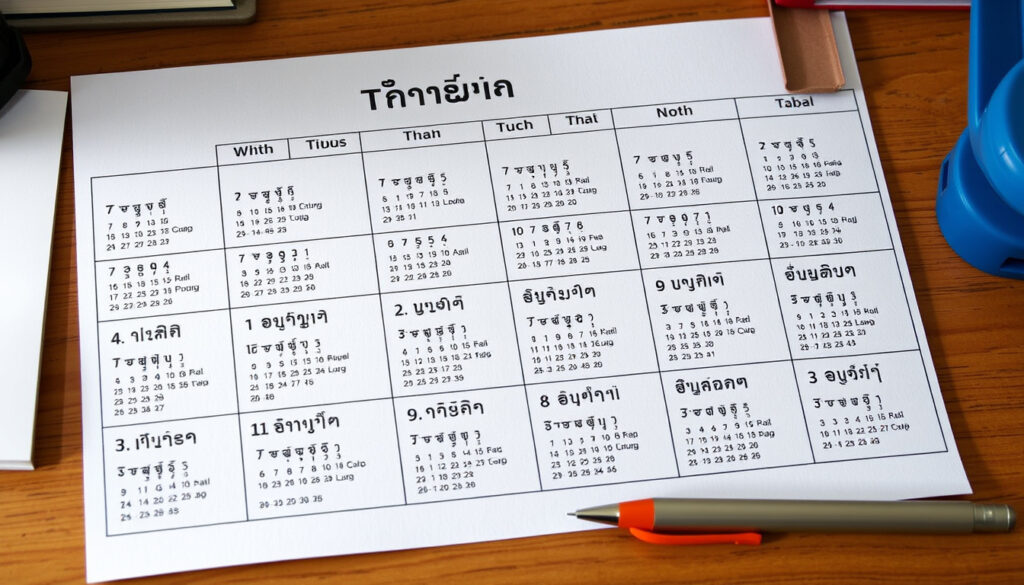
English Months: 12 Months with Thai Translations and Abbreviations
If you’re learning English and trying to remember the names of the months, you’re not alone. Many Thai learners find the English month names tricky because they sound very different from the Thai equivalents. In this guide, you’ll get a complete list with Thai translations, standard abbreviations, and pronunciation tips to help you master เดือนภาษาอังกฤษ from January to December.
Months in English: 12 ·
Standard abbreviations: 3-letter ·
Common abbreviation length: 3 characters ·
Capitalization rule: Always capitalize ·
Typical teaching grade: Primary 1-3 (Thailand) ·
Most searched month (Thai context): September (กันยายน)
Quick snapshot
- 12 months listed in order from January to December (Encyclopaedia Britannica calendar reference)
- Each name always starts with a capital letter (Encyclopaedia Britannica Gregorian calendar)
- 3-letter abbreviations: Jan, Feb, Mar, Apr, May, Jun, Jul, Aug, Sep, Oct, Nov, Dec (Preply language learning platform)
- Used in calendars, notes, and forms (Preply language learning platform)
- Each month has a direct Thai equivalent (Learn Thai with Mod language blog)
- Thai names: มกราคม to ธันวาคม (Learn Thai with Mod language blog)
- Thai phonetic approximations for each month (Preply months in Thai)
- Helps Thai learners speak English months correctly (Preply months in Thai)
The pattern: the English calendar is built around a set of 12 names that always stay capitalized and follow a fixed order from January to December.
| Label | Value |
|---|---|
| Number of months | 12 |
| First month | January (มกราคม) |
| Last month | December (ธันวาคม) |
| Months with 31 days | January, March, May, July, August, October, December |
| Months with 30 days | April, June, September, November |
| Month with 28/29 days | February |
The pattern: The month names are a fixed set — learn the order and you can navigate any date reference in English.
What are the 12 months in English?
List of months with Thai translation
- January – มกราคม (Encyclopaedia Britannica Gregorian calendar)
- February – กุมภาพันธ์ (Preply months in Thai)
- March – มีนาคม
- April – เมษายน
- May – พฤษภาคม
- June – มิถุนายน
- July – กรกฎาคม
- August – สิงหาคม
- September – กันยายน
- October – ตุลาคม
- November – พฤศจิกายน
- December – ธันวาคม (Learn Thai with Mod language blog)
English month names in order
- The 12 months always appear in the same sequence: January (1st), February (2nd), March (3rd), April (4th), May (5th), June (6th), July (7th), August (8th), September (9th), October (10th), November (11th), December (12th).
- Each name must be capitalized in English (Encyclopaedia Britannica Gregorian calendar).
The implication: For Thai learners, memorizing the order of the months is the first step — once that’s solid, abbreviations and pronunciation become much easier.
How do you write the months in English with abbreviations?
Standard 3-letter abbreviations for each month
- Common abbreviations: Jan, Feb, Mar, Apr, May, Jun, Jul, Aug, Sep, Oct, Nov, Dec (Preply language learning platform).
- May has no common abbreviation — it is used in full because it is already short.
- Some sources show Sept. with a period, but the 3-letter form without a period is most common in modern calendars and forms.
When to use abbreviations vs full names
- Abbreviations are standard in calendars, tables, notes, and form fields.
- Full month names are used in formal writing, letters, invitations, and dates written in sentences (e.g., “5 September 2025”).
What this means: A Thai learner writing “13 Sep 2025” in a calendar is correct — reserve the full “September” for official documents or emails.
How do you pronounce the months in English?
Pronunciation guide with Thai phonetic approximation
- January: แจน-ยัว-รี or แจน-ยู-เออ-รี
- February: เฟบ-รู-เออ-รี or เฟบ-บู-รี
- March: มาร์ช
- April: เอ-พริล
- May: เม
- June: จูน
- July: จู-ลาย
- August: ออ-กัสต์
- September: เซป-เทม-เบอร์
- October: ออค-โท-เบอร์
- November: โน-เวม-เบอร์
- December: ดี-เซม-เบอร์
Source for phonetics: Preply months in Thai
Common pronunciation errors for Thai speakers
- “February” is often said with two syllables (“Feb-yoo-ary”) in informal American English — the Thai phonetic เฟบ-รู-เออ-รี helps.
- “March” with a clear “ch” sound (มาร์ช) rather than “มาร์ก”.
- “April” – avoid dropping the first vowel: เอ-พริล not “อพริล”.
The catch: American and British pronunciations differ slightly (e.g., “September” stress), but the Thai phonetics above are a safe middle ground for Thai learners.
How do you translate months from Thai to English?
Thai month names with English equivalents
- มกราคม = January (Preply months in Thai)
- กุมภาพันธ์ = February
- มีนาคม = March
- เมษายน = April
- พฤษภาคม = May
- มิถุนายน = June
- กรกฎาคม = July
- สิงหาคม = August
- กันยายน = September
- ตุลาคม = October
- พฤศจิกายน = November
- ธันวาคม = December
Differences in month order and cultural notes
- Thai month names are not phonetic renderings of English names; they come from Sanskrit-based traditions (Learn Thai with Mod language blog).
- The order is identical to the English calendar — no cultural shift in sequence.
Why this matters: Knowing the Thai names helps bridge the two languages — when you see กันยายน in a Thai document, you immediately know it’s September.
What is the abbreviation for September in English?
Common abbreviations for September
- Standard abbreviation: Sep (Preply language learning platform).
- Also sometimes written as Sept. (with a period) in older style guides.
- September is the 9th month of the year (Encyclopaedia Britannica Gregorian calendar).
Why September is often searched (กันยายน)
- กันยายน is September in Thai.
- Thai learners often search for its abbreviation because กันยายน is a longer word and they want to confirm the correct short form.
The catch: Many Thai sources write “Sep.” with a period, but the dominant modern usage (especially in digital calendars) is “Sep” without a period — stick with three letters.
How to learn the months in English: a step-by-step guide for Thai learners
Thai learners face a double challenge: different sounds and different writing rules. The step-by-step approach below tackles both halves.
- Memorize the full list in order. Write down the 12 months from January to December, paired with their Thai translations. Use a mnemonic: “JFMAMJJASOND” — the first letters in order.
- Learn the 3-letter abbreviations. Practice writing the short forms: Jan, Feb, Mar, Apr, May, Jun, Jul, Aug, Sep, Oct, Nov, Dec. Remember: May stays as May (no abbreviation).
- Practice pronunciation with Thai phonetics. Say each month out loud while reading the Thai phonetic hint (e.g., “January = แจน-ยัว-รี”). Record yourself and compare with a native speaker audio (Learn Thai with Mod language blog suggests listening to English media).
- Write dates correctly. In English, the month is always capitalized. Example: “15 September 2025” (not “15 september 2025”). In forms, use the abbreviated format: “15 Sep 2025”.
The pattern: Consistent practice with the order and the abbreviations builds automatic recall — you’ll stop translating from Thai in your head.
Confirmed facts
- The 12 month names in English are January, February, March, April, May, June, July, August, September, October, November, December (Encyclopaedia Britannica calendar reference).
- Each month has a standard 3-letter abbreviation (Preply language learning platform).
- Thai translations are: มกราคม, กุมภาพันธ์, มีนาคม, เมษายน, พฤษภาคม, มิถุนายน, กรกฎาคม, สิงหาคม, กันยายน, ตุลาคม, พฤศจิกายน, ธันวาคม (Preply months in Thai).
What’s unclear
- Some sources list alternate abbreviations (e.g., Sept. with period) – the 3-letter form without period is most common in modern usage (Preply language learning platform notes both forms).
- Pronunciation variations exist between American and British English (e.g., “February” can sound different).
“The Gregorian calendar consists of 12 months, each with a distinct name that must be capitalized in written English.”
— Encyclopaedia Britannica Gregorian calendar
“Thai month abbreviations are written without spaces between the abbreviation letters and are typically read as the full month name rather than spelled out.”
— Preply language learning platform
“Thai month names are derived from Sanskrit and related naming traditions rather than being simple phonetic borrowings of English month names.”
— Learn Thai with Mod language blog
For Thai learners in Thailand, the choice is clear: invest a few focused sessions memorizing the list and abbreviations, or keep stumbling every time a date format requires the English month name. A small investment today — 12 months, 12 abbreviations, 12 pronunciations — saves years of guesswork.
Frequently asked questions
Why are the month names capitalized in English?
In English, all proper nouns — including month names — are always capitalized. This is a standard grammar rule (Encyclopaedia Britannica Gregorian calendar).
What is the difference between ‘Sep’ and ‘Sept.’?
‘Sep’ is the modern 3-letter abbreviation without a period. ‘Sept.’ is an older form that includes a period and is still seen in some style guides, but ‘Sep’ is more common in digital use (Preply language learning platform).
How do you write dates with months in English?
Write the month with a capital letter, then the day, followed by a comma and year (American) or the day first (British). Example: January 1, 2025 or 1 January 2025.
Is ‘May’ ever abbreviated?
No — because May is already only three letters, it is always written in full. There is no standard abbreviation for May.
Which month has the longest name in English?
September is the longest with 9 letters, followed by November (8) and December (8).
How do you say ‘เดือน’ in English?
‘เดือน’ translates to ‘month’ in English. The plural is ‘months’.
What is the origin of the month names?
Most English month names come from Latin — for example, March is named after the god Mars, and July after Julius Caesar (Encyclopaedia Britannica calendar reference).
More related posts
 Manchester United vs Liverpool 2026: Preview, Tickets, Head-to-Head
 Bugis Junction Parking Rate 2025: Rates & Cheap Options
 Speaker of Parliament Singapore: Current Speaker, History, and Role
 Rainy Day Activities for Kids: Indoor Fun Ideas (Ireland Guide)
 Best Company Incorporation Services Singapore: Reviews & Fees
 Inter Miami vs Nashville SC Lineups: Confirmed & Result
 Thank You for Your Patience: Alternatives, Meaning & Grammar
