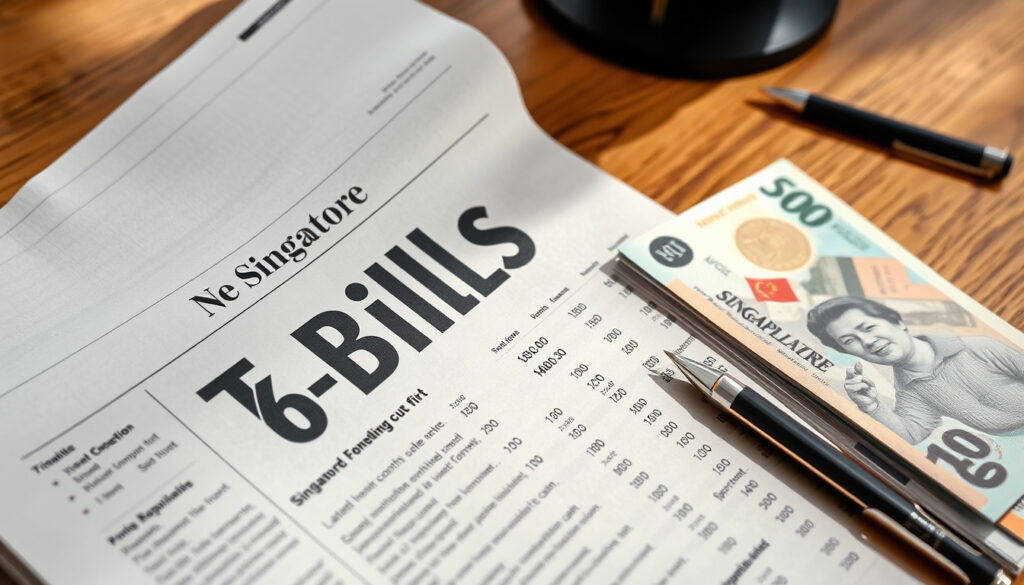
T-Bills Singapore Rate Today: Latest 6-Month Cut-Off Yield
If you have been letting cash sit in a bank account while wondering whether you are leaving something on the table, Singapore T-bills have probably crossed your mind. Here is the honest part worth starting with: the easiest money in Singapore is not hiding in a stock tip or a crypto token — it is sitting in a 6-month government bill, and it has recently been paying a yield that looks surprisingly reasonable for something this boring.
Latest 6-month cut-off yield: 1.92% · Issue date: 2026-09-24 · Tenor offered: 6-month · Minimum investment: S$1,000
Key facts at a glance
- Latest 6-month cut-off yield: 1.92% p.a. SGYieldHub
- Most recent 1-month cut-off yield: 2.80% p.a. SGYieldHub
- Cash sitting idle for 6 months.
- Investors wanting a top-up over bank deposits.
- Anyone avoiding duration and credit risk.
- No capital loss if held to maturity.
- Opportunity cost if rates rise.
What is the current interest rate on a Singapore T-bill?
The most recent 6-month T-bill result in the market is BS26119A, auctioned on 2026-09-24 with a cut-off yield of 1.92% and issued on 2026-10-01, according to MAS auction results for BS26119A. Before that, the 6-month T-bill BS26117A, auctioned on 2026-09-01, showed a cut-off yield of roughly 1.9% per MAS auction calendar. And if you look at the yield-tracking site SGYieldHub T-bill yield tracker, the picture is the same: the 6-month cut-off yield has been hovering in the high-1s to mid-2s over recent auctions. The useful way to read this is not “yields are collapsing” but “the market has settled into a new, saner normal after the spike of 2022–2023.”
The 1-month T-bill tells a similar story. The latest 1-month cut-off yield, for the bill auctioned on 2026-09-29, came in at 2.80%, according to data from SGYieldHub. That means the shortest end of the curve is actually yielding slightly more than the 6-month, which is a quirk of auction timing rather than a signal about the economy — and it matters because it changes the “which tenor do I pick?” calculation for investors.
The yield environment described here — 6-month bills around 1.9–2.7%, 1-month bills near 2.8% — is a world away from the near-zero rates of 2020–21. For someone parking six figures, the difference between a bank deposit at 0.05% and a T-bill at 2.7% is real money.
Latest 6-month T-bill at a glance
Here is a quick spec sheet for the latest 6-month T-bill:
| Metric | Value |
|---|---|
| Tenor | 6 months |
| Cut-off yield | 1.92% (Sep 2026 auction) |
| Recent 6-month yield | Up to 2.74% (Oct 2026 auction) |
| Recent 1-month yield | 2.80% (Sep 2026 auction) |
| Price | Issued at a discount; no coupon |
| Issuer | Government of Singapore (via MAS) |
| Status | Open to individuals via DBS/POSB, OCBC, UOB, and CPF |
Is it worth to invest in T-bills in Singapore?
The short answer is: if you have cash you plan to use within a year, the 6-month bill is one of the few instruments that gives you a known, government-backed return without tying up your money for years. As the MAS T-bill overview explains, T-bills are issued at a discount and purchased at a discount, which means the “interest” you earn is visible from day one — there are no coupon payments to reinvest and no surprises.
For cash with a defined time horizon, the T-bill’s structure — a known face value at a known date — is the feature, not the bug.
The 6-month bill excels in three specific situations: you are saving for a known expense like a property down payment or tax bill due in 3–6 months; you want to diversify a bond portfolio that has become too duration-heavy; or you simply find it psychologically easier to commit to a fixed maturity date than to watch a money market fund’s yield fluctuate. StashAway makes this exact point: for cash with a defined time horizon, the T-bill’s structure is the feature.
Pros
- Government-backed, no credit risk; no capital loss if held to maturity
- Low minimum (S$1,000); no coupon reinvestment risk
- Tax treatment often favourable for individuals
Cons
- Money is locked until maturity unless you sell early (and T-bills may be less liquid than the SSB)
- Yield is set at auction, so you might get less than you hoped
- If rates rise, your six-month return will lag the market; there is a small opportunity cost versus shorter or more flexible options
What is interesting, though, is the role the bill plays in a portfolio. It is not a growth asset and should never be mistaken for one. The StashAway T-bill explainer is blunt about this: T-bills are for capital preservation and short-term goals, not for building long-term wealth. The moment you start expecting a T-bill to beat inflation or the stock market over a decade, the product is being misused.
The real cost of “risk-free” shows up if you sell before the maturity date: you might not get the face value back if market yields have moved.
The implication: T-bills are a cash-management tool, not a growth engine. Use them for liquidity, not for returns.
Is it wise to buy Treasury bills?
Treasury bills are among the safest short-term investments available. They are issued at a discount and pay face value at maturity, offering predictable returns over a short horizon. For Singapore savers, this means a government-backed yield that has recently beaten most savings accounts. The wisdom comes from matching the bill’s tenor to your cash need, not from trying to time auctions.
How does the 6-month rate compare with other short-term options?
For a few years now, the T-bill has been quietly winning the “where do I put my cash?” contest. When the 6-month T-bill was yielding above 3%, it beat most fixed deposits and many money market funds on a risk-adjusted basis; today, with the latest cut-off around 1.92%, it is still competitive, but the reward comes with a catch — your money is locked up for the full six months, whereas a MAS auction result page shows bills are available in tenors as short as 6 months and as long as 1 year MAS comparison for individuals.
Singapore T-bills are issued at a discount to face value and have no coupon interest rate.
The table below lines up the 6-month, 1-month, and the broader Singapore Savings Bond (SSB) so you can see the trade-off without squinting at an auction calendar.
| Instrument | Tenor | Yield | Key trait |
|---|---|---|---|
| 6-month T-bill | 6 months | ~1.92–2.74% | Best for matching a known cash need |
| 1-month T-bill | 1 month | 2.80% | Best for very short-term cash |
| Singapore Savings Bond | Up to 10 years | Step-up, resets over time | Best for flexibility and long-term parking |
The pattern in the table is the story: the 6-month bill usually pays more than the 1-month when the yield curve is upward-sloping, but recently the 1-month has been paying more. That does not make the 6-month “bad” — it makes it a bet on where rates are heading, and right now the market is telling you it expects short-term rates to ease, which is why SGYieldHub year-end data shows the 6-month cut-off has come down from its 2022–2023 peaks.
| Specification | Details |
|---|---|
| Latest 6-month T-bill issue code | BS26117A |
| Latest 6-month T-bill issue date | 2026-09-01 |
| Latest 6-month T-bill cut-off yield | ~1.9% |
| Tenor offered | 6 months |
| Minimum investment | S$1,000 |
| Security type | Discount instrument, no coupon |
| Issued by | Monetary Authority of Singapore |
The takeaway: the 6-month T-bill offers a straightforward yield that, while variable, remains competitive with conservative alternatives.
What is the 10 year T-bill rate today?
Singapore does not issue 10-year T-bills. Its T-bills mature in 6 months or 1 year. The 10-year Treasury note is a different instrument — a bond, not a bill. Long-term Singapore government securities are called Singapore Government Securities (bonds). If you see a search for “10-year T-bill rate,” it likely refers to US Treasuries, not Singapore instruments.
Why is Warren Buffett buying treasury bills?
Berkshire Hathaway has parked significant cash in short-term T-bills. This is a cash-management strategy, not a bet on rising rates. T-bills provide liquidity and safety while waiting for investment opportunities. For individual investors, the lesson is that even the world’s most famous investor uses T-bills for parking cash — not for growth.
When are the next T-bill auctions and what does the timeline look like?
The 6-month T-bill cycle runs like clockwork. Using the most recent visible dates from MAS and the auction calendar, the pattern is: announcement, auction, issue, then a six-month countdown to maturity. The table below shows the last few completed cycles so you can see the rhythm for yourself — the MAS publishes the full auctions and issuance calendar well in advance for anyone planning ahead.
| Auction date | Issue date | 6M cut-off yield |
|---|---|---|
| 2026-08-19 | 2026-08-26 | 1.94% |
| 2026-09-01 | 2026-09-08 | 1.90% |
| 2026-09-15 | 2026-09-22 | 2.10% |
| 2026-09-24 | 2026-10-01 | 1.92% |
Two things stand out from this timeline. First, the cycle is compact: roughly two weeks from auction to issue, and then a six-month lock-up. Second, the volatility in cut-off yields means you cannot “time” a T-bill — one auction in late September cleared at 1.92%, and the previous one at 2.10%, according to SGYieldHub auction results data. If a rate-sensitive investor had sat out that week, they would have left meaningful money on the table.
That auction-to-auction gap is why the professional playbook is simple: submit a non-competitive bid, accept whatever the cut-off is, and move on. Trying to predict the 20-basis-point swings in a 6-month government bill is a fool’s errand. What you can control is how much of your emergency cash stays in a 0.05% bank account versus riding the auction cycle that the MAS runs every few weeks.
What should you believe about T-bill yields?
If you have been following financial news, you have probably read two contradictory things about T-bills in the past year: first, that yields are “surging” because the MAS cut rates; second, that T-bills are a great deal because bank deposits pay “nothing.” Both can be true at different times, but they are not true at the same time. Here is what the actual data, and the actual issuers, say.
Confirmed facts:
- T-bills are issued by the MAS at a discount, with no coupon payments. (MAS)
- The latest 6-month T-bill visible in the data, BS26119A, was issued on 2026-09-24 with a 1.92% cut-off yield. (SGYieldHub)
- The 1-month T-bill cut-off yield was 2.80% for the auction on 2026-09-29. (SGYieldHub)
- MAS publishes T-bill issue and maturity dates, and the 10-year Treasury note is a different instrument from a 6-month bill. (MAS)
What is more of a judgment call: the financial press often says T-bill demand means “investors are nervous about the stock market,” but the numbers say otherwise. T-bill demand is driven as much by the habit of parking cash as by risk appetite, and the fact that the 6-month yield can swing from 1.92% to 2.10% in a single week shows how mechanically the yield is set at auction — not by the central bank’s mood.
What the experts say about Singapore T-bills
The quietest money in Singapore does not make headlines. But the people who run these products, and the ones who advise on them, have a surprisingly consistent message. From a 2025 note by StashAway investment guidance on how T-bills fit into a cash portfolio, to the Monetary Authority of Singapore, the tune is the same: this is a cash-management strategy, not a bet on rising rates. The MAS issuance calendar puts the bills on the table every month; the investors show up; and the yield is whatever it is.
A quick note on the six-month yield’s moving pieces
One of the most counterintuitive things about a T-bill is that “yield” and “price” are in a seesaw. When the cut-off yield rises, the price you pay drops — which sounds bad, but it simply means the market is cleaning up for inflation or rate expectations. The 6-month T-bill cut-off yield you see quoted as 1.92% on any given Wednesday is the market’s guess, not a guarantee, about what the next six months of Singapore dollar interest rates will look like.
And that is the thread that ties all of this together: T-bills are not a return forecast, they are a discount instrument whose yield is set at auction. There is no fixed rate, no coupon, and no way to time the auction perfectly — which is the reason the steady-handed advice from UOB retail bank explainer and SGYieldHub yield tracker remains the same: buy what you can, hold it to maturity, and treat the six-month bill as the parking spot it was always meant to be.
Summary
The story of the Singapore 6-month T-bill in 2026 is not about one auction. It is about the slow, boring reassembly of an investment habit — one where a government-backed discount instrument pays a market-clearing yield, and where your S$10,000 can sit safely for six months and return roughly S$96–120 in interest . The investor who understands that framing will treat the T-bill as a tool, not a trophy. The one who does not will keep reloading a savings-app page looking for a “better” rate that is not coming.
If you are in the market for a stable yield, the next move is not to wait for the perfect cut-off. It is to watch the MAS auction calendar, know your holding period, and bid. Everything else is just furniture.
Related reading: Gold Rate in Singapore Today: 22K & 24K Per Gram · CPF Contribution Rate 2026: New Rates for Senior Workers
mas.gov.sg, mas.gov.sg, mas.gov.sg, mas.gov.sg, mas.gov.sg, stashaway.sg, smartcalculator.sg, syfe.com, mas.gov.sg, sgyieldhub.com
Frequently asked questions
What happens when my T-bill matures?
You receive the face value in your bank account — the difference between your purchase price and the face value is your “interest” (no coupon is paid before that).
Can I sell a T-bill before maturity?
Yes, in the secondary market, but there is no guarantee you will get the face value back — the price can change with market yields. If you hold to maturity, you always get the full face value.
Why did the latest 6-month T-bill yield drop from 2.74% to 1.92%?
Because the cut-off yield is set at each auction. A high subscription wave or a shift in rate expectations between auctions can push yields down (and prices up).
How much money do I need to invest in a 6-month T-bill?
The minimum is S$1,000, and you can apply via DBS/POSB, OCBC, UOB, or CPF.
Is T-bill interest taxed?
For individuals, it is generally treated as tax-exempt interest income in Singapore, but you should verify your situation with your own tax adviser or IRAS guidance.
Is the 6-month T-bill better than a fixed deposit?
Often yes, because T-bills are government-backed and the yield is set at auction. Fixed deposits are bank-issued and their rates tend to be sticky. Compare the current 6-month T-bill auction yield with your bank’s fixed-deposit rate.
Related reading
For a deeper comparison of T-bill tenors and products, go straight to the MAS compare-products page. If you want the latest auction results as they print, SGYieldHub T-bill tracker is a handy periodic table. And if you prefer an expert voice, the StashAway explainer walks through the “why” behind T-bill investing in plain English.
More related posts
 Swansea vs Nottm Forest: TV, result, Snoop Dogg & rivalry
 UOB One Credit Card Cashback Guide: How It Works & Tips
 One&Only Desaru Coast: New Mandarin Oriental Owner & Timeline
 Aircon Gas Top Up Singapore: Costs, DIY Risks & When You Need It
 Domestic Helper Insurance Singapore – Requirements, Costs and Best Plans
 Lucky Plaza Money Changer: Best Rates, Locations & Tips
 How Old Do I Look? 5 Free Face Age Calculators Compared
 Intl Cement Share Price: KUO.SI Live Quote & Analysis
