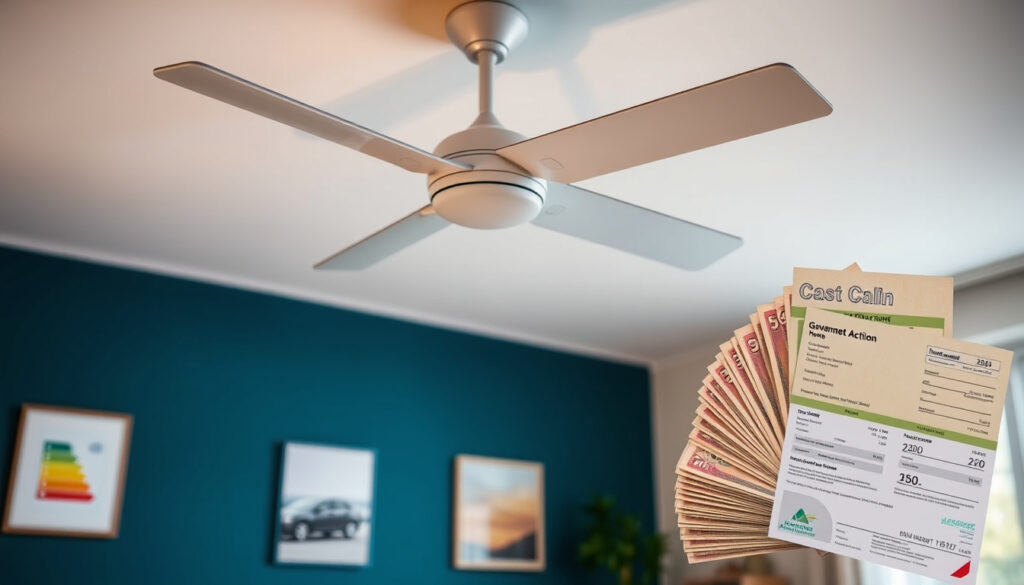
Ceiling Fan Climate Voucher: State Rebate Guide Australia
Australia lacks a single national ceiling fan climate voucher, but targeted state rebates in NSW and the ACT can still cut your cooling costs. This guide breaks down the patchwork of state-based schemes, from Queensland’s community housing offer to NSW’s income-capped loans, so you can claim what is available.
Coverage type: State and federal incentives · Primary focus: Ceiling fan installation and energy upgrades · Estimated potential: Up to $500 per household (where applicable) · National measure: Household Energy Upgrades Fund
Key Facts at a Glance
- No single “ceiling fan climate voucher” exists; instead, the federal government funds the Household Energy Upgrades Fund to support whole-home efficiency.
- The national scheme channels money through states and territories, which decide local rules and rebate levels. (Household Energy Upgrades Fund)
- Queensland’s Community Housing Energy Upgrades program covers ceiling fans for eligible community housing providers, but offers no rebate for owner-occupiers in 2024–25.
- The scheme funds up to $500 per ceiling fan for community housing properties, with a total program cap of $66 million until 2026. (Queensland Treasury)
- NSW’s ceiling fans rebate is part of the broader Home Energy Efficiency Retrofits program, requiring you to be an Australian citizen or permanent resident.
- Households must have a combined annual taxable income of up to $210,000 to qualify. (NSW Climate and Energy Action)
- The ACT offers Home Energy Support rebates for eligible homeowners, with ceiling fans covered when installed as part of a broader efficiency upgrade.
- Eligibility requires ACT residency and holding an eligible concession card or health care card. (ACT Climate Choices)
Is There a National Ceiling Fan Voucher?
The short answer is no. There is no federal “climate voucher” that hands you a check for a new fan. Instead, the federal government operates the Household Energy Upgrades Fund, which aims to reduce the upfront cost of energy-saving upgrades across the country. The fund encourages states to design their own programs, meaning the help you get depends on where you live.
The federal government sets the policy direction, but each state and territory controls the purse strings, leading to different offers from Brisbane to Perth.
What this means for you is that the question isn’t “what can I get?” but rather “what does my state offer?”—and sometimes that answer changes depending on whether you’re a homeowner, a renter, or a community housing provider.
Energy.gov.au lists the national framework, but the real details are in the state-based pages.
The national fund supports whole-home upgrades, but ceiling fans are often only one eligible measure among many.
The implication: states hold the key to real savings, and your location determines your luck.
Queensland’s Community Housing Offer
If you live in Queensland and are not in community housing, you are out of luck for a direct rebate right now. The state’s Community Housing Energy Upgrades program specifically targets community housing providers, not individual homeowners. The program will provide up to $500 per ceiling fan for eligible community housing properties, with the total program capped at $66 million until 2026.
“The program provides up to $500 per ceiling fan for eligible community housing properties,” states the Queensland Treasury.
| Detail | Information |
|---|---|
| Eligible entities | Community housing providers (not owner-occupiers) |
| Rebate per fan | Up to $500 per ceiling fan (subject to installation conditions) |
| Program expiry | June 2026 (program extension to June 2027 announced) |
| Total funding | $66 million |
| Additional requirements | Other energy-saving measures must be bundled (e.g., insulation, solar) |
According to the Queensland Treasury, the program also includes a supplementary measure that must be carried out with one or more eligible upgrades. This bundling rule makes ceiling fans a practical add-on when you are already installing insulation or sealing your home.
For homeowners, the state has focused efforts elsewhere, including solar rebates and battery schemes, so a ceiling fan-specific rebate remains out of reach for now.
The program’s bundling requirement encourages whole-home efficiency, but it complicates simple fan replacements for smaller properties.
The catch: Queensland’s funding remains locked for community housing, leaving owner-occupiers to pay full price.
New South Wales: A Means-Tested Rebate
In New South Wales, the story changes. The state’s ceiling fans page is clear: eligible applicants must be Australian citizens or permanent residents, and that is just the start. You must also have a combined annual taxable household income of up to $210,000 to qualify for assistance.
“Eligible applicants must be Australian citizens or permanent residents,” according to the NSW Climate and Energy Action website.
The NSW scheme is part of a broader energy efficiency effort that includes ceiling fans as a cost-effective way to reduce air conditioning loads. The application process is handled through the NSW Climate and Energy Action office, and you will need to meet the criteria set for the entire home retrofit program.
- Citizenship – Must be an Australian citizen or permanent resident.
- Income cap – Combined annual taxable income of up to $210,000.
- Property type – Typically for owner-occupied homes; renters need landlord consent.
- Application method – Online via the designated portal; no paper forms.
- Documentation – Provide income statements, proof of residency, and the contractor’s invoice.
Remember, the rebate is not a voucher you take to the store. You must pay upfront for the installation and then claim the rebate after the work is done, which is a hurdle for many households even with reasonable incomes.
The scheme’s official guideline (NSW Climate and Energy Action’s guide) states that both conditional and final approval applications must be made via QRIDA’s online portal, which adds a layer of bureaucracy but also provides a clear trail.
The income cap makes this a middle-class support measure, not just a concession for low-income earners, which broadens its impact.
What this means: the income cap makes this a middle-class support measure, not just concession for low-income earners.
ACT: Concession Holders Get More
The Australian Capital Territory takes a different approach. Its Home Energy Support rebates program is designed for homeowners who hold a concession card, making it a targeted measure for those who need it most.
“The scheme covers ceiling fans when they are part of a broader efficiency package,” notes the ACT Climate Choices program page.
| Feature | ACT Rebate |
|---|---|
| Target group | Homeowners with concession cards |
| Fan coverage | Part of a broader upgrade package |
| Application route | Online via ACT Climate Choices |
| Supplementary requirements | Must include other energy-saving measures |
This bundling requirement reflects a philosophy that ceiling fans alone do not solve the energy problem—they work best when your home is already efficient. The ACT government is betting that pairing a fan with better insulation will cut the need for air conditioning, which is the biggest single electricity user in most homes.
For a homeowner thinking about a fan, the ACT route means a bigger project, but also a bigger long-term saving.
If you are a low-income renter in the ACT, this scheme does not help you directly—it targets homeowners, leaving renters to negotiate with landlords.
What this means: low-income renters in the ACT are left out, making the scheme only partially inclusive.
How to Apply (Step-by-Step)
Applying for a ceiling fan rebate is rarely a single step, but each state follows a similar pattern. Here is a generalized guide that applies to the NSW, QLD, and ACT programs.
- Check your eligibility – Start on each state’s energy website to confirm you meet the income, residency, and property rules.
- Book an assessment – Many programs require a home energy assessment before you buy anything. This assessment determines which upgrades are sensible and what the rebate will cover.
- Choose a qualified installer – Use the program’s approved list of contractors. DIY fans are not eligible.
- Pay upfront – You must cover the cost of the fan and installation, then claim the rebate afterwards with the invoice and your assessment report.
- Submit the claim – Go online and upload your documents. Processing times vary but expect at least a few weeks.
- Receive the rebate – Once approved, the money goes into your nominated bank account, usually within a month.
Each program also has its own quirks. For example, the QLD community housing scheme requires the housing provider to initiate the application on behalf of the tenant, while the NSW portal is open to individual homeowners.
The pattern: the rebate process demands upfront payment and paperwork, discouraging those without cash flow.
Queensland’s Funding Breakdown
The Queensland program’s numbers tell a clear story about priorities. With a $66 million budget until 2027, the government is investing heavily in social housing retrofits, but that money is not available to the general public. The official Queensland Treasury page outlines the two phases: an initial program ending in 2026 and a supplementary measure running to 2027, which suggests a long-term commitment to lowering energy costs for vulnerable households.
The $500 per fan figure is a cap, not a guarantee. If the fan costs less, the rebate is lower. If installation costs more, you cover the difference. This is standard practice, but it surprises people who expect a flat fee.
The fact that the program is run through the Treasury, rather than the energy department, signals a budgetary focus—this is about managing costs as much as saving energy.
Further extensions of Queensland’s scheme could open up to owner-occupiers if the government shifts its political priorities, but nothing suggests that is imminent.
The implication: Queensland’s scheme prioritizes cost management over broad accessibility.
7news.com.au, suburbanland.act.gov.au, energy.gov.au, energy.nsw.gov.au, ahd.csiro.au, housing.qld.gov.au, energy.gov.au, energy.gov.au, environment.nsw.gov.au
Frequently Asked Questions
What is the NSW rebate amount for ceiling fans?
The NSW program does not publish a fixed fan amount; it funds a portion of the upgrade cost as part of its Home Energy Efficiency Retrofits initiative, subject to the program’s rules and available budget.
Can renters claim any ceiling fan rebates?
Most schemes require the property owner’s consent. Renters typically cannot claim directly in Queensland or the ACT, but they can ask landlords to apply and possibly adjust the lease.
What is the QRIDA role in Queensland’s scheme?
QRIDA (Queensland Rural and Industry Development Authority) processes applications for the Community Housing Energy Upgrades program, so all paperwork goes through its online portal.
Do I need an energy assessment to claim?
Yes, for most comprehensive programs. The assessment determines which upgrades are eligible and calculates the expected savings, which is why DIY installations rarely qualify.
Can I claim a ceiling fan rebate alongside solar panels?
Yes, in most states. The programs are designed to complement each other, but check your specific scheme because some have “stacking” limits.
Related Reading
For more guidance on energy efficiency and household finance, explore these resources:
- Aircon Gas Top Up Singapore: Costs, DIY Risks & When You Need It
- Singapore Government Assistance Programs
Final consideration: The programs are set to change, with Queensland’s extension to 2027 and NSW’s income cap potentially being reviewed. For anyone planning an upgrade, the smartest move is to compare local schemes and start the application process before priorities change—because one thing is certain: the cost of running an old fan is nothing compared to the cost of a hot summer. Homeowners should act now before programs change, as the cost of running an old fan pales next to a hot summer without rebates.
More related posts
 How to Repair a Leaky Pipe: Step-by-Step Guide (2025)
 White-Bellied Sea Eagle: Facts, Habitat, and Comparisons
 Gardens by the Bay Guide: Tickets & Free Areas
 Old Airport Road Hawker – Stalls, Timings and Safety Tips
 Black Pearl Steakhouse Reviews: Singapore Siglap Steaks Worth It?
 Mount Pleasant BTO Flats 2025: Prices, Eligibility & Masterplan
 How to Calculate CAGR in Excel: Formula & Examples
 Taxi From Singapore to JB – Costs, Booking and Full Guide
