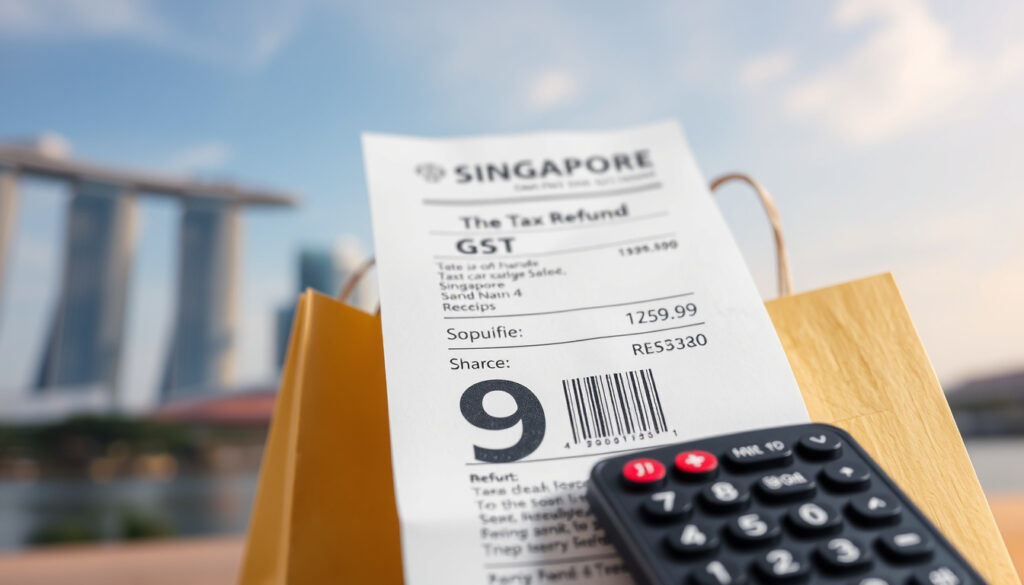
GST in Singapore 2025: 9% Rate, Refund & Calculation
If you’ve ever looked at a receipt in Singapore and spotted a line for GST, you’ve seen the city-state’s version of a consumption tax in action. Since January 2024, that rate has been 9% — a figure that applies to most goods and services you buy locally, and understanding how GST works can save you money as a shopper or help you plan a business’s compliance costs, especially with the rate holding steady through 2026.
Current GST Rate (Singapore): 9% ·
Next Scheduled Increase: None announced for 2026+ ·
GST Refund for Tourists: Up to 9% on eligible purchases ≥ S$100 ·
Effective Date of 9% Rate: January 1, 2024
Quick snapshot
- 9% effective 1 Jan 2024 (IRAS — Singapore’s tax authority)
- Applies to most goods and services (IRAS)
- No increase to 10% announced (IRAS — Rate change for consumers)
- Claim 9% back on purchases ≥ S$100 (Singapore Customs — Tourist Refund Scheme)
- Use eTRS kiosk at airport (eTRS — Electronic Tourist Refund Scheme)
- Excludes services and consumables (IRAS — Tourist Refund Scheme)
- Multiply price by 0.09 for GST amount (IRAS)
- Add: price × 1.09 (IRAS)
- Extract: total ÷ 1.09 × 0.09 (IRAS)
- GST is a type of VAT (Wikipedia — Goods and Services Tax (Singapore))
- Both are consumption taxes (Wikipedia — Goods and Services Tax (Singapore))
- Different names, same concept (Wikipedia — Goods and Services Tax (Singapore))
Six key facts about Singapore’s GST — from the current rate to past increases — help frame the system’s mechanics for both locals and visitors.
| Label | Value |
|---|---|
| Current rate | 9% |
| Effective from | 1 January 2024 |
| Previous rate | 8% (2023) |
| Rate before 2023 | 7% (2007–2022) |
| GST registration threshold | S$1 million annual turnover |
| Refund processing fee | Approximately S$2 per transaction |
What this means: The rate has risen in two quick steps from 7% to 9% over 2023–2024, but no further hike is on the horizon for the near term, giving businesses and tourists a period of stability.
Is GST Still 10%?
No — the current GST rate in Singapore is 9%, not 10%. This is a common point of confusion because many visitors hear about a “GST hike” and assume the top rate is a round 10%.
What is the current GST rate in 2025?
- Singapore’s GST rate is 9% as of 1 January 2024, confirmed by IRAS (Inland Revenue Authority of Singapore).
- This applies to nearly all taxable supplies of goods and services.
Has the GST rate changed recently?
- Yes — it rose from 7% to 8% on 1 January 2023, then to 9% on 1 January 2024.
- The two-step increase was announced in Budget 2021 by the Straits Times (Singapore’s leading newspaper), with the timing tied to economic conditions.
When did the 9% rate take effect?
- 1 January 2024 — no later adjustments have been implemented or announced for 2025 or 2026.
The implication: Anyone quoting a 10% GST in Singapore is working with outdated information. The rate is 9%, and it will likely remain there for the rest of 2025 and 2026.
This clarity helps shoppers and tourists plan accordingly.
How Much Is the GST Refund in Singapore?
Tourists visiting Singapore can claim back the 9% GST they pay on goods bought before departure, but only under specific conditions.
Who qualifies for the tourist refund?
- Non-residents who are not working in Singapore and are departing from Changi or Seletar Airport.
- Must have made purchases at participating stores displaying the “Tax Free” or “eTRS” logo (Singapore Customs — Tourist Refund Scheme).
What is the minimum purchase amount?
- Minimum S$100 (including GST) per receipt from the same store.
- Goods must be exported within 2 months of purchase.
How to claim GST refund at Changi Airport?
- Use the eTRS self-help kiosks at the departure hall before checking in luggage.
- Present your passport, original receipts, and the goods for inspection if requested.
- Refunds are processed to credit cards or via cash, minus a processing fee of roughly S$2 per transaction (Global Blue — Tax Free Shopping Singapore).
What this means: The refund is not a full 9% back in your pocket — the processing fee eats into it, so effective refund is closer to 8.5%–9% of the purchase price, depending on the agent.
Tourists who buy services, food consumed in Singapore, or goods worth less than S$100 per receipt cannot claim any refund. Plan shopping accordingly.
Knowing these thresholds ensures you don’t miss out on a meaningful refund.
How to Calculate GST in Singapore?
Calculating GST is straightforward once you know whether the price quoted already includes tax. Singapore typically displays prices GST-inclusive.
- Check if the price includes GST – Singapore prices are usually inclusive.
- To add GST to a pre-tax amount, multiply by 1.09.
- To extract GST from an inclusive price, divide by 1.09 and multiply by 0.09.
Formula for including GST
- Price before GST × 1.09 = final price (including 9% GST).
How to find the GST amount from a total price
- GST amount = Total price ÷ 1.09 × 0.09.
- Example: On a S$1000 total, GST = 1000 ÷ 1.09 × 0.09 ≈ S$82.57.
Example: GST on $1000
- If the price tag says S$1,000 (GST inclusive), the actual GST component is approximately S$82.57. The seller’s revenue before GST is S$917.43.
A practical frame: Think of GST as a 9% surcharge on the pre-tax price. If a merchant quotes S$1,000 inclusive, the government takes S$82.57 of that.
Businesses that fail to charge or account for GST correctly risk penalties. For tourists, knowing the calculation helps verify refund amounts.
Mastering this simple math ensures you budget accurately whether shopping or running a business.
Is GST Similar to VAT?
Yes — GST (Goods and Services Tax) and VAT (Value Added Tax) are essentially the same thing. Singapore calls its consumption tax GST; European countries call theirs VAT.
Key similarities
- Both are multi-stage consumption taxes collected at every point in the supply chain.
- Businesses can claim input tax credits on purchases, so the tax burden ultimately falls on the end consumer.
- Both are levied on most goods and services, with some exemptions.
Key differences
- Name only — the mechanics are nearly identical. Singapore’s GST is technically a VAT.
- Rates differ: Singapore’s 9% is lower than many European VAT rates (e.g., UK 20%, Germany 19%).
- Singapore uses eTRS for tourist refunds; many EU countries use counter-based refund desks.
Which countries use GST vs VAT?
- GST is used in Singapore, India, Australia, Canada, New Zealand, and Malaysia.
- VAT is the term used across Europe and in many other parts of the world.
The pattern: If you understand VAT, you understand GST. The practical difference comes down to administrative procedures, not tax structure.
Do Tourists Get a Tax Refund in Singapore?
Yes — eligible tourists can claim a refund on GST paid for goods brought back home, under the Tourist Refund Scheme (TRS).
Eligibility criteria for tourist refund
- Must be a non-resident visitor departing within 2 months of purchase.
- Purchases must be from a store participating in TRS (look for the “Tax Free” logo).
- Goods must be hand-carried out of Singapore — no shipped items.
How much can be claimed back?
- The full 9% GST paid, minus a service fee (around S$2 per transaction).
- Example: On S$200 of goods, GST charged = S$18, refund after fee ≈ S$16.
What items are excluded?
- Services (hotel stays, dining, transport), perishable goods, and items consumed in Singapore.
- Goods brought into Singapore for commercial purposes.
The trade-off: Tourists who buy big-ticket items like electronics or luxury goods can recoup a meaningful sum, but small purchases under S$100 per receipt are not refundable. Group smaller buys from the same store on one receipt to meet the threshold.
The Tourist Refund Scheme is generous by global standards — no minimum stay, no per-person limit. Compare that to the EU, where minimum purchase thresholds are often higher and refunds require customs stamping.
For international visitors, knowing these rules turns a tax into an opportunity.
GST Rate Changes in Singapore: A Timeline
Singapore’s GST has climbed from its introduction at 3% in 1994 to today’s 9%. Each increase reflects fiscal policy decisions tied to government revenue needs.
- — GST introduced at 3% (Wikipedia)
- — Rate increased to 4% (Wikipedia)
- — Rate increased to 5% (Wikipedia)
- — Rate increased to 7% (Wikipedia)
- — Rate increased to 8% (IRAS — Rate change for consumers)
- — Rate increased to 9% (current) (IRAS — Current GST rates)
- — No further increase announced; rate remains 9% (IRAS)
The pattern: After 16 years at 7%, the government moved quickly in two years to 9%. The next review date is not set, but the current economic outlook suggests stability.
Confirmed Facts and What Remains Unclear
Confirmed facts
- Current GST rate is 9% (IRAS).
- No planned increase to 10% as of 2025.
- Tourists can claim refund on goods ≥ S$100 (Singapore Customs).
What’s unclear
- Whether GST will increase after 2026 (government reviews periodically).
- Exact processing fee amount for refunds (may vary by agent; Visit Singapore — tourist guidance notes fees may differ).
These confirmed facts give travellers and businesses a reliable foundation for decision-making in 2025–2026.
GST-registered businesses in Singapore must charge and account for GST at 9% on taxable sales of goods and services.
IRAS — Current GST Rates
The Tourist Refund Scheme is Singapore’s electronic Tourist Refund Scheme for tourists to claim GST refunds.
IRAS — Tourist Refund Scheme
Budget 2021 announced that the planned GST hike would take place between 2022 and 2025, sooner rather than later.
For anyone planning to shop or do business in Singapore in 2025, the 9% GST is a fixed cost that is not going away. Tourists who understand the refund rules can recover most of the tax they pay, while businesses must stay on top of their GST obligations. The implication for international travelers is clear: bring your receipts, use the eTRS kiosks, and keep purchases above S$100 per store — or lose out on a refund that’s worth claiming.
ph.trip.com, paulhypepage.com, wise.com, youtube.com, iras.gov.sg
For a practical breakdown of how to calculate GST and service charge on restaurant bills, the step-by-step guide clarifies the order of operations.
Frequently asked questions
Can I get a GST refund as a tourist in Singapore?
Yes, if you are a non-resident departing from Changi or Seletar Airport and have purchased goods worth at least S$100 (including GST) per receipt from a participating store.
How do I calculate GST on a $500 item?
If the price is GST-inclusive, the GST portion is 500 ÷ 1.09 × 0.09 ≈ S$41.28. If the price is before tax, the total is 500 × 1.09 = S$545.
Is GST the same as sales tax?
No — sales tax is a single-stage tax on the final sale, while GST is a multi-stage tax on each step of the supply chain. Singapore’s GST is more like a VAT than a sales tax.
What items are exempt from GST in Singapore?
Most financial services, residential property sales, and the import of investment-grade precious metals are exempt. Basic groceries and some medical supplies are also GST-free.
Do I need to register for GST as a small business?
You must register if your annual taxable turnover exceeds S$1 million. Below that threshold, registration is voluntary but may be beneficial for input tax recovery.
How is GST different from VAT in the UK?
Both are consumption taxes, but the UK’s VAT rate is 20% (standard), while Singapore’s GST is 9%. The refund process for visitors also differs — Singapore uses eTRS self-help kiosks; the UK uses paper forms and counter services.
More related posts
 The Plump Frenchman Photos: Menu, Reviews & Price in Singapore
 SSC Napoli vs Genoa CFC Lineups: Feb 7, 2026 Match Analysis
 Galaxy Z Fold 2 to Buy: 2025 Value Guide
 Concrete Floor Troweling: Process, Price & Rental Guide
 Yong He Eating House Closure: History, Menu, and Future
 DBS Woman’s World Card: 4mpd Online Miles & Fees Review
 What Is a Metaphor? Definition, Examples, and Simile vs. Metaphor
 Micron Semiconductor Asia Operations Pte Ltd Profile
