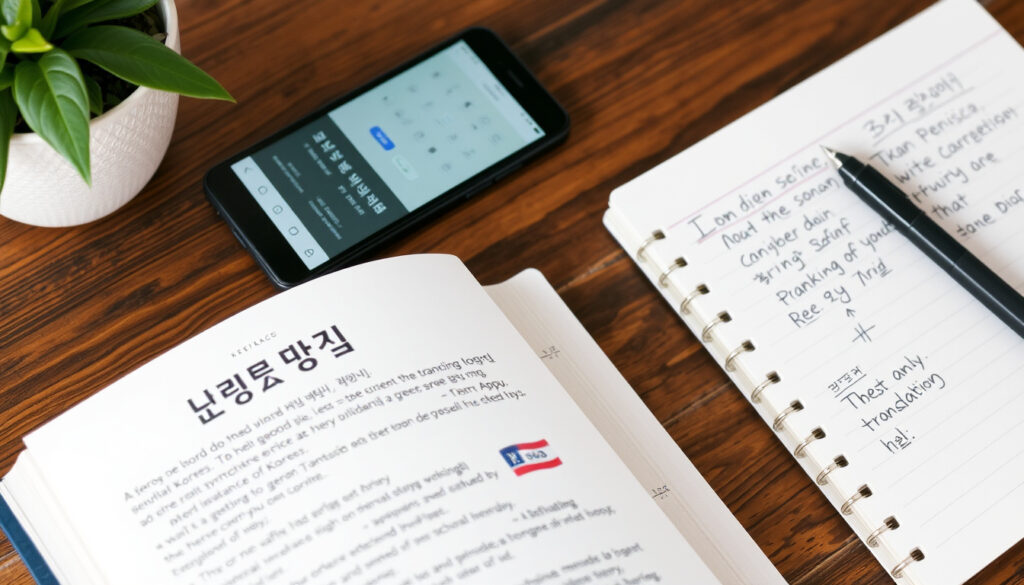
Korean to English Translation: Tools, Accuracy, & Phrases
Anyone who has tried to translate a simple Korean phrase like ‘jal ja’ knows it’s not just about finding the right English words — it’s about catching the tone, the relationship, and the moment. Korean is a high-context language where politeness levels and cultural cues shape meaning more than a dictionary definition, and this guide walks through the best translation tools, essential phrases with their social baggage, and why the most accurate translator for Korean to English often depends on who you’re talking to.
Korean speakers worldwide: 81.7 million (Ethnologue, 2023) ·
Hangul letters: 24 ·
Google Translate languages supported: 133 ·
Most visited translation tool: Google Translate ·
Korean learning difficulty for English speakers: Category V (most difficult)
Quick snapshot
- Google Translate leads with 78% user preference (Glotera AI)
- QuillBot offers AI-powered Korean-English translation (MotaWord translation guide)
- ‘I love you’ = ‘saranghae’ (informal) or ‘saranghamnida’ (formal) (MotaWord translation guide)
- ‘Good night’ = ‘jal ja’ (informal) or ‘jal jaseyo’ (polite) (MotaWord translation guide)
- ‘Thank you’ = ‘gomawoyo’ (polite) or ‘kamsahamnida’ (formal) (Kent State University MCLS)
- Korean uses honorifics and speech levels that change verb endings (MotaWord translation guide)
- Formal vs. informal can alter meaning of the same word (MotaWord translation guide)
- Start with reading Hangul – it’s phonetic and easy to pick up (MotaWord translation guide)
- Focus on grammar particles because word order differs from English (MotaWord translation guide)
Key facts about Korean to English translation are summarised below:
| Fact | Value |
|---|---|
| Korean speakers | 81.7 million |
| Hangul creation | 1443 CE |
| Google Translate languages | 133 |
| FSI difficulty rank | Category V |
| Most accurate translator (user survey) | Google Translate (78% preference) |
What is the most accurate Korean to English translator?
Here is a comparison of popular translation tools for Korean to English:
| Tool | Strengths | Weaknesses |
|---|---|---|
| Google Translate | Free, supports 133 languages, voice and image translation | Struggles with honorifics, idioms, and context-dependent phrases |
| QuillBot | AI-powered rephrasing for better nuance | Less tested for Korean, limited language support |
| Papago (Naver) | Better handling of full sentences and Korean-specific expressions | Supports fewer languages than Google Translate |
No single tool wins every scenario. Accuracy varies by text type – slang, formal documents, or conversational phrases each play to different strengths. Google Translate, the most visited translation tool overall, supports Korean to English and handles basic phrases reliably. According to Glotera AI, its accuracy for Korean to English sits around 65–75%.
Google Translate overview
- Free and supports 133 languages, including Korean.
- Offers text, voice, and image translation via the mobile app.
- Handles casual phrases well but stumbles on formal honorifics and idioms.
Other top translation tools
QuillBot uses AI to rephrase translations, improving nuance. Maestra provides live voice translation for conversations. Both are newer but less tested for Korean than Google Translate.
Accuracy factors
Context is everything. Translating a standalone word like ‘ ’ (joayo) will give you ‘it’s good’. But in a sentence like ‘ ’ it means ‘I like this food’. The Kent State University MCLS translation program emphasizes that translators must go beyond word-for-word meaning to capture intent and cultural norms.
The most accurate tool for a casual text may be the least accurate for a business email. Google Translate excels at speed; human reviewers excel at cultural fit.
The implication: pick your tool based on what you’re translating. For simple phrases, Google Translate works. For anything involving social relationships, add a human check.
How to speak Korea ‘I love you’?
The Korean phrase for ‘I love you’ is ‘saranghae’ in informal speech and ‘saranghamnida’ in formal. But Koreans say it less often than English speakers expect, especially early in a relationship.
Standard phrase: saranghae
- ‘Saranghae’ ( ) is casual, used between close partners or friends.
- ‘Saranghamnida’ ( ) is polite, used in formal settings or when addressing elders.
Formal vs casual usage
In Korean culture, direct expressions of love are often saved for significant moments. Overusing ‘saranghae’ can feel less meaningful. Instead, Koreans show affection through actions and indirect phrases like ‘I like you’ (joaheyo).
Related love expressions
- ‘I like you’: ‘joaheyo’ ( )
- ‘You are pretty’: ‘yeppeo’ ( ) informal
- ‘I miss you’: ‘bogoshipo’ ( )
What this means: if you’re learning Korean to express feelings, start with ‘joaheyo’ and save ‘saranghae’ for the right moment.
What does ‘jal ja’ mean?
‘Jal ja’ ( ) literally translates to ‘sleep well’ in English. It is an informal good-night phrase used between close friends, family, or romantic partners.
Meaning: ‘sleep well’
- Composed of ‘jal’ (well) + ‘ja’ (sleep, imperative).
- Equivalent to saying ‘sleep tight’ or ‘night night.’
When to use jal ja
Use ‘jal ja’ only with people you are close to and who are the same age or younger. For elders or strangers, switch to the polite form.
Formal good night phrases
- ‘Jal jaseyo’ ( ): polite, can be used with colleagues.
- ‘Annyonghi jumuseyo’ ( ): very formal, means ‘sleep peacefully,’ used for elders.
The pattern: the same core verb ‘jada’ (to sleep) changes ending to match the relationship.
What is the difference between johayo and joaheyo?
These two words are a common point of confusion for Korean learners. Both are polite, but they mean different things.
Meaning and usage of johayo
- ‘Johayo’ ( ) is the present tense of the adjective ‘jota’ (good). It means ‘it is good’ or ‘it is nice.’
- Used to describe an object, experience, or situation: ‘This coffee is good’ = ‘i keopi johayo.’
Meaning and usage of joaheyo
- ‘Joaheyo’ ( ) is a conjugated form of the verb ‘johahada’ (to like). It means ‘I like it’ or ‘I like someone.’
- Used to express preference or affection: ‘I like you’ = ‘neoga joaheyo.’
Politeness level differences
Both are polite ( -ending), but they belong to different parts of speech. Mistaking one for the other can change the sentence from ‘it is good’ to ‘I like it’. The MotaWord translation guide notes that Korean verbs and adjectives have distinct conjugation patterns, and direct translation tools often mix them up.
The trade-off: online translators frequently output the wrong word. If you want to say ‘I like you,’ don’t rely on a tool that returns ‘good you.’ Learn the verb ‘johahada.’
What is say girl in Korean?
The English word ‘girl’ has several Korean equivalents depending on age and context.
Direct translation: ‘sonyeo’
- ‘Sonyeo’ ( ) means ‘girl’ in the sense of a female child, usually under high school age.
- Often used in formal descriptions and literature.
Contextual usage: ‘yeoja’
- ‘Yeoja’ ( ) means ‘woman’ or ‘female.’ It can refer to a young adult woman, not necessarily a child.
- Colloquially, ‘yeoja’ is common in everyday speech.
Slang and casual terms
- ‘Kyeong’ or ‘nyeon’ are vulgar – avoid.
- ‘Aga’ ( ) is a cute term for ‘baby’ or ‘girl.’
The catch: if you use ‘sonyeo’ for a 25-year-old woman, you sound odd. Always match the term to the person’s age group.
Is it rude to not say gomawoyo?
In Korean culture, expressing gratitude is expected in many daily interactions. Skipping ‘gomawoyo’ can be perceived as rude, especially in service settings.
Korean gratitude etiquette
- ‘Gomawoyo’ ( ) is polite thank you, used with strangers, colleagues, and acquaintances.
- ‘Kamsahamnida’ ( ) is formal, used in business, to elders, or in public announcements.
- ‘Gomawo’ ( ) is casual, used among close friends.
When gomawoyo is expected
After receiving food, service, or a small favor, saying ‘gomawoyo’ is the baseline. In formal settings like a business meeting, ‘kamsahamnida’ is expected. The Kent State University MCLS translation program advises setting the right register for the audience – a lesson that applies directly to thank-you phrases.
Alternatives like kamsahamnida
If you’re unsure of the formality level, err on the side of formality. ‘Kamsahamnida’ is safe with anyone older or in a professional context.
Why this matters: a missing ‘thank you’ can damage a first impression in Korea more than in most English-speaking cultures.
Is it hard to learn Korean?
Korean is classified as a Category V language by the Foreign Service Institute, meaning it is one of the most difficult languages for English speakers to master. However, the writing system Hangul is phonetic and can be learned in a few days.
Language difficulty ranking
- FSI ranks Korean as Category V, requiring roughly 88 weeks (2200 class hours) of study for professional proficiency.
- This is similar to Japanese, Mandarin, and Arabic.
Hangul vs grammar challenges
- Hangul is easy to learn because it is a featural alphabet, with characters representing mouth shapes.
- Grammar is the main hurdle: subject-object-verb word order, grammar particles, honorifics, and speech levels must be mastered.
Tips for English speakers
- Start with Hangul reading and writing.
- Focus on verb conjugations and politeness levels early.
- Immerse in K-dramas and music to internalize natural speech patterns.
The challenge is real but surmountable: many English speakers become fluent with consistent practice and cultural exposure.
How to translate Korean to English effectively
Four steps that bridge the gap between machine output and natural English.
- Provide context to your translation tool. If you’re translating a phrase like ‘ ’, include the surrounding sentence. This helps the AI pick the right verb form.
- Check politeness level. After getting a machine translation, ask: is the output too formal or too casual for the situation? Tools rarely flag this mismatch. Consult a grammar guide or ask a native speaker.
- Use a cultural validator for sensitive material. For important documents or public-facing content, the IRC CARRE cultural validation toolkit recommends having a trained translator or cultural validator review the translation for cultural appropriateness.
- Practice listening with K-dramas. Immersion helps internalize speech levels. Turn on Korean subtitles and try to match the tone to what you read.
For English speakers learning Korean, the hardest part isn’t the alphabet – it’s tracking who you are talking to. Every verb ending carries social information.
By following these steps, English speakers can significantly improve the accuracy and cultural appropriateness of their Korean translations.
What we know and what remains unclear
Confirmed facts
- Hangul was created in 1443 by King Sejong the Great.
- Korean uses honorifics and speech levels that change verb endings.
- Google Translate is free and handles basic Korean-English translation.
- ‘Saranghae’ means ‘I love you’ in informal Korean.
What’s unclear
- Which single translator is ‘most accurate’ depends on text type and context – no universal winner.
- The exact origin of the phrase ‘joayo’ vs ‘joaheyo’ dialect differences.
- Whether Papago consistently outperforms Google Translate across all Korean text types remains subjective.
- The claimed 65-75% accuracy figure for Google Translate is from a single source and lacks independent replication.
These uncertainties highlight the challenges of Korean-English translation.
Expert perspectives
“Korean translation requires cultural awareness, tone control, and context-based choices beyond direct word conversion.”
– MotaWord translation services guide
“If material is sensitive, long-lasting, and likely to be repeatedly interpreted, the toolkit recommends using several cultural validators to reach consensus.”
For anyone translating Korean to English, the best tool is the one that matches your context. Google Translate is fast and free, but it misses the social layers that make Korean unique. For English speakers learning the language, the choice is clear: invest time in understanding speech levels and cultural expectations, or risk sounding rude even with the right words.
asaptranslate.com, rsisinternational.org, prontotranslations.com
For those working in the opposite direction, English to Korean translation tools offer a complementary set of resources for navigating the same linguistic challenges.
Frequently asked questions
How does Google Translate handle Korean grammar?
Google Translate relies on statistical patterns and neural networks. It generally handles simple sentences but struggles with subject omission and honorifics, which are core to Korean grammar.
What is the best free Korean translation app?
Google Translate is the most widely used free option. Papago (by Naver) is also highly rated for Korean and often offers better accuracy for full sentences.
Can I translate Korean handwriting using Google Translate?
Yes. The Google Translate mobile app allows handwriting input on the screen for Korean characters, which is useful for signs or printed text.
Why are there multiple ways to say ‘thank you’ in Korean?
Korean uses different speech levels to show respect. ‘Gomawoyo’ is polite, ‘kamsahamnida’ is formal, and ‘gomawo’ is casual. Choosing the right one depends on your relationship with the listener.
How do I type in Korean on an English keyboard?
You can install the Korean keyboard in your device settings. On Windows, add Korean as an input language. On mobile, switch to the Korean keyboard (2-set or 3-set layout).
What is the difference between ‘johda’ and ‘johahada’?
‘Johda’ ( ) is an adjective meaning ‘to be good.’ ‘Johahada’ ( ) is a verb meaning ‘to like.’ They conjugate differently and carry distinct meanings.
Is Papago better than Google Translate for Korean?
Many Korean learners report that Papago handles Korean to English translations more naturally, especially for longer texts. Google Translate still wins for global language coverage.
Related reading
More related posts
 Soi Thai Soi Nice Guide – Menu, Locations, Reviews
 Catholic Church Near Me in Dublin: Mass Times, Famous Churches, and Etiquette
 How to Top Up TikTok Coins: Safe Ways to Buy Online
 White-Bellied Sea Eagle: Facts, Habitat, and Comparisons
 1 SGD to INR: Singapore Dollar to Indian Rupees Rate Today
 Seminar Buffet Catering Singapore: Prices, Reviews & Best Providers
 Mount Pleasant BTO Flats 2025: Prices, Eligibility & Masterplan
