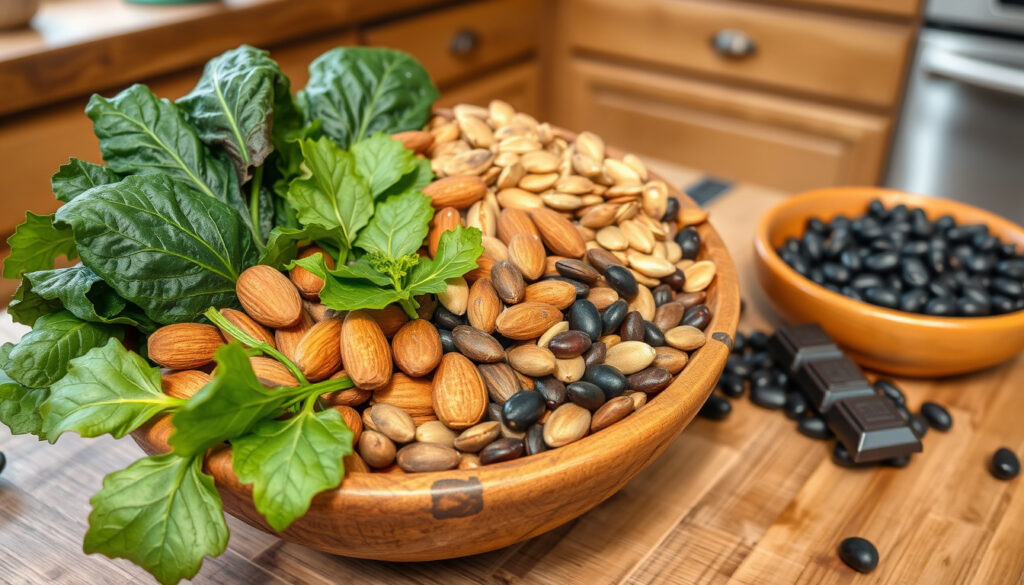
Foods High in Magnesium: Complete Guide to Boosting Levels
You don’t think about magnesium until a muscle cramp pulls you out of a deep sleep or the afternoon slump starts feeling permanent. Your diet has more to do with that than you’d guess: the body absorbs only about 30 to 40 percent of the magnesium you eat, according to the NIH Office of Dietary Supplements (federal nutrient authority), and the foods that fix it are mostly ordinary — seeds, leafy greens, beans — and the warning signs are recognizable before they turn serious.
Daily recommended intake: 400 mg for men, 310 mg for women (NIH) ·
Top food source: Pumpkin seeds — 168 mg per 1 oz (28 g) (Northwestern Medicine) ·
Deficiency prevalence: Affects up to 50% of the U.S. population (NHANES)
Quick snapshot
- Magnesium deficiency can cause muscle cramps and abnormal heart rhythms (NHS Dorset (U.K. health service guidance))
- Home test kits for magnesium are not clinically validated for deficiency
- Optimal daily intake varies widely by individual health status
- Whether supplements beat food for speed of recovery isn’t settled
- Plant foods dominate the leaderboard: legumes, leafy greens, nuts, seeds, whole grains (Harvard T.H. Chan School of Public Health (academic nutrition research))
- Pumpkin seeds: 168 mg per oz · Cooked spinach: 157 mg per cup · Black beans: 120 mg per cup · Almonds: 80 mg per oz (Northwestern Medicine)
- How much you absorb depends on how much you eat at once and how low your stores are — spread intake across the day (Magnesium: Nutrition and Homoeostasis (peer‑reviewed review))
- Soaking, sprouting, or fermenting plant foods can make their magnesium easier to use (Magnesium: Health Effects, Deficiency Burden, and Future Public Health Directions (peer‑reviewed review))
Six numbers, one pattern: the daily target is higher than most people guess, and even the single best food covers only about two-fifths of it.
| Key fact | Value |
|---|---|
| Daily requirement, adult men | 400–420 mg |
| Daily requirement, adult women | 310–320 mg |
| Top food source by weight | Pumpkin seeds — 168 mg per 1 oz (28 g) (Northwestern Medicine) |
| Deficiency prevalence | ~50% of Americans consume less than recommended (NHANES) |
| Magnesium absorption rate | 30–40% from food, varies by source |
| Banana’s contribution | About 32 mg per medium fruit |
The pattern: seeds, greens, and beans are the foods that move the needle; everything else is a supporting player.
What Are the 7 Signs Your Body Needs Magnesium?
The frustrating part about a magnesium gap is how ordinary the early warnings feel. Fatigue? That’s just life. A poor appetite? It’s been a busy month. Each symptom is easy to write off — and that’s exactly why low magnesium goes unnoticed for so long.
Common physical signs: muscle cramps, fatigue, and irregular heartbeat
- Fatigue, weakness, and poor appetite are among the first signs to show up (Harvard T.H. Chan School of Public Health (academic nutrition research))
- Nausea and vomiting are also listed as early symptoms (NHS Dorset (U.K. health service guidance))
- As deficiency advances: numbness, tingling, muscle cramps, seizures, personality changes, and abnormal heart rhythms (NHS Dorset (U.K. health service guidance))
- Lethargy, cramps, and muscle weakness are common — but they’re nonspecific, so they’re easily blamed on stress or poor sleep (NHS Specialist Pharmacy Service (U.K. clinical pharmacy guidance))
The early signs are vague by design — fatigue, nausea, poor appetite. By the time cramps and rhythm changes appear, the gap has usually been building for a while, which is why the 30–40% absorption number matters: eating more isn’t automatically the same as absorbing more.
Cravings for chocolate or salt
- Chocolate cravings are sometimes read as a magnesium clue — cocoa is a genuine magnesium source, and a shortfall may nudge you toward it. The evidence here is anecdotal, not proven.
- Salt cravings also come up in anecdotal reports, but they’re less specific and shared with many other conditions.
- Paired with the physical signs above, cravings are a supporting detail — not a diagnosis on their own.
You won’t find “craves chocolate” in most medical checklists, and that’s the point: cravings are the popular signal, while fatigue, nausea, cramps, and rhythm changes are the documented ones. If the hard signs are present, don’t let a craving — or its absence — make the decision for you.
When to see a doctor for deficiency
- A doctor can check serum magnesium with a standard blood test; home test kits aren’t clinically validated for diagnosing deficiency.
- Make the appointment if cramps, weakness, or fatigue are persistent — especially if you have type 2 diabetes, a digestive condition, or take a proton pump inhibitor long-term.
- Don’t self-prescribe high-dose supplements before testing; more isn’t better when the mineral isn’t the problem.
The takeaway: don’t wait for the dramatic signs. If fatigue, poor appetite, and cramps have become your new normal, a magnesium blood test is one of the cheapest ways to rule a real gap in or out.
What One Food Is Highest in Magnesium?
Ask the question directly and the answer is a small green seed. Pumpkin seeds beat every other common food on magnesium density — but they don’t get to win alone.
Pumpkin seeds: the highest concentration per serving
- One ounce (28 g) delivers 168 mg — about 40% of the daily value (Northwestern Medicine)
- They also bring zinc, iron, and healthy fats, so the calories do double duty.
- Roasted, shelled pumpkin seeds are the most convenient form: oatmeal, salads, yogurt, or a straight handful.
Gram for gram, pumpkin seeds edge out the entire field. That doesn’t make them a magic bullet — it makes them the best single anchor for a magnesium-rich day.
Other top sources: almonds, spinach, and black beans
- Cooked spinach: 157 mg per cup (37% DV) · Black beans: 120 mg per cooked cup (29% DV) · Almonds: 80 mg per ounce (19% DV)
Notice the pattern: plants own the leaderboard. Legumes, dark green leafy vegetables, nuts, seeds, and whole grains are the food groups doing the heavy lifting (Harvard T.H. Chan School of Public Health (academic nutrition research)). Animal foods contribute, but they rarely reach the same density per serving.
How much does one banana provide?
- A medium banana carries roughly 32 mg — about 8% of a 400 mg target.
Bananas are fine for potassium and convenience, but they’re not a serious magnesium vehicle. You’d need more than a dozen a day to reach the adult target — so treat the banana as a snack, not a strategy.
The implication: if you want one food to anchor on, pick pumpkin seeds; if you want a working strategy, combine them with greens and beans. The seed gets the crown; the pattern gets the result.
How Can I Raise My Magnesium Quickly?
Raising magnesium quickly comes down to three levers: food, supplements, and absorption. The fastest safe route usually combines all three — in the right order.
Using magnesium supplements: glycinate and citrate
- When a blood test confirms low magnesium, supplementation is a medical decision — clinicians use oral and IV products with a specific dose and follow-up (NHS Specialist Pharmacy Service (U.K. clinical pharmacy guidance))
- Glycinate and citrate are the forms most commonly chosen because they’re well tolerated and absorb well.
- More isn’t faster: high-dose supplements carry real risks, so the dose should match a test result, not a hunch.
A step-by-step plan to raise your magnesium with food
Food-first is steadier and cheaper than supplements, and it can’t be overdosed. One ounce of pumpkin seeds at breakfast covers 168 mg — roughly 40% of the day — before you’ve touched a supplement.
- Put 1 oz of pumpkin seeds (168 mg) on breakfast — oatmeal, yogurt, or a smoothie bowl.
- Add a cup of cooked spinach (157 mg) or black beans (120 mg) to lunch or dinner.
- Swap one processed snack for almonds (80 mg per oz).
- Spread magnesium across the day: absorption improves when intake is moderate and frequent.
- Soak or sprout beans and grains before cooking so their magnesium is easier to absorb.
- Reassess after 2–3 weeks. If cramps and fatigue haven’t budged, ask for a blood test instead of adding more supplements.
Transdermal magnesium: Epsom salt baths
- Epsom salt (magnesium sulfate) baths are a popular muscle-relaxation ritual.
- The evidence that meaningful amounts cross the skin is far thinner than the marketing implies — treat the bath as self-care, not a clinical fix.
The trade-off: food is slower but self-correcting; supplements are faster but need supervision. For most readers, the quickest safe win is the food plan — it works in days, costs less, and can’t be overdosed.
What Depletes Magnesium the Most?
You can eat pumpkin seeds all day and still run low if your daily habits push magnesium out faster than it goes in. Depletion usually comes from three directions.
Common dietary depleters: caffeine, alcohol, and high sugar
- Caffeine and alcohol both increase magnesium excretion; heavy alcohol intake is a recognized risk factor for low magnesium (NIH Office of Dietary Supplements (federal nutrient authority))
- High-sugar, ultra-processed diets crowd out the seeds, greens, and beans that would otherwise supply magnesium.
- Eating rhythm matters too: constantly grazing on low-magnesium foods keeps intake low without a single obvious culprit.
Medications that lower magnesium: diuretics, antibiotics, and PPIs
- Long-term use of proton pump inhibitors for reflux is associated with lower magnesium levels (NIH Office of Dietary Supplements (federal nutrient authority))
- Diuretics and certain antibiotics also increase magnesium losses, which is why repeat prescriptions can quietly drain your status.
Foods that can cancel out magnesium absorption
- Phytates in whole grains and legumes can bind magnesium and reduce how much you absorb (Going to the Roots of Reduced Magnesium Dietary Intake (peer‑reviewed review))
- Oxalates in spinach, chard, and beet greens do the same — the spinach that delivers 157 mg per cup also carries some binding baggage.
- Very high fiber intake can further decrease magnesium absorption or retention (Dietary Reference Intakes for Calcium, Phosphorus, Magnesium, Vitamin D, and Fluoride (federal nutrition standards))
The same foods that deliver magnesium — spinach, beans, whole grains — also carry compounds that limit absorption. Preparation is the difference between a mineral that reaches your cells and one that passes through.
The twist: the best magnesium foods often contain the very compounds that limit absorption. That’s why preparation matters as much as selection — soaking, sprouting, and fermenting make the mineral more available.
The catch: you can out-eat a deficiency and still lose the race if depleters outnumber sources. Cut the big drains — heavy alcohol, long-term acid-reducing meds, and relying on unsoaked grains — and the foods you add will finally count.
What Organ Is Most Affected by Magnesium?
If magnesium had a favorite organ, it would be the one you can’t afford to lose: the heart. Muscles and vitamin D metabolism are close behind.
The heart: rhythm, contraction, and relaxation
- Magnesium is central to normal heart rhythm; advanced deficiency is listed as a cause of abnormal heart rhythms (NHS Dorset (U.K. health service guidance))
- Arrhythmias are the severe end of the spectrum — a reason heart symptoms should never be self-diagnosed as “just magnesium.”
The heart muscle contracts and relaxes with every beat, and magnesium sits in the middle of that exchange. When levels drop, the electrical signaling gets noisier.
Muscles: the cramp signal
- Muscle relaxation depends on magnesium; cramps, twitches, and weakness are the signals people actually notice (NHS Specialist Pharmacy Service (U.K. clinical pharmacy guidance))
- As the symptom list above shows, cramps arrive with numbness and tingling when deficiency advances — they’re an early warning, not the finish line.
The vitamin D interaction
- Your body needs magnesium to activate vitamin D; without enough magnesium, vitamin D supplements may not deliver the expected effect (Magnesium: Health Effects, Deficiency Burden, and Future Public Health Directions (peer‑reviewed review))
- That’s the practical reason to check magnesium alongside vitamin D if routine supplementation isn’t moving your numbers.
Why this matters: the organs that send the loudest signals — heart, muscles — are the ones worth protecting. Cramps and palpitations won’t all be magnesium, but magnesium is one of the first things worth ruling out when they appear.
What We Know vs. What’s Still Unclear
After sorting through the evidence, the confirmed list is short but solid — and the unresolved questions matter just as much.
Confirmed facts
- Pumpkin seeds are the densest common food source at 168 mg per ounce (NIH Office of Dietary Supplements)
- Phytates and oxalates reduce how much you absorb (Going to the Roots of Reduced Magnesium Dietary Intake (peer‑reviewed review))
What’s unclear
- Home test kits for magnesium aren’t clinically validated for diagnosing deficiency
- Optimal daily intake varies widely by individual health status
- Whether supplements beat food for speed of correction isn’t settled
- How much transdermal magnesium actually crosses the skin remains an open question
- Caffeine and alcohol increase magnesium excretion, but the exact impact depends on individual factors
The honest read: the fundamentals are proven — food sources, deficiency signs, depleters. What’s unsettled is precision: your exact target, your exact absorption, and whether a kit or a cream can reliably measure or deliver magnesium.
What the experts say
The institutional sources tell a consistent story about magnesium: common, under-recognized, and fixable.
“Magnesium from food and beverages is typically absorbed at about 30% to 40%.”
— NIH Office of Dietary Supplements, Magnesium Consumer Fact Sheet (federal nutrient authority)
“More advanced deficiency can cause numbness, tingling, muscle cramps, seizures, personality changes, and abnormal heart rhythms.”
— NHS Dorset, Management of hypomagnesaemia in primary care (U.K. health service guidance)
“Early signs of magnesium deficiency can include fatigue, weakness, and poor appetite.”
— Harvard T.H. Chan School of Public Health, The Nutrition Source (academic nutrition research)
Three sources, one through-line: the gap is common, the symptoms are identifiable, and the fixes are ordinary foods most people already have in their kitchen.
A magnesium gap rarely announces itself in neon — it’s the fatigue you blame on work, the cramp you blame on the gym, the afternoon that coffee can’t fix. The fix is a rhythm, not a pill: seeds in the morning, greens and beans through the day, and preparation that lets the mineral actually get in. For anyone who’d rather eat than supplement, the choice is clear: make pumpkin seeds, spinach, and black beans a daily reflex — or keep paying the quiet tax that low magnesium charges on your energy, your recovery, and your heart.
pmc.ncbi.nlm.nih.gov, sps.nhs.uk, ncbi.nlm.nih.gov, pmc.ncbi.nlm.nih.gov
Frequently asked questions
Can you overdose on magnesium from food?
A healthy body clears excess magnesium from food efficiently, so toxicity from dietary sources is uncommon. High-dose supplements are the real concern — treat them with the same respect as a medication.
What is the best time to take magnesium supplements?
Consistency beats a perfect hour. Many people take magnesium with the evening meal because it supports muscle relaxation; the important detail is pairing it with food and taking it daily.
Does magnesium help with sleep?
Magnesium is involved in nervous-system relaxation, and people with better magnesium status tend to report easier sleep. It’s not a guaranteed sleeping pill — but correcting a genuine gap is a reasonable first step.
Can magnesium lower blood pressure?
Dietary patterns rich in magnesium — vegetables, legumes, nuts, and whole grains — are linked with healthier blood pressure in population research. Food-based patterns matter; isolated supplements are not a substitute for prescribed treatment.
Which magnesium supplement form is best for absorption?
Glycinate and citrate are commonly chosen for good absorption and digestive comfort. If a blood test confirms low magnesium, let a clinician pick the form and dose rather than guessing from a pharmacy shelf.
How long does it take to correct a deficiency?
Food-based changes shift intake within days, and symptoms like cramps and fatigue often improve within a few weeks. A confirmed deficiency managed with medical supplementation can move faster but needs follow-up testing.
Related reading
- What Is a Spaetzle? Ingredients, Taste, and Best Pairings
- Do I Have ADHD? Complete Symptoms, Tests, and Next Steps
This article is for general education and does not replace individualized medical advice. If you suspect a magnesium deficiency, a blood test and a clinician’s guidance beat self-diagnosis and self-prescribed supplements.
More related posts
 DBS Woman’s World Card Guide: Benefits, Fees, Overseas Use
 Lee Chae-min Girlfriend: Ryu Da-in Relationship 2025
 Lexis Hibiscus Port Dickson: Private Pool Villa Guide
 Where to Watch F1 in Singapore – Singtel Channels, Streams and Public Views
 Average IQ in the World: Key Facts, Sources, and Limitations
 WSG Tirol vs Real Madrid: Score, Highlights, and How to Watch the Friendly
 What to Eat in JB: Best Johor Bahru Food 2025 Guide
 PS.Cafe Marina Bay Sands Menu: Prices, Dishes & Reservations
