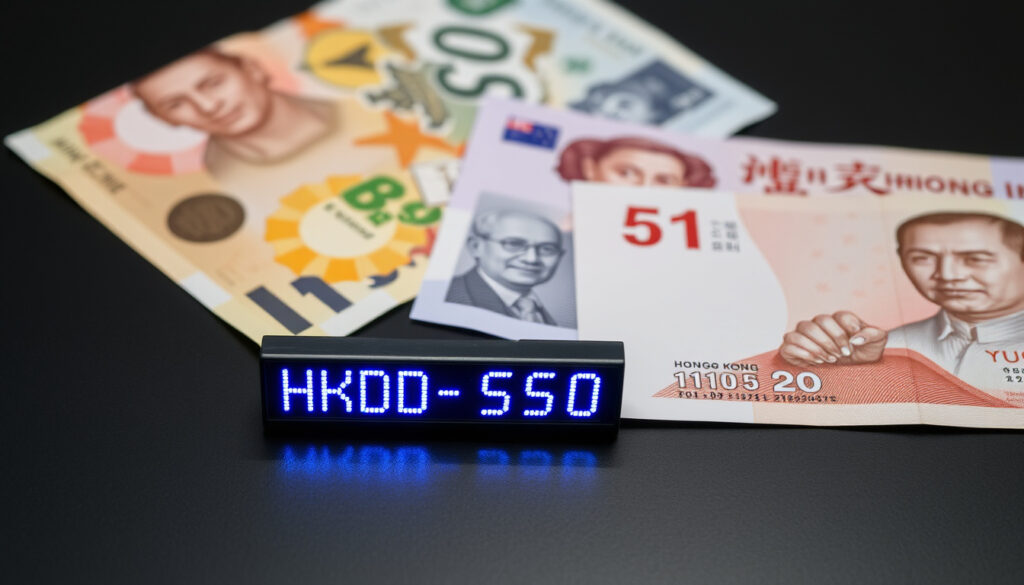
Hong Kong Dollar to SGD: Conversions and Exchange Rate
Anyone who has opened a transfer app knows the first question is rarely the rate — it’s how much will actually arrive. For Hong Kong dollars to Singapore dollars, 1 HKD buys about 0.163 SGD (Wise (mid-market rate tracker)), and that small number is a two-step cross rate: the HKD is pegged to the US dollar, the SGD floats against a basket, and that mechanism decides which quotes to trust.
1 HKD to SGD: ≈ 0.163 SGD ·
250 HKD to SGD: ≈ 40.8 SGD ·
1 SGD to HKD: ≈ 6.13 HKD ·
10,000 HKD to SGD: ≈ 1,631 SGD ·
30,000 HKD to SGD: ≈ 4,893 SGD ·
60,000 HKD to SGD: ≈ 9,786 SGD
Quick snapshot
- 1 HKD ≈ 0.163133 SGD as of 13 October 2026 (Forbes Advisor (exchange-rate reference))
- HKD is pegged to USD within 7.75–7.85 HKD per USD (Hong Kong Monetary Authority (monetary authority))
- Inverse sample: 1 SGD ≈ 6.125546 HKD (OFX (foreign-exchange provider))
- The exact HKD/SGD rate you get depends on provider, timing, and payment channel (Wise (mid-market rate tracker))
- Cross rates such as HKD/AUD and HKD/EUR trade without an official fix and move through the day (Investing.com (currency market data))
- “Rich” and “livable salary” have no single official threshold (Census and Statistics Department (official wage data))
- 1 HKD fell from 0.167334 SGD (30 Nov 2025) to 0.162839 (31 May 2026), then firmed to 0.164460 (30 Jun 2026) (OFX (foreign-exchange provider), cited above)
- The HKD/USD peg milestones set the band that contains every HKD/SGD move (Hong Kong Monetary Authority (monetary authority), cited above)
- Watch the USD/SGD leg: while the peg holds, that is where HKD/SGD moves originate (Monetary Authority of Singapore (central bank), cited below)
- Check a live quote before locking anything in — every published rate is a snapshot (Wise (mid-market rate tracker), cited above)
- Compare the all-in cost (rate plus fees plus spread), not the headline number (OFX (foreign-exchange provider), cited above)
The pattern: the HKD’s value is stable by design, and the last decimal of the HKD/SGD quote is where providers compete.
Six conversion values, one rate: the rows below simply multiply the rounded 0.163 reference rate that Forbes Advisor (exchange-rate reference) showed on 13 October 2026; the peg row is the HKMA band cited in the snapshot above.
| Conversion | Value |
|---|---|
| 1 HKD in SGD | ≈ 0.163 SGD |
| 250 HKD in SGD | ≈ 40.8 SGD |
| 10,000 HKD in SGD | ≈ 1,631 SGD |
| 30,000 HKD in SGD | ≈ 4,893 SGD |
| 60,000 HKD in SGD | ≈ 9,786 SGD |
| HKD/USD peg band | 7.75–7.85 HKD per USD |
| 1 SGD in HKD | ≈ 6.13 HKD (inverse sample) |
Every rate on this page is a sample snapshot from the cited source pages, taken on the dates shown. Rates move continuously, so treat these numbers as a mechanism lesson, then check a live quote before you transfer.
What is the exchange rate of 250 Hong Kong dollars to Singapore dollars?
At the 0.163 reference rate cited above, 250 HKD converts to about 40.8 SGD. The math is a single multiplication: 250 × 0.163 = 40.75, which rounds to 40.8. The provider quotes behind that number differ by fractions of a cent, as the comparison section shows.
How much is 100 HKD in SGD?
- 100 HKD ≈ 16.3 SGD at the 0.163 reference rate
- Smaller amounts work the same way: 79 HKD ≈ 12.88 SGD and 28 HKD ≈ 4.56 SGD
One multiplication — amount × 0.163 — covers every HKD figure. Using the inverse, divide by 6.13 instead; the answers match.
How much is 10,000 HKD in SGD?
- 10,000 HKD ≈ 1,631 SGD at the 0.163 reference rate
- Inverse check: 10,000 ÷ 6.13 ≈ 1,631 SGD
The inverse check is useful because some providers quote a “client rate” that looks similar but delivers a smaller amount after the spread.
How much is 30,000 HKD in SGD?
- 30,000 HKD ≈ 4,893 SGD at the 0.163 reference rate
- 4,000 HKD ≈ 652 SGD at the same rate
The numbers scale linearly, so the only thing that changes between 4,000 and 30,000 HKD is the size of the fee — which makes comparing fees more valuable on larger transfers.
How much is 60,000 HKD in SGD?
- 60,000 HKD ≈ 9,786 SGD at the 0.163 reference rate
- A 0.002 rate difference on this amount is worth about S$120
That last bullet is the practical edge: on a large transfer, chasing an extra 0.002 in the rate compounds into a real sum, so the provider’s rate matters here — not just the fee.
What is the SGD to HKD trend?
- 1 SGD ≈ 6.13 HKD at the inverse of the sample rates
- The 30-day HKD/SGD band: 0.1616–0.1632; the 90-day band: 0.1612–0.1652 (Wise (mid-market rate tracker))
- OFX’s monthly path, cited in the snapshot above, moved from 0.167334 (Nov 2025) to 0.162839 (May 2026), then back to 0.164460 (Jun 2026)
Reading the bands together, the HKD has been range-bound rather than trending one way. For a 30,000 HKD transfer, a move of 0.003 shifts the outcome by about S$90 — so timing matters less than avoiding a poor spread.
How do I convert HKD to SGD?
- Find the current mid-market rate from a reference source such as Forbes Advisor, Wise, or OFX.
- Multiply your HKD amount by the rate. For 10,000 HKD at 0.163, that is 1,631 SGD.
- Subtract the provider’s fee and spread to get the SGD that actually lands in your account.
The conversion is one step; the real work is comparing the all-in cost across providers.
The pattern: every provider quotes a slightly different number, but the headline rate is only one part of the cost. Fees and the buy-sell spread decide which quote is actually cheapest.
The reference rate is the start, not the contract: on any transfer day, the all-in cost decides the result.
How much is a HK dollar?
One Hong Kong dollar is a small unit because the peg keeps it small. At the band’s 7.80 midpoint, 1 HKD is worth about 0.128 USD; at the 0.163 reference rate, it buys about 0.163 SGD.
- 1 HKD ≈ 0.128 USD at the peg midpoint
- 1 HKD ≈ 0.163 SGD at the sample reference rate
Those two numbers are the same currency viewed through its two anchors: one peg, one managed float.
How much is $200 in Hong Kong dollars?
- If $200 means USD: about 1,560 HKD (200 × 7.80)
- If $200 means SGD: about 1,227 HKD (200 ÷ 0.163)
The ambiguity is the point: “$200” travels badly between Hong Kong and Singapore. Clarifying the currency first prevents a mismatch of roughly 330 HKD — the gap between the two answers.
What is the HKD/USD peg band?
- Strong side: 7.75 HKD per USD, guaranteed since 1998
- Weak side: 7.85 HKD per USD, in place since 2005
- Midpoint: 7.80 HKD per USD, the level chosen in 1983
- The SGD side is managed against a basket of trading partners’ currencies, not a USD peg (Monetary Authority of Singapore (central bank))
Every HKD/SGD quote is therefore two steps: HKD into USD at the peg, then USD into SGD against the MAS-managed basket. The first step is predictable; the second does the moving.
Because the HKD leg is fixed, the HKD/SGD rate is a clear two-step view: the peg answers “how many USD per HKD,” and the managed SGD answers “how many SGD per USD.” Watch the second leg, and the HKD/SGD move stops being a surprise.
The catch: a “weak” HKD in unit terms says nothing about economic fragility. It says the peg is working as designed.
How much is Hong Kong dollar to AUD?
There is no official HKD/AUD fix. Like HKD/SGD, this pair is a cross rate: the HKD leg is pinned to USD, while the Australian dollar floats on its own. Live cross-rate feeds, such as Investing.com (currency market data), recently showed 1 HKD near 0.19 AUD.
- 1 HKD ≈ 0.19 AUD at recent sample levels
- 1,000 HKD ≈ 190 AUD at the same rate
- The rate shifts whenever the AUD moves against the USD
The scaling is identical to the HKD/SGD case — multiply the HKD amount by the cross rate.
How many euros is 100 Hong Kong dollars?
- 100 HKD ≈ 11.8 EUR at recent sample levels
- 1 HKD ≈ 0.118 EUR at the same rate
No official HKD/EUR rate exists either. Same logic, same caution: check a live feed before converting for a trip or a transfer.
The implication: for AUD and EUR, don’t rely on a mental shortcut. Check a live cross rate, because the HKD’s fixed leg is the only stable part of the equation.
Which is stronger, USD or HKD?
By face value, the US dollar is stronger: 1 USD buys about 7.8 HKD at the peg midpoint. But “stronger” can mean face value, purchasing power, or reserve status, and the usual face-value list — Kuwaiti dinar, Bahraini dinar, Omani rial — is a standard reference in currency market data (Investing.com (currency market data)).
What are the 3 strongest currencies in the world?
- Kuwaiti dinar (KWD) — commonly ranked first by face value
- Bahraini dinar (BHD) — second in the usual list
- Omani rial (OMR) — third in the usual list
This ranking measures how many US dollars one unit buys. It says nothing about inflation, stability, or how easy a currency is to spend abroad.
Why is Hong Kong’s dollar so weak?
- Because the peg holds HKD between 7.75 and 7.85 per USD
- Because that band was chosen for trade stability, not for unit value
- Because the HKMA backs the band with substantial USD reserves — detailed in the timeline below
A currency that buys roughly one-seventh of a US dollar looks weak next to the dollar. The mechanism that keeps it there is a policy choice designed to make Hong Kong’s trade and capital flows predictable.
Why this matters: when someone says the HKD is weak, the honest answer is “by design.” Unit value is not economic strength; the stability of the peg is.
Is $50,000 HKD a good salary?
HK$50,000 per month is about S$8,150 at the 0.163 reference rate. The territory’s official wage statistics are published by the Census and Statistics Department (official wage data), but the livable-salary question is less about payroll and more about housing.
- HK$50,000/month ≈ S$8,150 at the 0.163 reference rate
- That is about S$97,800 per year (12 × S$8,150)
- Rent is the main cost driver in Hong Kong household budgets
The annual figure makes the salary easier to compare with a Singapore package, but the exchange rate is the wrong lens. Housing and household size decide whether S$8,150 a month is comfortable.
What is a livable salary in Hong Kong?
- There is no official livable-salary threshold
- The practical benchmark depends on household size, housing, and lifestyle
- For most budgets, housing dominates before anything else
The useful habit: convert the salary to SGD for context, then subtract realistic housing costs before judging the offer.
The trade-off: S$8,150 a month converts well on paper, but Hong Kong salaries must absorb some of Asia’s steepest housing costs. Judge the number after rent, not before.
Is living in HK expensive?
Yes, by regional standards: Hong Kong is consistently ranked among the most expensive cities in Asia, and the consumer-price data published by the Census and Statistics Department (official price data) shows housing as the dominant cost.
- Rent and real estate are the main cost drivers
- Hong Kong ranks consistently among Asia’s most expensive cities
- For expat budgets, housing decides whether the city feels expensive or merely pricey
Two people can live in the same city at wildly different costs — one in a central flat, another a 40-minute commute out. The average “expensive” verdict hides that range.
How much is considered rich in HK?
- No official threshold defines “rich” in Hong Kong
- In common commentary, income above HK$100,000 per month is often treated as high income
- At the 0.163 reference rate, HK$100,000/month ≈ S$16,300/month
The SGD equivalent keeps the local conversation portable: HK$100,000 a month is roughly S$16,300, a level that would also count as a strong professional income in Singapore.
The implication: if you are pricing a move, model rent in HKD first, then convert the rest to SGD. That single step answers most of the “is it expensive” question.
HKD to SGD: how the quoted rates compare
Three sources, one pattern: the headline quotes sit within about 0.0001 of one another, so the fee line decides the deal. Forbes Advisor (exchange-rate reference), Wise (mid-market rate tracker), and OFX (foreign-exchange provider) all cluster near 0.163.
| Provider | 1 HKD in SGD | Sample date |
|---|---|---|
| Forbes Advisor | 0.163133 | |
| Wise | 0.1632 | |
| OFX | 0.163251 | Page snapshot |
The inverse direction is just as useful on the Singapore side. Forbes’s inverse quote was 6.129967572 HKD per SGD; OFX’s was 6.125546. Round to 6.13 and the math stays clean.
The takeaway: on a 30,000 HKD transfer, a 0.0001 rate difference is worth about S$3, while a 1% fee is worth about S$49. Do the fee math first.
How to convert HKD to SGD step by step
A clean conversion takes about two minutes once you know the drill.
- Get the mid-market rate. Use a reference source such as Forbes Advisor, Wise, or OFX (linked in the comparison above).
- Multiply your HKD amount by the rate. For 10,000 HKD at 0.163, that is 1,631 SGD.
- Check the inverse for sanity. 1 SGD ≈ 6.13 HKD, so 10,000 ÷ 6.13 ≈ 1,631 SGD. The two answers should match.
- Add fees and spread. Banks and money changers quote a client rate that is worse than the mid-market rate.
- Compare at least two providers for the same amount on the same day. The headline rate alone rarely decides the winner.
- Confirm the SGD receiving account details before locking the transfer.
The 10,000 ÷ 6.13 shortcut works because 6.13 is the inverse of 0.163 — same math, other direction.
The rate you see on a bank’s marketing page is usually the mid-market rate; the rate you get is the bank’s client rate, which includes a spread that can be several times the difference between provider quotes.
The mid-market rate is the comparison baseline; the client rate is the price you actually pay.
How the HKD/SGD rate moved
The band was built in three steps by the Hong Kong Monetary Authority (monetary authority), and the HKD has lived inside it ever since.
- 1983: Hong Kong pegs the HKD to the USD at 7.80
- 1998: the HKMA adds a strong-side convertibility guarantee at 7.75
- 2005: the HKMA sets the weak-side limit at 7.85, completing the current 7.75–7.85 band
Inside the band, the HKD/SGD cross rate drifts with the USD/SGD leg. OFX’s monthly snapshots (cited in the trend section above) tracked 1 HKD from 0.167334 SGD in November 2025 to 0.162839 in May 2026, then back to 0.164460 in June 2026.
The pattern: the peg explains the range; the USD/SGD leg explains the movement inside it.
What is confirmed and what is still unclear
The difference between “published” and “guaranteed” is where most currency confusion starts.
Confirmed facts
- HKD is pegged to USD within 7.75–7.85 HKD per USD (Hong Kong Monetary Authority (monetary authority), cited above)
- Sample HKD/SGD reference rates cluster near 0.163 (Forbes Advisor, Wise, and OFX, cited above)
- HK$50,000 per month is about S$8,150 at 0.163
- 1 SGD buys roughly 6.13 HKD at the inverse of the sample rates
What’s unclear
- The exact rate you get depends on provider, timing, and payment channel
- “Strongest currency” can mean face value, purchasing power, or reserve status
- “Rich” and “livable salary” have no single official definition
- HKD/AUD and HKD/EUR have no official fix and move through the day
- Transfer fees and spreads are often missing from the headline quote
The pattern: the foundational facts are stable — the peg band, the approximate rate, the inverses. The unstable parts are the last decimal, the fee line, and any definition that depends on lifestyle.
What the official sources say
Two central banks frame the conversion: one anchors the HKD, the other manages the SGD.
The purpose of the Linked Exchange Rate System is to maintain exchange rate stability of the Hong Kong dollar, with convertibility guaranteed within the band of 7.75 to 7.85 Hong Kong dollars per US dollar.
Hong Kong Monetary Authority (monetary authority)
The Singapore dollar is managed against a basket of currencies of Singapore’s major trading partners, with the trade-weighted exchange rate serving as a key input to monetary policy.
Monetary Authority of Singapore (central bank)
Read the two statements together and the cross-rate logic is clear: one currency is anchored, the other is managed, and the HKD/SGD quote sits between them.
Bottom line: the HKD/SGD rate is a two-step cross rate, not a mystery: the HKMA holds HKD near 7.80 per USD, the MAS manages the SGD against a basket, and the market quotes the result in the fourth decimal. For anyone sending money from Hong Kong to Singapore, the choice is clear: compare the all-in cost — rate plus fees plus spread — for the exact amount you’re sending, or accept a headline rate that tells you only half the story.
finance.yahoo.com, finance.yahoo.com, investing.com, pluang.com
Frequently asked questions
Do banks and money changers charge fees for HKD to SGD conversion?
Most do. Banks typically build a spread into the quoted rate and may add a separate transfer fee. Specialist services such as Wise and OFX publish a mid-market rate and then show their fee separately, which makes the all-in cost easier to compare.
Can I use Hong Kong dollars directly in Singapore?
No. Singapore uses the Singapore dollar, and Hong Kong dollars are not accepted as everyday payment. You would need to exchange HKD cash at a money changer or a bank, at their quoted rate.
Is the Hong Kong dollar pegged to the US dollar?
Yes. The HKMA manages HKD within a guaranteed band of 7.75 to 7.85 per USD, as detailed in the timeline section above.
Are HKD to SGD rates the same at every money changer?
No. Each provider quotes its own rate. The sample rates from Forbes Advisor, Wise, and OFX differ by fractions of a cent, and added fees create larger gaps than the headline rate differences.
What affects the HKD to SGD exchange rate?
Because the HKD is pegged to USD while the SGD is managed against a basket of trading partners’ currencies (Monetary Authority of Singapore (central bank)), the HKD/SGD rate mostly tracks the USD/SGD leg. When the US dollar strengthens against the Singapore dollar, the HKD tends to buy more SGD; when the USD weakens, the HKD loses value in SGD terms.
How do I know if I am getting a fair HKD to SGD rate?
Compare the offered rate with the mid-market sample: at 0.163, 10,000 HKD should produce roughly 1,631 SGD before fees. If a quote lands well below that, the spread is eating your transfer.
The FAQs map back to one rule: verify the live quote and the fee, because the published rate is only half the picture.
Related reading
- 5000 Yen to SGD: Convert 5000 JPY to Singapore Dollars
- SGD to LKR Today: Exchange Rate & Converter (1 SGD = ?)
Both guides follow the same rule: convert at the mid-market rate, then subtract the provider’s spread and fee.
More related posts
 Pre Owned Watches Singapore: SPF Licensed Dealers & Tips
 First Day of School 2026 in Ireland: Key Dates & Calendar
 Concrete Floor Troweling: Process, Price & Rental Guide
 Where to Stay in Chengdu – Best Neighborhoods Guide
 Wedding Car Rental Singapore: Prices & Top Reviews
 Casa Vostra JEM Reviews: Menu, Queue, Owner & Worth It
 BitMine Immersion Technologies (BMNR): Buy or Sell
 Frasers Hospitality Trust Share Price: Current Value & Forecast
