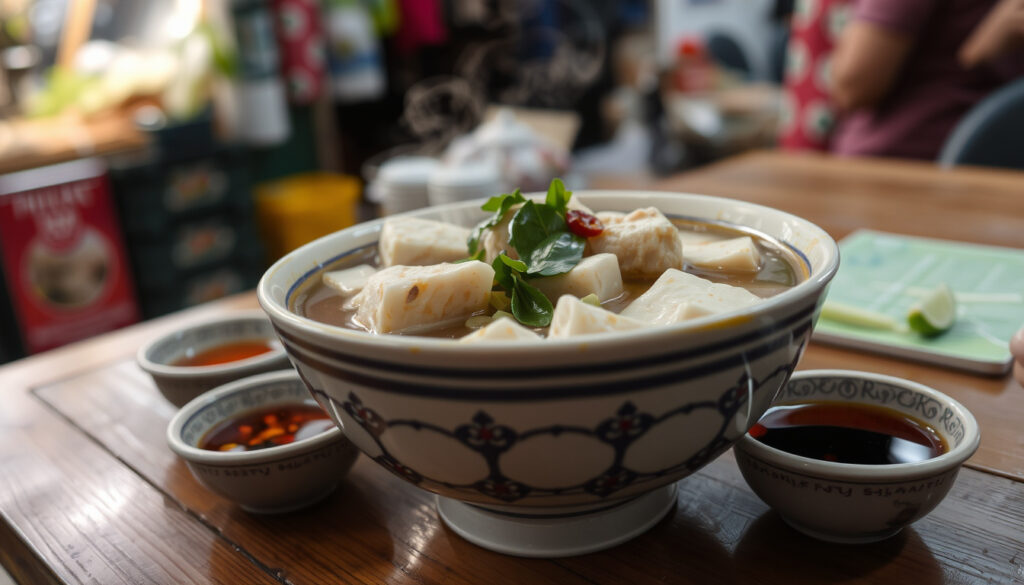
Yong Tau Foo Near Me: Best Stalls, History & Ordering Guide
There’s a reason your stomach growls every time you walk past a steaming pot of stuffed tofu, fish paste, and vegetables in a light broth — yong tau foo is one of those rare dishes that feels both comforting and endlessly customisable. Whether you pick your own ingredients from a tray or order a set bowl, the experience is part of the charm.
Average price: $5 SGD ·
Common filling: Fish paste (surimi) ·
Top stall Google rating: 4.5 stars (109 Yong Tau Foo) ·
Calories per bowl (boiled): ~300 ·
Year of origin: 1950s
Quick snapshot
- Yong tau foo is a Hakka Chinese dish (Eatbook.sg (food guide))
- Common fillings include fish paste and vegetables (Daniel Food Diary (food critic))
- Sold in hawker centres in Singapore and Malaysia (Miss Tam Chiak (Singapore food blog))
- Exact origin country is disputed between Malaysia and Singapore
- Exact date of invention is unknown
- Many stalls close early afternoon (e.g., Yong Xiang Xing opens 1pm–5pm Tue–Sun) (Miss Tam Chiak)
- 24-hour stalls like Meixi Yong Tau Foo exist in Toa Payoh (Eatbook.sg)
- Check halal options like Jason Niang Dou Fu near Bugis (Eatbook.sg)
- Prioritise stalls with fresh ingredients and high Google ratings (Eatbook.sg)
Looking at a handful of popular stalls, one pattern stands out: many close by late afternoon or have irregular hours, so planning ahead matters as much as choosing the right gravy.
| Stall / Location | Google Rating | Halal? | Hours | Price Range |
|---|---|---|---|---|
| 109 Yong Tau Foo (90 Circular Rd) | 4.5★ (Miss Tam Chiak) | No | Mon–Sat 11am–10pm | $5–7 SGD |
| Fu Lin Fried Yong Tau Foo (127 Telok Ayer) | Not disclosed | No (Eatbook.sg) | Mon–Sat 10am–3pm | $4–6 SGD |
| Jason Niang Dou Fu (Beach Rd / Bugis) | Not disclosed | Yes (Eatbook.sg) | Daily 11am–10pm | $5–8 SGD |
The pattern: halal-certified stalls are rare, and the most popular ones operate tight hours — you’ll need to check the opening times before you head out.
Upsides
- Customisable — pick your own ingredients
- Healthy option if boiled (low calorie, high protein)
- Affordable street food ($4–6 SGD per bowl)
Downsides
- Many stalls not halal-certified
- Short operating hours (often closed by 4pm)
- Long queues at top-rated stalls
What is the English name for yong tau foo?
Yong tau foo is the English transliteration of the Hakka Chinese phrase (niàng dòufu), which literally means “stuffed tofu.” In English-language menus, it’s often called stuffed tofu or yong tau foo (the latter being more common in Singapore and Malaysia). Some food courts list it as yong tau fu or yong tau foo soup. But no matter the spelling, the dish starts with the same foundation: tofu stuffed with a savoury filling.
What does ‘yong tau foo’ mean?
- “Yong” ( ) means “to stuff” in Hakka.
- “Tau foo” ( ) is “tofu.”
- So the full name describes exactly what it is: stuffed tofu.
Common English translations
- Yong tau foo (most common in Singapore/Malaysia)
- Stuffed tofu (literal translation)
- Yong tau fu (alternative spelling)
The implication: if you’re searching for “yong tau foo near me” in English, the dishes you find will all centre on that same stuffed-tofu core — the variations are in the broth, the filling, and whether it’s fried.
What is yong tau foo made of?
The base is always tofu, but the fillings and accompaniments vary widely. According to Daniel Food Diary (local food critic), modern versions stuff the tofu with fish paste (surimi), then add vegetables like eggplant, bitter gourd, and okra. The whole assortment is either boiled in a light savoury broth or deep-fried until golden.
Main ingredients: tofu, fish paste, vegetables
- Tofu: Soft or firm cubes, often deep-fried first to hold the filling.
- Fish paste: Usually made from batang (Spanish mackerel) or threadfin, seasoned with salt and pepper.
- Vegetables: Eggplant, bitter gourd, long beans, okra, fried bean curd skin.
Common fillings and variations
- Some stalls offer lean pork as an alternative to fish paste.
- Fried versions use a crispy batter; boiled versions keep the texture tender.
- Toppings: fried shallots, sliced chili, spring onions.
The trade-off: boiled yong tau foo retains the delicate flavour of the tofu, while frying adds crunch but also more oil — your choice depends on whether you prioritise health or texture.
Is yong tau foo Malaysian or Singaporean?
It’s both — and neither. Yong tau foo originated with the Hakka Chinese community, and the dish is popular in both Malaysia and Singapore, with each country claiming its own regional spin. According to Miss Tam Chiak (Singapore food guide), Singapore’s version leans toward fish-paste-heavy bowls with a clear broth, while Malaysian versions (especially in Ipoh and Kuala Lumpur) often include a richer, more herby soup.
Origins in Hakka cuisine
- The Hakka people are known for stuffed dishes (e.g., stuffed tofu, stuffed peppers).
- Yong tau foo likely evolved from Hakka stuffed tofu brought by Chinese immigrants to Southeast Asia.
Debate between Malaysia and Singapore
- No official record pinpoints the first hawker stall.
- Both countries have strong claims: Malaysia points to Ipoh’s early Hakko stalls; Singapore points to its hawker-centre history in the 1950s.
What this means: you won’t settle the dispute by eating a bowl — but you’ll enjoy the argument over a second helping.
Is yong tau foo usually fried or boiled?
Both methods are common, and the choice often depends on where you order. Daniel Food Diary notes that Singapore stalls like Poy Kee serve it boiled in a soup, while Fu Lin Fried Yong Tau Foo specialises in a crispy fried version.
Boiled yong tau foo is healthier
- Lower calorie count (~250–350 per bowl).
- Retains the natural umami of tofu and fish paste.
Fried versions are crispier
- Deep-fried until golden; adds crunch but also 100–150 more calories.
- Often served with sweet chili sauce or a thicker gravy.
The catch: if you’re watching your waistline, go boiled. If you’re after texture, fried is worth the trade-off.
A diner seeking a filling, low‑calorie meal will find boiled yong tau foo an excellent option. A fried‑food lover, on the other hand, will appreciate the crispy texture — but must accept the extra calories and fat.
Is eating yong tau foo healthy?
A boiled yong tau foo bowl — heavy on tofu and vegetables, light on oil — can be a healthy meal. Tofu is a good source of plant-based protein and contains all nine essential amino acids. However, the health profile changes with preparation.
Nutritional profile
- Calories: 250–350 (boiled) vs 400–500 (fried).
- Protein: 15–20g from tofu and fish paste.
- Sodium: The broth can add significant salt; some stalls pack 800–1000mg sodium per bowl.
- Fat: 5–10g (boiled) vs 15–25g (fried).
Health benefits of tofu
- Rich in calcium and iron.
- Low in saturated fat.
- May help reduce cholesterol when part of a balanced diet.
Considerations for fried versions
- Frying increases calorie and fat content significantly.
- Some stalls use reused oil, which can increase trans fats.
- Pair with a light broth and fresh vegetables to offset.
Why this matters: a bowl of boiled yong tau foo can be a smart lunch choice for weight‑watchers — but the fried version turns it into a splurge, especially with the added gravy.
Clarity: what we know and what we don’t
Confirmed facts
- 109 Yong Tau Foo has a 4.5-star Google rating (Miss Tam Chiak)
- Jason Niang Dou Fu is halal-certified (Eatbook.sg)
- Meixi Yong Tau Foo operates 24 hours (Eatbook.sg)
- Yong tau foo contains fish paste as typical filling (Daniel Food Diary)
What’s unclear
- Exact country of origin (Malaysia vs Singapore) remains debated
- Year of first hawker stall is undocumented
- No official nutritional data from government sources
“109 Yong Tau Foo at 90 Circular Road is the best-rated yong tau foo stall on Google, with a perfect spot for office crowds.”
— Seth Lui, Eatbook.sg (food reviewer)
“Rated 4.0 of 5 on Tripadvisor — a solid choice if you’re in the Bugis area and want a quick, tasty bowl.”
For the average Singapore diner making a “yong tau foo near me” search, the decision comes down to three factors: halal status, hours, and whether you prefer fried or boiled. Once you know those, the right stall is usually within a 15‑minute walk.
Related reading: Scissors Cut Curry Rice: What It Is, History & Where to Eat
Frequently asked questions
How do I find yong tau foo near me?
Use Google Maps search with “yong tau foo” and check the opening hours — many stalls close by late afternoon. Filter by halal if needed.
What is the difference between yong tau foo and hakka tofu?
Hakka tofu is the generic name for stuffed tofu in Hakka cuisine; yong tau foo is the specific Southeast Asian street‑food version that includes a variety of stuffed vegetables and a broth.
Can I freeze yong tau foo?
Yes — the plain stuffed tofu freezes well for up to 2 months. The broth is best made fresh.
Is yong tau foo vegetarian?
Most versions contain fish paste, so not vegetarian. Some stalls offer a variant with mock meat or no filling — ask the hawker.
What is the best time to visit a yong tau foo stall?
Lunch rush (11:30am–1pm) is busiest. Go between 2pm and 4pm for shorter queues, but confirm the stall is still open.
Do yong tau foo stalls accept credit cards?
Most hawker stalls take PayNow or cash; few accept credit cards. Carry small bills.
What side dishes go well with yong tau foo?
Side orders of fried wanton, spring rolls, or a bowl of white rice are common. Some stalls sell “yong tau foo set” with rice.
More related posts
 Thank You for Your Patience: Alternatives, Meaning & Grammar
 TTSH Integrated Care Hub (ICH): 608-Bed Step-Down Care
 Great World City Restaurants: Best Dining Guide for 2025
 Where to Stay in Guangzhou: Best Areas & Districts
 Pre Owned Watches Singapore: SPF Licensed Dealers & Tips
 Black Bolt White Flare: Pokémon TCG Card List & Value Guide
 SG60 Voucher to Cash: Can You Sell or Convert in Singapore?
 DBS Branch Opening Hours 2025: Weekday, Saturday & Sunday Guide
