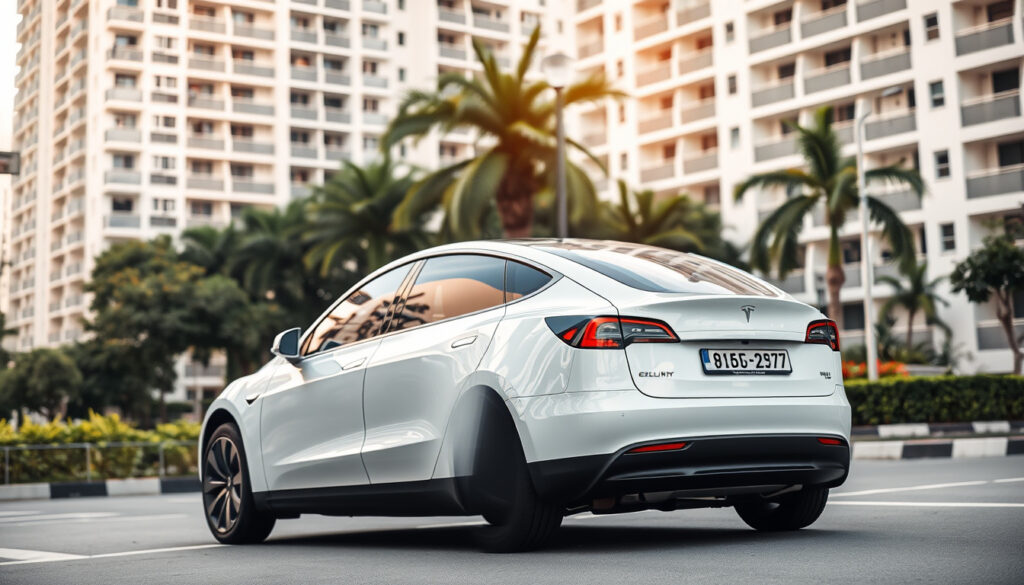
Tesla Model Y Singapore: Price, Depreciation & Buying Verdict
If you’ve ever looked at the price of a new car in Singapore and felt your jaw drop, the Tesla Model Y is probably the reason. It’s not just the sticker price that surprises buyers—it’s the financial puzzle tied to a 10-year Certificate of Entitlement (COE). Here are the real numbers: from COE-driven depreciation to monthly ownership costs, so you can decide if this electric SUV makes sense for your wallet.
Starting price (Premium RWD with COE): $222,999 ·
Annual depreciation: $23,200 ·
Used Model Y RWD example: $179,000 ·
Monthly ownership cost: $2,638
Quick snapshot
- Model Y Premium RWD priced at $222,999 with COE (PaperValue.sg (market price aggregator))
- Annual depreciation estimated at $23,200 (EVCostIQ (ownership cost calculator))
- Late 2023, EVs pay an additional $700 annual road-tax component (Tesla Singapore Support (official FAQ))
- Actual COE amount paid by each buyer depends on the monthly bidding cycle (Tesla Singapore Support)
- Future resale value after 5 years is highly speculative—no long-term Singapore data exists (Tesla Singapore Support)
- Battery replacement cost outside warranty is not publicly disclosed by Tesla Singapore (Tesla Singapore Support)
- COE expiry is the single biggest depreciation event—value drops sharply as the 10-year clock runs (Motorist Singapore (used car marketplace))
- Early adopters (2021–2022) are now selling, increasing second-hand supply (Motorist Singapore (used car marketplace))
- More used Model Y units will hit the market as COE prices stabilise or drop (Motorist Singapore (used car listing))
- Buyers should factor in COE renewal costs if planning to keep the car beyond 10 years (Motorist Singapore (used car listing))
Five key numbers, one pattern: the real cost of a Tesla Model Y in Singapore is dominated by COE and ARF, not electricity.
| Metric | Value |
|---|---|
| Starting price (Premium RWD with COE) | PaperValue.sg (market data site) |
| Annual depreciation (RWD estimate) | EVCostIQ (cost calculator) |
| Downpayment (60% loan on $222,999) | $133,799 |
| Monthly ownership cost (includes depreciation, charging, insurance) | EVCostIQ (ownership tool) |
| COE + ARF as % of registered price | EVCostIQ (breakdown) |
How Much Is a Tesla Model Y in Singapore?
Official Tesla Singapore pricing with COE
Tesla Singapore doesn’t publish a single fixed price because the COE component fluctuates monthly. However, independent aggregators like PaperValue.sg track real-time listings. As of early 2025, the Model Y Premium RWD starts at $222,999 with COE included. The Premium Long Range RWD is listed at $242,999, and the Performance AWD tops out at $268,999.
Price breakdown without COE
Before COE, the car itself (OMV + ARF + duties) for the RWD variant is estimated at around $76,090 based on EVCostIQ’s breakdown. The remaining ~$146,000 goes to COE, ARF, registration fees, and taxes.
Cost of COE and its impact
Singapore’s COE system makes the Model Y a high-stakes purchase. According to EVCostIQ, COE and ARF together represent 76% of the registered price. If COE prices drop during your ownership, the car’s resale value takes a direct hit.
Buyers who lock in a high COE today risk negative equity if COE premiums fall—but those who plan to keep the car the full 10 years avoid that market timing risk.
Bottom line: The Model Y’s headline price is misleading. The real cost is COE plus ARF—about three-quarters of what you pay.
Why Is a Tesla Model Y Depreciating So Quickly?
The role of COE expiry in depreciation
The COE is a 10-year license that loses value with every passing year. When you sell a car, the remaining COE value (pro-rated) is one of the biggest factors. For a Model Y that already costs ~$222,999 new, the annual depreciation works out to $23,200 according to EVCostIQ’s 5-year ownership estimate.
Market oversupply of used Teslas
Early adopters who bought in 2021–2022 are now selling their Model Ys, creating a growing second-hand pool. On Motorist Singapore, a 2023 Model Y RWD with $85,010 COE and $52,540 OMV is listed at $179,000, implying annual depreciation of $21,583—close to the new-car figure.
Battery degradation concerns
While Tesla’s battery warranty covers 8 years or 192,000 km, capacity loss is inevitable. After 10 years, typical retention is 70–80%, but replacement cost is not disclosed by Tesla Singapore, creating uncertainty for long-term owners.
High annual depreciation means the Model Y loses value faster than most petrol equivalents. If you sell at year 5, you’ll likely recover only ~50% of your purchase price, largely because the remaining COE is worth less.
The implication: the faster the COE clock ticks, the more the car’s value erodes—timing matters as much as the car itself.
Is Tesla Model Y a Good Buy?
Pros: Running cost, tech, safety
- Low running cost: EVCostIQ estimates electricity costs at about 15% of a comparable petrol SUV’s fuel bill.
- Over-the-air software updates keep the car current without dealer visits.
- 5-star Euro NCAP safety rating.
Cons: Depreciation, build quality, ride comfort
- High depreciation (~$23,200/year) makes short-term ownership expensive.
- Common complaints include stiff suspension and noticeable road noise (per owner forums cited in market analysis).
- Panel gap inconsistencies reported by some owners.
Upsides
- Minimal fuel costs (electricity at $0.25/kWh vs petrol at $2.50/L)
- Strong acceleration and advanced autopilot features
- Government rebates: 45% ARF rebate (capped at $15,000) + $25,000 VES rebate (Tesla Singapore Support)
Downsides
- Annual depreciation of $23,200 means a $116,000 loss over 5 years
- Ride quality is firmer than competitors like the Hyundai Ioniq 5
- Road noise at highway speeds is above average for the segment
- Service centre wait times can exceed 2 weeks (Motorist Singapore notes)
The pattern: the Model Y’s strength in running costs is offset by a heavy depreciation tax that makes short-term ownership a losing bet financially.
What Is the Biggest Complaint About Tesla Model Y?
Financial burden over build quality
While panel gaps and harsh ride are often mentioned, the single biggest complaint in Singapore is the total cost of ownership. According to EVCostIQ, the monthly ownership cost of $2,638 (including depreciation, insurance, maintenance, and financing) is higher than many luxury petrol SUVs. The COE component alone is a six-figure gamble.
Firm ride and cabin noise
Reviews from owners on platforms like Motorist Singapore describe the suspension as “stiff” and note that road noise becomes intrusive above 80 km/h.
Long wait time for repairs
Several owners report that getting a service appointment at Tesla’s Singapore centre can take weeks, especially for bodywork or electrical issues.
Will a Tesla Model Y Last 10 Years?
Battery longevity and warranty
Tesla’s battery warranty covers 8 years or 192,000 km, whichever comes first. Based on industry data, capacity retention after 10 years typically falls between 70% and 80%. Tesla does not publish replacement costs in Singapore, but third-party estimates suggest $15,000–$20,000 for a full pack.
Structural durability and rust issues
No major structural recalls have been reported for the Model Y in Singapore. The aluminium body resists corrosion, but owners in coastal areas should monitor underbody components.
Software updates keeping the car current
Tesla’s over-the-air updates improve functionality over time—adding features like improved range estimation, UI enhancements, and safety tweaks. This means a 10-year-old Model Y will still feel modern in terms of infotainment.
If you plan to keep the Model Y for 8+ years, you sidestep the worst of the depreciation curve and benefit from low running costs. But the battery replacement risk remains after year 8.
The catch: the longer you hold, the more you spread the COE cost—but you gamble on battery health after warranty ends.
“Tesla Model Y qualifies for the EV Early Adoption Incentive, a 45% ARF rebate capped at S$15,000, and the A1 VES rebate of S$25,000.”
Tesla Singapore Support (official FAQ)
“This used Model Y RWD is priced at S$179,000 with an annual depreciation of S$21,583 and a remaining COE of 8 years.”
Motorist Singapore (used car listing)
The implication is clear: the Tesla Model Y in Singapore is less about driving and more about financial timing. The car itself is competent, but the COE system makes it a high-stakes investment. For buyers planning to hold for 10 years, the low running costs and software longevity make it worth considering. For those who upgrade every 3–5 years, the depreciation hit may be too steep. The pattern is consistent: the real cost is not the sticker price—it’s the 10-year depreciation gamble.
For the Singapore buyer who values financial predictability over EV badge prestige, the choice is clear: commit to a full 10-year ownership, or buy a cheaper used EV with lower annual depreciation. Otherwise, lease or consider a petrol hybrid that retains value better.
Frequently asked questions
How expensive is a Tesla in Singapore?
The Tesla Model Y starts at about $222,999 with COE. Including taxes, the total cost can exceed $270,000 for high-performance variants.
How much will a Tesla Model Y be worth after 5 years?
Based on current depreciation trends (~$23,200/year), a Model Y bought new at $222,999 could be worth around $100,000–$110,000 after 5 years, assuming COE value is pro-rated.
Should I still buy a Tesla in 2026?
If you plan to keep the car for 8+ years, yes—the low running costs and software updates make it a good long-term buy. For shorter ownership, depreciation is a major risk.
Is it worth buying a second hand Tesla?
Yes, if you find a well-maintained Model Y with a high remaining COE and a strong PARF rebate. The annual depreciation on used units can be lower than new ones.
Why are so many people getting rid of their Teslas?
Many early adopters are selling before their COE value drops sharply. Others find the stiff ride and service wait times frustrating, or simply want to upgrade to newer EV models.
More related posts
 Cheng Chuan Motor Services: Car Spray Painting & Body Kit in SG
 Concrete Floor Troweling: Process, Price & Rental Guide
 Travel Fair 2025 Singapore: Dates, Tickets & Biggest NATAS Fair
 1000 SGD to PHP: Live Rate and What Your Money Buys
 76ers vs Lakers Match Player Stats: Feb 5 Box Score
 Buy and Ship Singapore: How Forwarding Works, Cost & Reviews
 Study Group (TV Series): Plot, Cast, Season 2 & Where to Watch
 Museum of Ice Cream Singapore Reviews: Is It Worth Visiting
