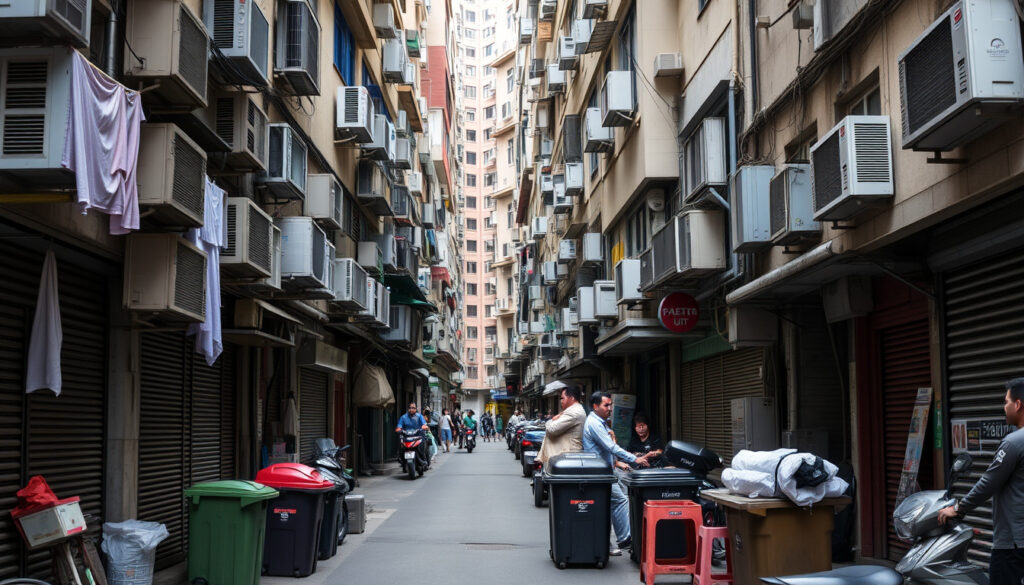
Joo Chiat Shophouse Overcrowding: Causes, Impact and Solutions
Few parts of Singapore blur the line between postcard and pressure cooker quite like Joo Chiat. Its pastel Peranakan shophouses anchor a conservation district that tour buses circle daily, but a case from late 2025 exposed the costs of that appeal: a five-bedroom shophouse on Marshall Road was found with nine workers inside during a November 27 inspection, five over the legal cap (AsiaOne (Singapore news site)).
Singapore population (2023): 5.9 million · Singapore land area: 734.3 km² · Joo Chiat area: ~3.5 km² · Estimated shophouses in Joo Chiat: ~2,000 · Median shophouse resale price (2021): S$3.2 million · Population density in Joo Chiat: ~6,000 people/km²
Quick snapshot
- Nine workers were found in a five-bedroom Marshall Road shophouse during a November 27 inspection (AsiaOne).
- Private homes smaller than 90 square metres are capped at six unrelated occupants; larger homes may hold up to eight tenants if registered with URA (AsiaOne, citing URA).
- The property was later vacated and restored, with alternative housing arranged for the workers (AsiaOne).
- No official survey counts how many people actually live per shophouse unit.
- Whether the Marshall Road case is an isolated breach or a wider pattern.
- Whether enforcement will catch up with short-term rentals and informal conversions.
- The owner bought the shophouse in October 2025 and was overseas when the breach surfaced (International Investment (real-estate trade publication)).
- An eviction notice demanded the premises be vacated by Jan. 5 (AsiaOne). (International Investment (real-estate trade publication))
- The tenant’s spokesperson said the property was restored and alternative housing was arranged (AsiaOne). (Stomp (Singapore community news platform))
- Local business groups want closer coordination with the Singapore Tourism Board on visitor crowds (Stomp (Singapore community news platform)).
Ten numbers, one pattern: Joo Chiat’s conserved shophouse stock barely changes while the pressure on it keeps rising.
| Metric | Value | Context |
|---|---|---|
| Joo Chiat area | ~3.5 km² | Low-rise conservation district in eastern Singapore |
| Estimated shophouses in Joo Chiat | ~2,000 | Residential, retail and food-and-beverage units |
| Population density in Joo Chiat | ~6,000 people/km² | Higher than Singapore’s national average |
| Median shophouse resale price (2021) | S$3.2 million | Reflects investor demand for heritage units |
| Average monthly rent, shophouse unit | S$4,000 | District-level estimate for residential units |
| Singapore population (2023) | 5.9 million | Citizens, residents and foreign workers combined |
| Singapore land area | 734.3 km² | One of the world’s most densely settled countries |
| Occupancy cap, homes under 90 m² | 6 unrelated occupants | URA rule cited in the Marshall Road case (AsiaOne) |
| Occupancy cap, homes over 90 m² | 8 tenants with URA registration | URA rule cited in the Marshall Road case (AsiaOne) |
| Occupants found on Marshall Road | 9 (a 10th believed away) | November 27 inspection (AsiaOne) |
What is causing overcrowding in Joo Chiat shophouses?
A landlord can be the last person to know what is happening inside a heritage shophouse. The Marshall Road owner bought the property in October 2025 and was overseas when inspectors found nine occupants (International Investment).
Gentrification pressures
- Conservation status freezes the number of shophouses, so rising demand lands inside existing units.
- Heritage addresses became desirable among professionals, investors and short-stay operators.
- A conserved family home can generate more revenue as a dormitory than as a residence.
That last point is where the Marshall Road case stops being a curiosity and becomes a warning. The landlord suspected approximately 18 people were staying in the five-bedroom property; authorities found nine during the November 27 inspection, with a tenth person believed to be away (AsiaOne, citing Shin Min Daily News). The tenant acknowledged that the occupancy cap had been exceeded by five people (AsiaOne).
The interior told the same story: multiple bed frames, bunk beds and mattresses squeezed into living spaces and bedrooms, a configuration reported after the inspection (International Investment).
Influx of expats and younger professionals
- Joo Chiat’s cafes, boutiques and Peranakan facades made it a magnet for younger renters and expat families.
- Wealthier newcomers pushed resale values and rents upward, pricing out older residents.
- Investors came to see conserved units as an asset class, not just a home.
The district’s economics now pull in two directions at once. District-level estimates put the average monthly rent for a shophouse unit at S$4,000 and the median shophouse resale price at S$3.2 million in 2021 — numbers that make every square metre worth more as rental floorspace than as family living space.
Tourist pressure adds a separate layer. Joo Chiat’s colourful Peranakan shophouses on Koon Seng Road draw busloads of visitors to residential streets (Stomp). A resident complained of crowded walkways, noise, coach-driver conduct and trespassing linked to tour groups (Stomp). Tourist crowding and residential crowding are different problems, but they share a trigger: too many people with too few places to put them.
Lack of regulation on occupancy
- Private homes smaller than 90 m²: maximum six unrelated occupants (AsiaOne, citing URA).
- Private homes larger than 90 m²: maximum eight tenants, if registered with URA.
- Conservation guidelines focus on building facades, not on who sleeps inside.
The rules exist on paper. Reports from the case, citing URA, say the caps are meant to stop exactly this kind of informal crowding. What is missing is a practical layer of scrutiny: there is no official survey of how many people live in Joo Chiat’s shophouses today, and no public registry of internal conversions.
The implication: heritage protection froze the supply of Joo Chiat’s most desirable housing at the exact moment demand got hottest. The Marshall Road dormitory was not an accident. It was the predictable output of that squeeze.
Is Joo Chiat a rich area?
Joo Chiat’s wealth is displayed on its facades — and the same conservation rules that protect those facades are what keep its housing scarce and overcrowded.
Income levels in Joo Chiat
- Joo Chiat reads as a middle-class to upper-middle-class district by Singapore standards.
- Median household income in the area is above the national average.
- Residents are a mix of long-standing families, newer professionals and expat households.
That mix is exactly what makes the district feel different from a purely wealthy enclave. The people being priced out are often the same families who kept the area alive before the cafes arrived.
The income picture matters for the overcrowding story because it decides who competes for rooms. When a five-bedroom shophouse can be rented out bed-by-bed to workers for more than a family would pay for the whole unit, the market has an incentive to densify.
Property values and demographics
- Median shophouse resale price: S$3.2 million (2021).
- Average monthly rent for a shophouse unit: about S$4,000.
- Demographic pull: young professionals, expat families, design and food-and-beverage entrepreneurs.
Shophouse prices have risen significantly over the past decade, and those price levels do more than signal affluence — they reshape the physical building. The Marshall Road owner bought the shophouse in October 2025 and engaged a property agent while overseas; the interior was later found modified with multiple bed frames, bunk beds and mattresses across the living spaces (International Investment). The tenant reportedly refused initially to vacate and suggested that workers might have invited others to stay (International Investment).
Nothing about that sequence is class-specific, but the economics that made it possible are: high values and high rents push owners to chase yield per square metre.
Comparison with other districts
- Katong, next door: similar conserved housing stock and similar price bands.
- Tiong Bahru: another heritage enclave facing the same gentrification squeeze.
- Orchard Road: far higher footfall, but a commercial corridor, not a conserved residential district.
The comparison that matters here is inside Joo Chiat itself. Tourist pressure is concentrated around iconic Peranakan facades that are residences rather than businesses (Stomp) — so the same street can feel wealthy to a visitor and suffocating to a resident.
What are the housing issues in Singapore?
Singapore solved mass overcrowding in the 1960s by building towers. Joo Chiat’s conservation rules forbid towers, which is why a 1960s-style problem has resurfaced inside a 19th-century building form.
Affordability crisis
- Public housing (HDB flats) shelters most Singaporeans.
- Private property prices are among the highest in the world.
- Heritage shophouses sit in their own price bracket, above the HDB resale market.
For most Singaporeans the housing ladder starts with an HDB flat. Joo Chiat’s shophouses are private property, which means they compete with the investor market rather than the public-housing queue — and that changes who can live there.
Affordability also feeds the overcrowding loop. When a whole shophouse is too expensive, buyers and tenants split it into smaller, denser uses: more beds per room, more rooms per floor, more people per address.
Overcrowding and density
- URA’s occupancy caps allow six unrelated occupants in homes under 90 m².
- Larger homes may hold up to eight tenants if registered with URA.
- Illegal conversions test those caps and push pressure onto parking, waste and noise.
The Marshall Road case shows how the caps work in practice: private homes under 90 square metres are limited to six unrelated occupants, and larger private homes may accommodate up to eight tenants if registered with URA, according to the report citing URA (AsiaOne). Nine people were found in a five-bedroom unit on Marshall Road — a breach the tenant acknowledged went five over the cap (AsiaOne).
Density is not new in Joo Chiat; what is new is that the crowding now happens behind heritage facades, invisible from the street.
Public housing demand
- HDB built public housing at scale in the 1960s and 1970s.
- New town construction absorbed population growth and relieved older districts.
- Conservation areas were excluded from that high-rise solution.
The steady demand for public housing is a reminder that most of Singapore’s population lives in flats, not conserved property. The scarcity in Joo Chiat is therefore not a shortage of roofs — it is a shortage of heritage-coded roofs, and that is a different problem with a different price tag.
How are there so many people in Singapore?
- Singapore’s population reached 5.9 million in 2023.
- The entire country covers 734.3 km², roughly 3.5 km² of which is Joo Chiat.
- High-rise public housing is how the island absorbs its density.
Those three numbers explain the context behind every crowded street in Joo Chiat. 5.9 million people on 734.3 km² makes Singapore one of the most densely settled countries on earth — and its population keeps growing even as its land area stays almost fixed.
Population growth factors
- Natural increase and immigration both contribute to population growth.
- Singapore’s birth rate has been below replacement level for years.
- Every new resident adds demand to an already strained housing stock.
Singapore’s growth is not a mystery of geography; it is a policy. The government has used immigration to offset a birth rate that stays below replacement level, bringing in workers and families who need housing the moment they arrive. In a normal market, supply could expand to meet them. In a conserved district, it cannot.
Immigration policy
- Immigration is the main lever for workforce growth.
- New citizens and work-pass holders both enter the housing market.
- Rental demand from newcomers competes directly with local families for shophouse units.
The policy does not target Joo Chiat specifically. But demographic flows land somewhere, and heritage districts — with their fixed stock and central location — absorb a disproportionate share of rental demand.
Land constraints
- Total land area is 734.3 km², most of it already built out.
- Joo Chiat covers roughly 3.5 km², with low-rise shophouse stock protected from redevelopment.
- Koon Seng Road’s Peranakan facades are residences, yet they draw coachloads of tourists (Stomp).
Land constraint is the reason Singapore builds up. Conservation law is the reason Joo Chiat cannot. Put them together and you get a district whose supply is locked while every demographic pressure on the island pushes inward.
What was Singapore’s biggest challenge after independence?
- 1965: independence arrived with a severe housing shortage.
- 1960s–1970s: HDB built public housing at scale and reduced overcrowding.
- 1989: Joo Chiat was gazetted as a conservation area by URA, locking its street pattern and building scale.
Post-independence Singapore’s most urgent problem was not abstract — it was where people would sleep. The housing crisis was a top priority for the new government, and public housing became the main policy answer.
Housing shortage in the 1960s
- Overcrowding in shophouses and kampungs was widespread at independence.
- New flats were needed faster than the private market could build them.
- Joo Chiat’s shophouses were part of that crowded landscape.
This history matters because today’s conservation area was once a symptom of the problem Singapore set out to solve. The shophouses that sheltered multiple families in the 1960s are now protected buildings with a single-family ideal — and the crowding has crept back in a new form.
Creation of the HDB
- From the early 1960s, the Housing and Development Board led a massive public-housing programme.
- New towns drew people out of overcrowded older districts.
- By the 1970s, overcrowding in central districts had eased significantly.
Lee Kuan Yew’s government made public housing the centrepiece of its nation-building programme, and the HDB delivered at a pace private developers could not match. It was the original answer to shophouse overcrowding — move the population to planned high-rise towns. It worked. But conservation law then froze places like Joo Chiat in their pre-tower form, so the density pressure HDB relieved elsewhere found no outlet here.
Economic development and its link to housing
- Stable housing underpinned Singapore’s economic strategy.
- Home ownership gave citizens a stake in the country’s growth.
- Heritage districts later became assets in their own right — first cultural, then commercial.
The same government that moved people out of crowded shophouses in the 1960s designated Joo Chiat a conservation area in 1989. That shift from liability to heritage asset is the root of the current conflict: the buildings are now too valuable to demolish and too protected to expand, so all the pressure converts into usage intensity.
The irony: the state that solved Singapore’s first overcrowding crisis with density now protects a district where density is illegal — which is exactly why the next overcrowding crisis has to be managed inside the shophouses themselves.
Joo Chiat overcrowding: a timeline
- — Singapore gains independence with a severe housing shortage; shophouses across the island house multiple families.
- — HDB builds public housing at scale; overcrowding falls in the new towns.
- — URA names Joo Chiat a conservation area, limiting new construction and density increases.
- — Gentrification begins; heritage shophouses draw higher-income residents and investors.
- — Short-term rental platforms spread; Joo Chiat units are converted for transient stays.
- — Overcrowding complaints rise; residents call for stricter enforcement.
- — A five-bedroom Marshall Road shophouse is found housing nine workers; an eviction notice follows (AsiaOne).
The pattern: each wave of change raised the value of Joo Chiat’s fixed housing stock — and raised the incentive to fill it more densely.
What we know and what we don’t
Confirmed facts
- Singapore’s population is roughly 5.9 million (2023).
- Joo Chiat has about 2,000 shophouses within a ~3.5 km² district.
- At least one Joo Chiat shophouse operated as an unregistered worker dormitory until late 2025 (AsiaOne).
- URA occupancy rules cap unrelated occupants at six (units under 90 m²) or eight with registration (larger units) (AsiaOne, citing URA).
What’s unclear
- How many people actually live per shophouse unit — no official survey exists.
- Whether the Marshall Road case is an isolated breach or common practice.
- Whether stricter enforcement would ease pressure or simply displace it to other conservation areas.
- How much of Joo Chiat’s crowding is residential density versus tourist footfall.
- What the long-term effect will be on the district’s heritage character.
What this means: the absence of data on shophouse occupancy is itself a finding. Singapore is regulating a problem it does not yet measure.
Voices from Joo Chiat
The walkways outside Koon Seng Road’s shophouses are crowded with tour groups, and residents describe the noise, the coach parking and the trespassing as part of daily life.
— Joo Chiat resident, as reported by Stomp
The precinct may need closer coordination with the Singapore Tourism Board to address the overcrowding concerns around the heritage streets.
— Local business association representative, as reported by Stomp
The tenant acknowledged that the occupancy cap had been exceeded by five people.
— Marshall Road tenant, as reported by AsiaOne (citing Shin Min Daily News)
The property was vacated and restored to its original condition, and alternative housing arrangements were made for the affected workers.
— Tenant’s spokesperson, as reported by AsiaOne
The through-line: residents, businesses and enforcement describe the same discomfort — the district’s charm is drawing more people in than its fabric can hold.
Where Joo Chiat goes from here
The Marshall Road case closed quickly — the property was vacated, restored and the workers rehoused — but the forces that produced it did not. Joo Chiat’s shophouses remain capped in supply, rising in price and exposed to both tourist footfall and informal conversion. For Joo Chiat’s long-term residents and conservation advocates, the choice is clear: press URA and the Singapore Tourism Board to enforce occupancy caps and manage visitor flows now, or accept that the next overcrowding headline will come from another conserved street.
channelnewsasia.com, asiaone.com, straitstimes.com, straitstimes.com, ground.news
Frequently asked questions
How many shophouses are there in Joo Chiat?
Joo Chiat holds an estimated 2,000 shophouses within a conservation district of roughly 3.5 km². The figure is a district-level estimate rather than an official census count.
Are shophouses in Joo Chiat suitable for families?
They can be, but families should check floor area against occupancy rules: private homes smaller than 90 square metres are capped at six unrelated occupants, and larger homes may hold up to eight tenants if registered with URA. The Marshall Road case also showed how quickly a family-sized unit can become a shared dormitory when the economics favour it.
What are the rules for subletting a shophouse?
Occupancy rules are the main constraint: homes under 90 square metres may house up to six unrelated occupants, while larger homes may host up to eight if registered with URA (AsiaOne, citing URA). Conservation status also limits how the building can be modified or re-purposed.
How can I report overcrowding in a shophouse?
The Marshall Road case began with a landlord’s suspicion and an inspection by authorities, with URA’s occupancy rules as the reference point. No single dedicated reporting portal is named in the coverage, so the practical route is to flag concerns to URA, which administers the occupancy caps.
What is the future of Joo Chiat’s shophouse district?
It depends on enforcement. Heritage protection freezes supply, so demand keeps concentrating unless occupancy limits are actually policed. Business groups have also asked for closer coordination with the Singapore Tourism Board to manage visitor crowding around Koon Seng Road (Stomp).
Does the government plan to build more housing in Joo Chiat?
No major plan exists to add housing inside the conservation area — that constraint is exactly why shophouse overcrowding is hard to fix. New residential supply in Singapore continues to be directed to denser redevelopment sites and new towns rather than heritage districts.
The bigger question: occupancy rules, reporting channels and price trends all lead back to the same choice — whether Joo Chiat’s future is set by conservation policy or by whoever can squeeze the most value from a protected room.
More related posts
 Toy Story Hotel Shanghai – Location, Booking and Amenities Guide
 What Is Sample Count – How to Calculate for Accurate Research
 Singapore to Vienna Flights – Cheap Deals, Duration and Airlines
 Holland Village XO Fish Head Bee Hoon Restaurant – Location, Menu, Prices & Reviews
 Potato Corner Singapore Menu: Prices, Flavors & Sizes
 Percy Jackson Season 2 Release Date, Cast & What to Know
 Things to Do in Surabaya: Attractions, Itineraries & Tips
 Time in Australia Now: Sydney, Melbourne, Perth & Zones
