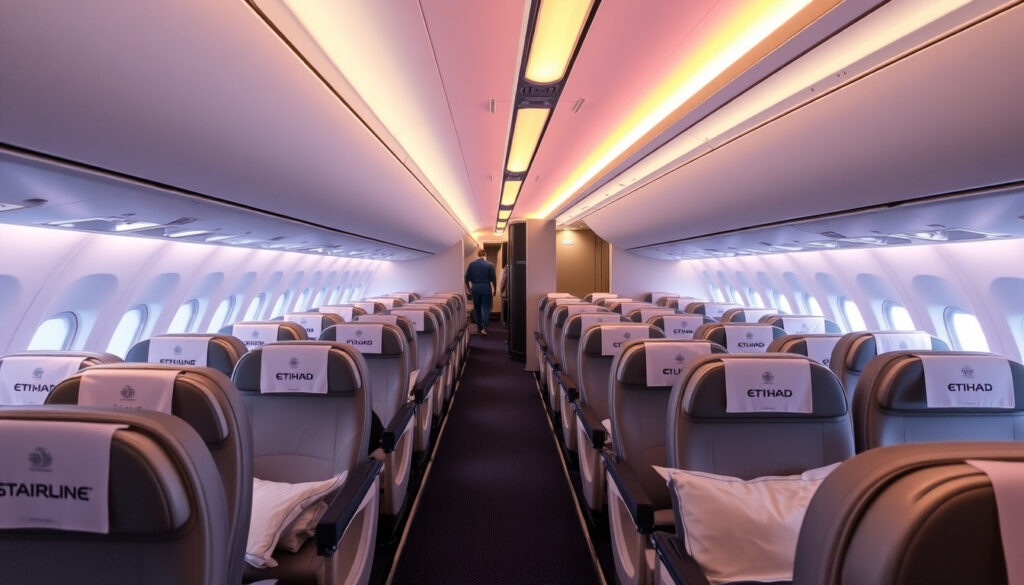
Boeing 787-10 – Singapore Airlines, KLM, Etihad Seat Maps
Boeing 787-10 Dreamliner: Complete Guide to Seats, Specs and Airlines
The Boeing 787-10 Dreamliner represents the largest variant in the 787 family, designed to offer airlines a blend of efficiency and passenger comfort on mid-size routes. First delivered to Singapore Airlines in 2018, this aircraft type has since been adopted by carriers including KLM and Etihad Airways, each configuring the cabin to meet their specific operational requirements.
For travelers evaluating options across different airlines, understanding how the Boeing 787-10 seat map varies becomes essential. The aircraft measures 68.3 metres in length with a wingspan of 60.1 metres, capable of carrying up to 344 passengers in dense configurations while maintaining a maximum range of approximately 12,000 kilometres. These technical specifications shape the passenger experience significantly.
Boeing 787-10 Seat Map and Layout
The Boeing 787-10 seat layout differs considerably depending on the airline operating the aircraft. Unlike older widebody designs that often follow standardized configurations, the 787-10 platform allows carriers substantial flexibility in cabin design. This adaptability has resulted in notably different approaches among operators.
68.3 m (224 ft)
60.1 m (197 ft)
12,000 km
903 km/h
- Largest variant in the Boeing 787 family, stretched 18 feet beyond the 787-9
- Singapore Airlines served as launch customer, introducing service on April 3, 2018
- Configured primarily for regional operations rather than ultra-long-haul routes
- Cabin pressurization and humidity levels designed to reduce passenger fatigue
- Large windows with electronic dimming replace traditional window shades
- Different airlines deploy varying seat counts, ranging from 294 to 344 based on configuration
| Aspect | Details |
|---|---|
| Length | 68.3 m (224 ft) |
| Typical Seating | 294–344 passengers |
| Max Takeoff Weight | 254,100 kg |
| Operators | Singapore Airlines, KLM, Etihad Airways |
| First Service | April 3, 2018 |
| Wingspan | 60.1 m (197 ft) |
Boeing 787-10 Business Class
Business class configurations on the Boeing 787-10 consistently feature full-flat seats arranged in a 1-2-1 layout across operators. This arrangement ensures direct aisle access for every passenger, a standard expectation in modern business class cabins. The specific dimensions and amenities vary, however, reflecting each airline’s product strategy.
Singapore Airlines Business Class
Singapore Airlines outfits its 787-10 fleet with 36 business class seats offering 60 inches (152 cm) of pitch and 20 inches (51 cm) of width. These seats recline to a full 180 degrees, providing a completely flat surface for sleeping. The configuration likely follows a 1-2-1 regional layout with consoles positioned between seats. According to available seat map data and the airline’s published fleet information, this represents the standard business offering on these aircraft.
Etihad Airways Business Class
Etihad Airways operates 32 business class seats on its 787-10 aircraft, with pitch listed as 78 inches (198 cm) though some sources indicate 73 inches (185 cm). Seat width ranges from 20 to 21 inches (51–53 cm), and like Singapore Airlines, these seats achieve a full 180-degree recline. The carrier’s Business Studio product includes this configuration, though the precise arrangement may vary between individual aircraft.
KLM World Business Class
KLM’s 787-10 fleet features World Business Class seats in a 1-2-1 layout with full-flat functionality. While the airline does not specify the exact seat count for business class on this aircraft type, the configuration details are available on KLM’s official website. Power outlets and USB ports support passenger device charging throughout the cabin.
Published seat dimensions may differ between sources due to different measurement methodologies. Airlines, third-party seat map services, and travel publications sometimes report slightly varying pitch and width figures for identical seats. When comparing options, consulting multiple sources including official airline pages provides the most reliable picture.
Boeing 787-10 Economy and Premium Economy
Economy class on the Boeing 787-10 typically uses a 3-3-3 seat layout, though the precise configuration varies by airline. KLM stands apart by offering a dedicated Premium Comfort cabin that functions as premium economy, a class absent from Singapore Airlines and Etihad 787-10 configurations based on available data.
KLM Premium Comfort Cabin
KLM’s four-class configuration includes Premium Comfort seats arranged in a 2-3-2 pattern with 97 cm (38 inches) of pitch. This positions the cabin between World Business Class and standard Economy, providing meaningfully more legroom than conventional economy seating. Economy Comfort seats on the same aircraft offer 89 cm (35 inches) of pitch, still exceeding the standard 79 cm (31 inches) available in regular economy.
Singapore Airlines Economy
The 787-10 fleet operated by Singapore Airlines accommodates 301 economy passengers across seats measuring 32 inches (81 cm) of pitch and 17 inches (43 cm) of width. Recline extends to 5 inches. The airline designates certain rows for extra legroom and accommodates infants with dedicated bassinets. All aisle seats, except those in the front row, feature movable armrests for added comfort.
Etihad Economy
Etihad Airways configured 295 economy seats with a pitch of 31-32 inches (79-81 cm) and width of 17-17.5 inches (43-44 cm). The carrier’s 787-10 aircraft offers extra legroom seating, bulkhead seats, and infant facilities. Detailed seat configuration is available on Etihad’s official website.
Airlines typically publish seat maps before departure, allowing passengers to identify preferred positions. Exit row and bulkhead seats often offer additional legroom but may come with restrictions such as limited under-seat storage. Movable armrests on aisle seats, as available on Singapore Airlines 787-10 aircraft, can improve comfort on longer flights.
Boeing 787-10 Configurations by Airline
The three major operators of the Boeing 787-10 have adopted distinct configuration strategies. Singapore Airlines and Etihad Airways both utilize two-class layouts emphasizing either business and economy density, while KLM employs a four-class structure that introduces premium economy as a distinct product tier.
KLM Boeing 787-10 Configuration
KLM configures its 787-10 aircraft for a maximum of 344 seats across four travel classes. The aircraft includes eight lavatories distributed throughout the cabin, partial WiFi connectivity, and varying power options by class. Economy and Economy Comfort passengers access USB-A charging, while Premium Comfort and Business class travelers benefit from 110-volt outlets alongside USB-A and USB-C ports. This represents the most comprehensive cabin differentiation among the three operators.
Singapore Airlines Boeing 787-10 Configuration
Singapore Airlines operates its 787-10 fleet with a total capacity of 337 passengers split between 36 business and 301 economy seats. The absence of premium economy means the airline concentrates its premium product entirely in business class, optimizing the cabin for routes where business demand justifies the configuration. The airline’s official fleet documentation confirms this two-class arrangement.
Etihad Airways Boeing 787-10 Configuration
Etihad Airways accommodates 327 passengers across its 787-10 fleet, comprising 32 business and 295 economy seats. Like Singapore Airlines, Etihad operates a two-class configuration without premium economy. The carrier’s published seat map details the arrangement, showing dedicated sections for extra legroom seating and infant facilities.
| Airline | Total Seats | Business (Layout/Pitch) | Premium Economy | Economy (Layout/Pitch) |
|---|---|---|---|---|
| KLM | 344 max | 1-2-1 / Full-flat | 2-3-2 / 97 cm | 3-3-3 / 79 cm |
| Singapore Airlines | 337 | 36 seats / 152 cm pitch | None | 301 / 81 cm pitch |
| Etihad Airways | 327 | 32 seats / 198 cm pitch | None | 295 / 79-81 cm pitch |
Individual aircraft within an airline’s fleet may vary slightly from published specifications. Airlines periodically reconfigure cabins or retire specific aircraft variants. Always verify your specific aircraft assignment through the airline’s pre-flight seat selection system or directly with the carrier before departure.
Boeing 787-10 vs Airbus A350-900
Direct comparisons between the Boeing 787-10 and Airbus A350-900 face limitations due to incomplete seat-specific data across matching airlines. Available information from each manufacturer indicates several structural differences worth noting, though travelers seeking precise comparisons between identical routes operated by both aircraft types should consult airline sources directly.
Technical Specifications
The A350-900 typically offers a longer range, reaching up to 15,000 kilometres compared to the 787-10’s 12,000-kilometre maximum. Cabin width differs as well, with the A350-900 generally configured for nine-abreast seating in economy while the 787-10 accommodates nine to ten passengers across the same row. These factors influence passenger comfort on different route types.
Singapore Airlines A350-900 Reference
For context, Singapore Airlines operates the A350-900 in configurations that have included 42 business seats, 24 premium economy seats, and 187 economy seats in certain layouts. The airline deploys this aircraft type on longer routes where the extended range provides operational advantages. The A350-900 thus serves a somewhat different mission profile than the 787-10 in the carrier’s fleet.
Other Operators
All Nippon Airways operates a 787-10 configuration featuring 38 business seats, 21 premium economy seats, and 235 economy seats across a total capacity of 294 passengers. The range of 11,600 kilometres positions this variant between the primary operators. This example illustrates the flexibility manufacturers build into the 787 family, allowing carriers to optimize configurations for specific route networks.
Published seat map data for A350-900 aircraft operated by Singapore Airlines, KLM, and Etihad was not available at the time of compilation. Comparisons between the 787-10 and A350-900 therefore rely on general aircraft specifications rather than airline-specific configurations. Travelers comparing these aircraft types directly should verify current data with each airline.
Boeing 787-10 Timeline and Service History
The Boeing 787-10 program progressed rapidly from design to commercial service, representing the final stretch variant in the Dreamliner family. Key milestones mark its development and deployment across international routes.
- April 3, 2018 — Singapore Airlines receives the first 787-10 and inaugurates commercial service on this aircraft type
- 2018–2019 — Additional 787-10 deliveries to Singapore Airlines as the carrier expands its fleet of this variant
- 2019 — KLM takes delivery of its first 787-10, introducing the aircraft on European and intercontinental routes
- 2019–2020 — Etihad Airways integrates 787-10 aircraft into its fleet, deploying the type across its route network
- Ongoing — Airlines continue to operate and periodically update 787-10 configurations based on fleet planning decisions
What Information Is Confirmed Versus Uncertain
When evaluating available data on the Boeing 787-10, distinguishing between confirmed specifications and areas of uncertainty helps travelers make informed decisions.
| Established Information | Variable or Uncertain Information |
|---|---|
| Aircraft length (68.3 m) and wingspan (60.1 m) | Precise business class seat count per aircraft (KLM) |
| Maximum range (12,000 km) | Etihad business class pitch discrepancy (198 cm vs 185 cm) |
| Singapore Airlines launch in April 2018 | A350-900 configurations for comparison airlines |
| KLM four-class configuration details | Individual aircraft variations within fleet |
| Singapore Airlines 337-seat total | Real-time seat availability and upgrades |
| Etihad Airways 327-seat total | Future fleet modifications |
The Boeing 787-10 in Aviation Context
The Boeing 787-10 occupies a specific niche in modern aviation, positioned as the most efficient option for medium-density routes where the larger 777 or A350 variants might offer excessive capacity. The aircraft family has fundamentally changed expectations for widebody comfort, with the 787-10 extending those benefits to a broader range of city pairs.
For travelers, the aircraft represents a reliable baseline of comfort regardless of airline, incorporating Boeing’s signature features including larger windows with electronic dimming, higher cabin humidity, and optimized air pressure to reduce fatigue. These design elements transfer across all 787-10 operators, meaning even economy passengers benefit from the manufacturer’s investment in passenger experience.
The differentiation that matters most then becomes the airline-specific cabin configuration. Business class travelers will find full-flat beds consistently across Singapore Airlines, Etihad, and KLM, while premium economy seekers should look to KLM specifically, as that option remains unavailable on the other two operators’ 787-10 fleets at present.
Sources and Official Documentation
This analysis draws on published seat maps, official airline fleet documentation, and third-party aviation databases. Key sources include each airline’s published seat configuration pages and available PDF documentation.
“Singapore Airlines Boeing 787-10 fleet operates with 36 business class seats offering 60-inch pitch and full-flat functionality, accompanied by 301 economy seats configured at 32-inch pitch.” — Official Singapore Airlines Fleet Documentation
“KLM Boeing 787-10 aircraft feature a four-class configuration including World Business Class, Premium Comfort, Economy Comfort, and Economy Class, with power outlets and USB charging distributed by cabin.” — KLM Aircraft Information Portal
Summary
The Boeing 787-10 offers travelers a comfortable widebody experience across three major operators with notably different cabin philosophies. Singapore Airlines and Etihad Airways emphasize two-class density with no premium economy, while KLM provides four distinct cabin options including dedicated premium economy seating. Business class consistently delivers full-flat accommodation with direct aisle access across all operators, though specific dimensions vary. Economy configurations generally follow a 3-3-3 layout with pitch ranging from 79 to 89 centimetres depending on the airline and seat type selected. Those researching flights between Singapore to Vienna or other international routes may encounter the 787-10 as a configured option worth evaluating based on these specifications.
Frequently Asked Questions
What airlines operate the Boeing 787-10?
Singapore Airlines, KLM, and Etihad Airways currently operate the Boeing 787-10. Singapore Airlines was the launch customer, taking delivery in April 2018.
Does Singapore Airlines 787-10 have premium economy?
No, Singapore Airlines operates its 787-10 fleet in a two-class configuration with only business and economy cabins. No premium economy option exists on these aircraft.
How many seats does the Boeing 787-10 have?
Seat capacity varies by airline configuration, ranging from 294 to 344 passengers. Singapore Airlines configures for 337 total seats, Etihad for 327, and KLM for up to 344.
What is the range of a Boeing 787-10?
The Boeing 787-10 has a maximum range of approximately 12,000 kilometres (6,330 nautical miles), making it suitable for medium-haul to long-haul regional operations.
Is Etihad Airways 787-10 business class fully flat?
Yes, Etihad Airways 787-10 business class seats recline to a full 180 degrees, providing a completely flat sleeping surface. Seat pitch is listed at 78 inches (198 cm).
What is the difference between Boeing 787-10 and 787-9?
The 787-10 is the longest variant in the 787 family, stretched 18 feet (5.5 metres) beyond the 787-9. This additional length increases passenger capacity while maintaining similar range capabilities.
Does KLM 787-10 have premium economy?
Yes, KLM offers Premium Comfort on its 787-10 aircraft, positioned between business and economy classes. This cabin features 2-3-2 seating with 97 cm of pitch.
How does the Boeing 787-10 compare to Airbus A350-900?
The A350-900 typically offers longer range (up to 15,000 km) and wider cabin configuration. Direct comparisons remain limited by incomplete seat-specific data across matching airlines.
More related posts
 Slot Gaming on Rajadewa138.com: Latest Verified Info (2026)
 New Tamil Movies Download 2026: Free and Legal Options
 YouTube Video Download: Free Tools, Safety & Legal Guide
 Man Fut Tong Nursing Home: Cost, Wait Time, and Services in Singapore
 Burnley F.C. vs Chelsea F.C. Lineups – Predicted XIs, Injuries, Team News
 Primary 5 Science Tuition Fees, Reviews & Centres Singapore
 Translate Indonesian to English: Best Free Tools & Apps
 White-Bellied Sea Eagle: Facts, Habitat, and Comparisons
